
EVIDENCE FILE 35 / SOURCE-LED
What Does the Rubin Evidence Actually Establish About 2026 ED138?
Separate the observation from the proposed explanation and its limitations.
THE SHORT ANSWER
The Rubin Observatory team identified 30 observations from 20 nights between March 4 and July 11, 2026, and matched them to older detections reaching back to 2016.
That supports further investigation, but it does not by itself prove every interpretation associated with the discovery.
OBSERVATION / INFERENCE / LIMIT
Follow the chain of reasoning.
The record
The Rubin Observatory team identified 30 observations from 20 nights between March 4 and July 11, 2026, and matched them to older detections reaching back to 2016.
The proposed explanation
Its location roughly 46 astronomical units from the Sun and apparent brightness suggest a substantial trans-Neptunian body. A broad diameter estimate of about 600–1,500 kilometers depends strongly on surface reflectivity.
The limit of the claim
The images do not reveal a detailed surface or a measured diameter. Provisional designation and estimated size do not constitute formal recognition as a dwarf planet.
HOW WE GET FROM SIGNAL TO STORY
Compare the evidence with the illustration.
Repeated observations turn one faint point into a moving solar-system object. Researchers first connected early Rubin detections and then used archived images from other instruments to follow the same body over more than a decade. That long time baseline is essential for understanding its orbit, especially against the dense stellar background of the Milky Way.
Brightness alone cannot tell astronomers whether an object is a small reflective world or a larger dark one. The proposed diameter interval is therefore deliberately broad. Thermal-infrared work and additional tracking could narrow the estimate, while dynamical analysis may clarify whether ED138 actually occupies a resonance near Neptune’s 12:7 orbital relationship.
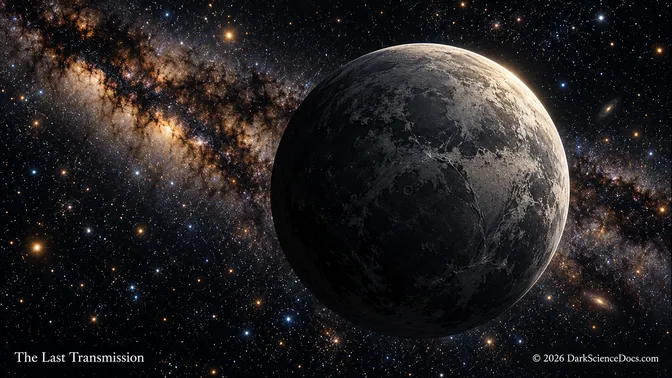
The discovery illustrates the difference between collecting light and recognizing evidence. Its orbit and motion are observational inferences supported by repeated detections; the cratered, icy terrain in the accompanying art is an illustration. The scientific story gets stronger by keeping those statements separate.
FOLLOW THE NEXT TEST
Return to the investigation.
PRIMARY RESEARCH & FURTHER READING