BLACK HOLE A
36.701 miles
horizon diameter59.065 km
- Radius
- 18.351 miles (29.533 km)
- Diameter in AU
- 0.00000039483 AU
 THE LAST TRANSMISSIONStories from the Edge of Science
THE LAST TRANSMISSION / SCALE LAB
A black hole’s boundary. A message crossing space. An atom beside a living cell. Change a number, follow the comparison, and see exactly what the answer assumes.
Keep a question. Bookmark a calculation. Return with another.
01 / BLACK-HOLE HORIZONS
Compare two idealized black holes. In this model, doubling the mass doubles the horizon’s radius. The bright ring in a telescope image involves light bending and glowing material, so it has a different size.
What is 1 AU? AU means astronomical unit. One AU is about 92,955,807 miles (149,597,870.7 km), a standard length close to Earth’s average distance from the Sun. The AU values below express the horizon’s diameter in units of that same length.
BLACK HOLE A
59.065 km
BLACK HOLE B
23,626,000 km
THE COMPARISON
A ratio below 1 means B is smaller.
THE LAST TRANSMISSION © 2026 DarkScienceDocs.com
WORKED EXAMPLE / 10 SOLAR MASSES
rs = 2GM / c²
D = 2rs
Using the nominal solar mass parameter, one solar mass gives a radius of about 1.835 miles (2.953 km). Multiply by 10: the radius is about 18.35 miles (29.53 km), and the diameter is about 36.70 miles (59.07 km). At 4 million solar masses, the diameter is 400,000 times larger, about 14.68 million miles (23.63 million km).
This is the Schwarzschild model: an isolated, nonrotating, uncharged black hole. Its horizon radius is the areal radius, defined by a sphere’s area of 4πr². Real astrophysical black holes can rotate, changing the geometry.
Mass is entered in nominal solar units, using GM☉ = 1.3271244 × 10²⁰ m³/s². The named mass presets are rounded comparisons, with observational uncertainty. Extra calculator digits describe the arithmetic, not extra measurement precision.
The horizon is a causal boundary. These lengths do not describe the accretion disk, the observed shadow, a material surface, or how long a spacecraft survives. The selectable mass range is a tool limit, not a list of confirmed black holes.
02 / SPACECRAFT SIGNAL DELAY
Radio and laser signals travel at the speed of light in vacuum. Choose a destination to compare a message from Earth, or enter your own sender–receiver separation. See the one-way delay and the wait for a hypothetical immediate reply.
What is 1 AU? AU means astronomical unit. One AU is about 92,955,807 miles (149,597,870.7 km), a standard length close to Earth’s average distance from the Sun. A spacecraft’s distance from the Sun can differ from its distance from Earth. Use the sender–receiver separation for signal delay.
What is a Julian year? A Julian year is a standard time unit in astronomy: exactly 365.25 days, or 31,557,600 seconds. A light-year is the distance light travels in vacuum during one Julian year, about 5.879 trillion miles (9.461 trillion km). When the delay readout says “Julian years,” each year uses that fixed duration. For example, a signal crossing one light-year takes one Julian year to arrive. Time and distance definitions ↗
THE DISTANCE BEHIND THIS DELAY
92,955,800 miles (149,598,000 km)
A fixed sender–receiver distance. Select a destination above or enter your own separation.
Distance reference ↗ONE WAY / t = d ÷ c
499.00478 seconds
HYPOTHETICAL IMMEDIATE REPLY / 2t
998.00957 seconds
THE LAST TRANSMISSION © 2026 DarkScienceDocs.com
WORKED EXAMPLE / 1 AU (ONE ASTRONOMICAL UNIT)
92,955,807.27 miles ÷ 186,282.397 miles/s
≈ 499.005 seconds one way
At a separation of one AU, about 92.956 million miles (149.598 million km), a message takes about 8 minutes 19 seconds to arrive. An instantaneous reply reaches the sender about 16 minutes 38 seconds after the original transmission. Higher bandwidth can send more information per second, while this travel time still applies.
Speed reference · Units reference · Communications reference · Miles conversion
The estimate uses t = d/c, a straight path through vacuum, constant separation, and an immediate reply. It omits processing time, transmission duration, scheduling, blocked lines of sight, motion during the exchange, plasma effects, and relativistic corrections. Mission navigation uses more complete models.
Light travels at about 186,282.397 miles/s. The underlying SI value, c = 299,792.458 km/s, is exact. One AU is about 92.956 million miles, exactly 149,597,870.7 km. Miles here use 1 mile = 1.609344 km exactly. A light-year here is the distance light travels in a Julian year of 365.25 days, or 31,557,600 seconds. Extra display digits describe the arithmetic; they do not increase the precision of a rounded destination distance.
The Moon example uses a rounded mean center-to-center Earth–Moon distance. Sun–Earth L2 uses about 932,000 miles (1.5 million km) from Earth, yielding about 5 seconds one way and 10 seconds for an immediate reply. This is a location reference for Roman’s quasi-halo orbit, not the telescope’s live range or a distance from the Sun. For planets and Pluto, we put Earth on a 1 AU circle and the destination on a circle of radius a, then compare |a − 1| AU on the same side of the Sun with a + 1 AU on opposite sides. This geometry is our teaching inference from rounded orbital sizes, not an ephemeris. In particular, Pluto’s eccentric orbit makes its circle a coarse comparison. The Sun blocks the direct path at exact opposite-side alignment. An orbital distance from the Sun does not by itself equal a spacecraft’s distance from Earth.
The Oort Cloud uses a chosen 50,000 AU sample in an inferred, extended region. Proxima Centauri and Proxima Centauri b share the same rounded 4.24-light-year distance. Sagittarius A* uses 26,000 light-years to a hypothetical receiver outside the horizon; an inside-horizon signal cannot return. Andromeda uses about 2.5 million light-years. At such large distances, motion during the exchange is substantial enough that the simple doubled time should be read only as a static comparison. The 10-million-light-year input ceiling is a tool limit. This calculator does not model cosmological light travel or demonstrate that a signal would be detectable.
03 / CELL TO ATOM
Use the same physical width in every panel. As you zoom inward, the cell outgrows the window, the mitochondrion follows, and the atom finally becomes visible. Dimensions are representative teaching choices you can change.
0.0007874 inches (20 µm) diameter
Visible at this scale
View width: 0.001969 inches (50 µm)
0.00007874 inches (2 µm) length
Visible at this scale
View width: 0.001969 inches (50 µm)
0.000000003937 inches (100 pm) characteristic extent
Too small to resolve here
View width: 0.001969 inches (50 µm)
THE LAST TRANSMISSION © 2026 DarkScienceDocs.com
CELL ÷ MITOCHONDRION
CELL ÷ ATOMIC EXTENT
MITOCHONDRION ÷ ATOMIC EXTENT
WORKED EXAMPLE / MATCH THE UNITS
20 µm = 20,000 nm
20,000 nm ÷ 0.1 nm = 200,000
A 20 µm cell is about 0.0007874 inches across; the 2 µm mitochondrion is about 0.00007874 inches long; the atomic reference is about 0.000000003937 inches. The representative cell’s diameter spans 200,000 atomic reference lengths along one line. The 2 µm mitochondrion is one tenth as long as that cell is wide. Neither ratio tells us how many mitochondria or atoms are contained in a cell.
Cell and atomic scale reference · Mitochondrial scale reference · Inches conversion
The starting dimensions are a 20 µm eukaryotic cell diameter, a 2 µm mitochondrial length, and a 0.1 nm atomic reference extent. Cells vary widely by type; mitochondria can change shape and form connected networks. Atoms have electron distributions whose extent depends on the atom, bonding and definition of size.
The drawings compare one linear dimension at a time. The mitochondrial width and internal folds are invented for the illustration. The atomic glow has no measured probability interpretation. These panels are scale diagrams, with no microscope magnification, molecular counting or resolution simulation.
The slider is logarithmic: one whole-number change in its underlying exponent changes the view width by a factor of ten. The ratios stay fixed while zoom changes. Only changing the chosen dimensions changes the ratios.
CHECK THE WORK / SOURCE TRAIL
Definitions and model scope were checked on October 11, 2026. The calculations use fixed constants and chosen inputs. Named examples remain rounded teaching comparisons.
The Schwarzschild radius, spacetime geometry and the scope of a nonrotating black-hole model.
The nominal solar mass parameter and nominal solar and terrestrial radii. These are exact conversion factors, with a distinction from measured physical properties.
The exact SI value of c used in both the horizon calculation and signal travel times.
The 2012 astronomical-unit definition and the Julian-year convention used to define a light-year.
The international mile used here is exactly 1,609.344 meters, or 1.609344 kilometers. Rounded display values use this exact conversion.
One standard inch is exactly 0.0254 meters. Microscopic dimensions and view widths use this conversion for their inch equivalents.
Uplink, downlink and the practical communication systems behind spacecraft exchanges. The lab isolates propagation time from the full communication process.
The rounded mean Earth–Moon distance used for the Moon signal example. The actual separation varies through the orbit.
NASA’s Roman observatory design describes a quasi-halo orbit around Sun–Earth L2, about 932,000 miles (1.5 million km) from Earth. The lab calculates a reference delay from this rounded Earth separation; the spacecraft’s actual range varies through its orbit.
J2000 semi-major axes supply the rounded sizes for Mercury through Neptune. The lab uses them as circular radii, with Earth at 1 AU, to illustrate alignment-dependent separation; it does not calculate current positions.
The rounded 39 AU solar-distance reference and the roughly 30–49.3 AU excursion of Pluto’s eccentric orbit. The lab’s circular comparison is deliberately approximate.
The inferred cloud’s uncertain extent: inner edge around 2,000–5,000 AU and outer edge around 10,000–100,000 AU from the Sun. We choose 50,000 AU as a sample separation, not a measured location.
NASA identifies Proxima Centauri at about 4.24 light-years. The lab uses that rounded separation for both the star and its planet.
The planet orbits the nearest star only about 4.35 million miles (7 million km) from its host. That orbit is tiny compared with the Earth–system separation, so both buttons have the same delay at the lab’s distance precision.
The approximately 26,000-light-year distance to Sagittarius A*. A hypothetical reply in the lab must come from outside its event horizon; strong-gravity effects are omitted.
The approximately 2.5-million-light-year distance used in this static comparison. The galaxy is extended and moving; the doubled time is not a prediction for a real exchange over millions of years.
Cell-size ranges and the logarithmic relative-size diagram, including the approximate 0.1 nm atomic scale. The 20 µm cell is our chosen representative example.
Research review describing micron-scale mitochondrial dimensions. The 2 µm length is a representative illustration rather than a universal measured size.
The Milky Way central black hole and a rounded four-million-solar-mass comparison. The observed image traces emission and a shadow.
The M87* emission-ring reconstruction and inferred mass near 6.5 billion solar masses. The preset rounds the published inference.
KEEP EXPLORING
FROM THE ILLUSTRATED ARCHIVE
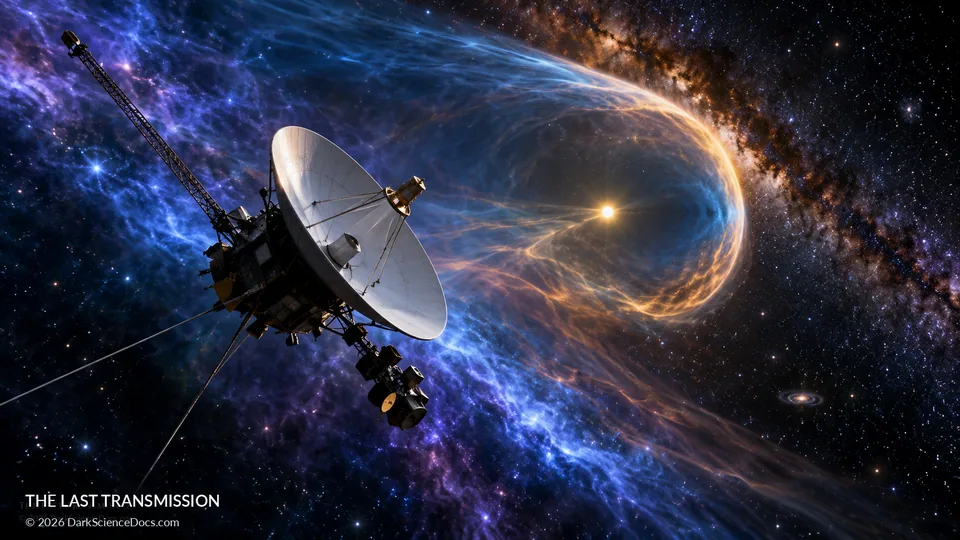
Nearly 49 years after leaving Earth, Voyager 1 is discovering that interstellar space is anything but empty.
LIGHT LAB
Move foreground galaxies to explore gravitational lensing, build a spectrum, measure parallax, or shift a source’s light to explore radial motion.
Enter Light LabSCIENTIFIC INQUIRY / APPLIED HERE
Explore all twelve principlesA Schwarzschild horizon, a fixed-distance light-time estimate, and representative microscopic dimensions each answer a different question. Change the inputs, track the units, and read the assumptions. A teaching diagram or extra calculator digit does not add observational evidence or measurement precision.
Ask yourself Which assumptions drive this result, and where would the model stop being useful?
FROM THE VISUAL ARCHIVE
Read the investigation ↗