
EVIDENCE FILE 36 / SOURCE-LED
Does a Black Hole’s Inner Horizon Make Time Travel Possible?
Separate the observation from the proposed explanation and its limitations.
THE SHORT ANSWER
Astronomers observe black holes through nearby matter, stellar orbits, and gravitational waves. No instrument has directly imaged a black hole interior.
That supports further investigation, but it does not by itself prove every interpretation associated with the discovery.
OBSERVATION / INFERENCE / LIMIT
Follow the chain of reasoning.
The record
Astronomers observe black holes through nearby matter, stellar orbits, and gravitational waves. No instrument has directly imaged a black hole interior.
The proposed explanation
An exact mathematical model for a rotating black hole (Kerr) contains an inner Cauchy horizon where conventional initial-value predictability can fail.
The limit of the claim
Real black holes are disturbed by infalling matter and radiation. Mass inflation and singular behavior may prevent the idealized extension from remaining physically traversable.
HOW WE GET FROM SIGNAL TO STORY
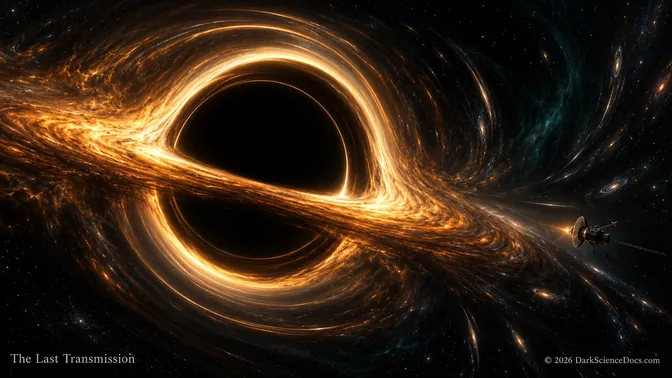
Compare the evidence with the illustration.
General relativity has survived extensive tests outside event horizons, but an exact solution is not the same thing as a verified map of an astrophysical black hole’s interior. In the stationary Kerr geometry, rotating spacetime has a second, inner boundary: the Cauchy horizon.
Across that mathematical boundary, data specified on an earlier surface no longer guarantee one unique classical extension. Some formal extensions contain unfamiliar spacetime regions and closed timelike curves. Those structures are mathematical possibilities under ideal assumptions, not observed corridors through time.
A major physical objection is the instability of the inner horizon. Even weak disturbances can be gravitationally blueshifted, leading to mass inflation and potentially singular geometry. Research on strong cosmic censorship asks which forms of a well-defined classical future survive this challenge.
FOLLOW THE NEXT TEST
Return to the investigation.
PRIMARY RESEARCH & FURTHER READING