
FIELD NOTE / Alien Worlds & Life
Interstellar Voyagers and the Centuries Left Behind
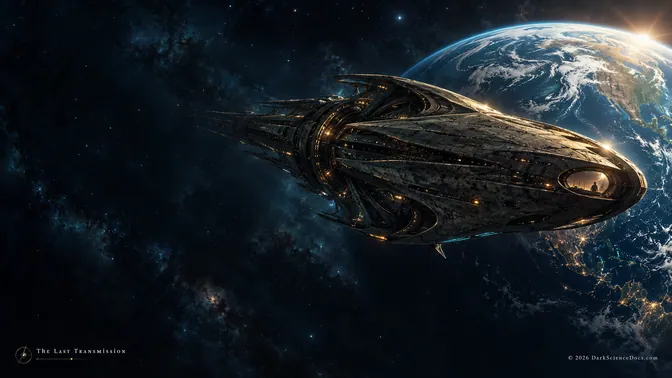
Near-light-speed travel can separate a crew’s elapsed time from centuries passing at home. The imagined visitors are fiction; the time-dilation equations are established physics.
A civilization sending explorers between stars must contend with distance and time. At 99.99 percent of light speed, a hypothetical 1,000-light-year cruise would span about 1,000 years in the galaxy’s approximate reference frame, while the people aboard would age only about fourteen years during the cruise.
What the evidence shows
That difference comes from special relativity, which connects elapsed time to the path taken through spacetime. It is established physics even though the high-speed vessel in this thought experiment is imagined. The travelers would not necessarily find an extinct civilization at home; how long societies endure is a separate, unknown question.
Where the claim stops
The engineering problem remains formidable: enormous kinetic energy, stopping at the destination, long-term life support, and dust collisions at relativistic speeds. The scenario invites questions about cosmic history without turning the Fermi paradox into evidence of extraterrestrial visitors.
MEASUREMENT / INTERPRETATION / OPEN QUESTION
What is recorded
Experiments with accurate clocks and rapidly moving particles have verified relativistic differences in elapsed time. No evidence for visiting extraterrestrial spacecraft is presented.
What it suggests
For an ideal cruise over 1,000 light-years at 99.99 percent of light speed, passengers could experience roughly 14 years while about a millennium passes in the departure frame.
What is not established
The illustration excludes acceleration, deceleration, propulsion costs, shielding requirements, and any evidence that a civilization actually made such a journey.
FOLLOW THE THREAD
Keep exploring the question.
READ THE SOURCE TRAIL
Research and further reading
These links include the complete published article and the research records cited in the supplied RSS edition.