
VISUAL ARCHIVE / IMAGE STORY
The Foil That Revealed a Center
Rare large-angle alpha-particle deflections changed the atomic model; this lab is reconstructed.
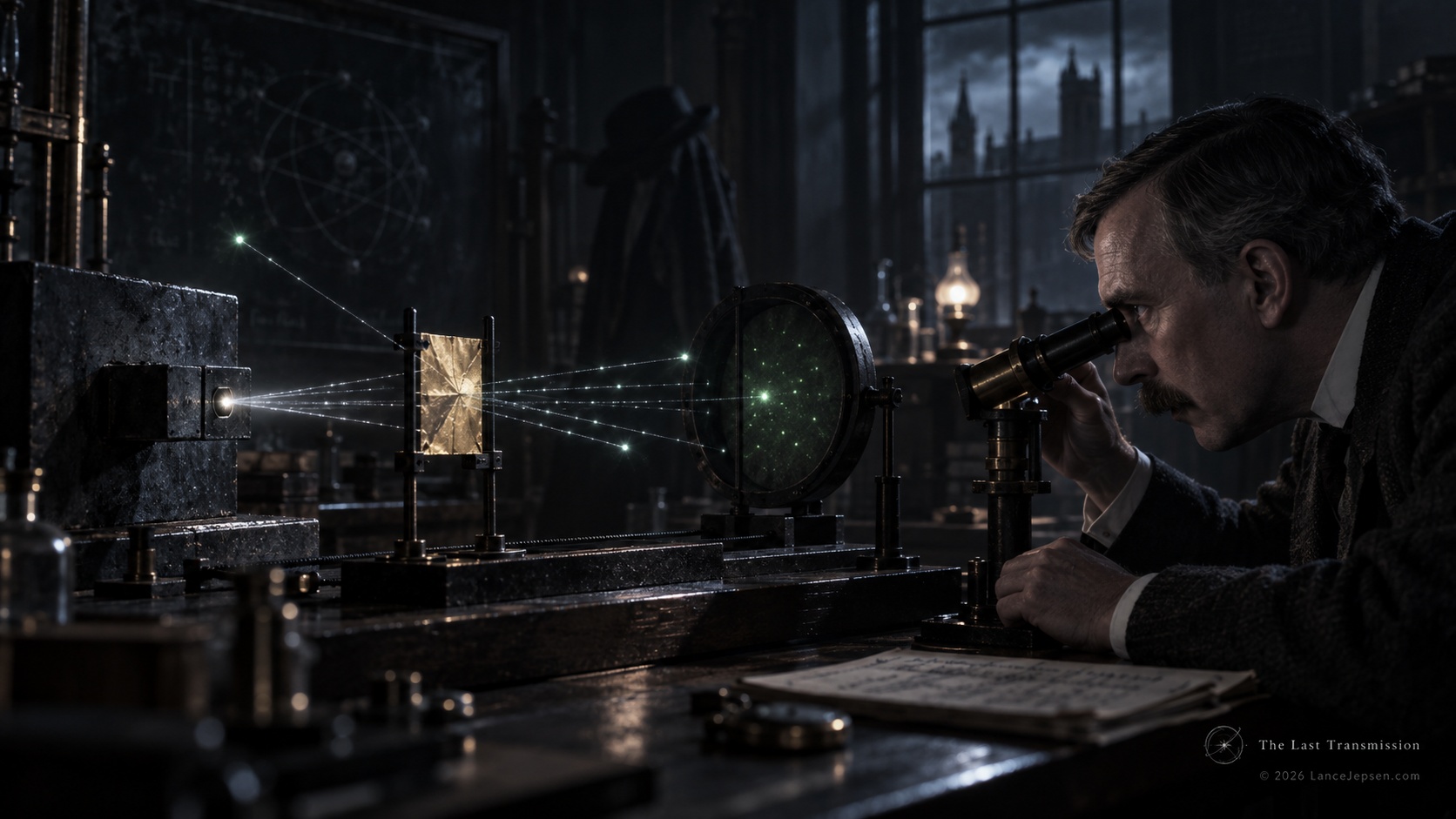
In Rutherford's laboratory, alpha particles were fired through thin gold foil while faint flashes revealed where they scattered. The rare particles that returned toward the source exposed the existence of an incredibly concentrated atomic nucleus. AI-generated historical visualization by The Last Transmission.
THE OBSERVATION
What we can actually see.
In early scattering experiments, most alpha particles passed through thin gold foil while a small fraction deflected strongly. That pattern was crucial evidence for a concentrated positive center in the atom. The finding came from counting events and testing a model, not from anyone seeing a nucleus with the naked eye.
THE ILLUSTRATION
What the artwork imagines.
The apparatus, researchers, and visible particle paths condense laboratory history into a single scene. Alpha particles did not leave luminous tracks in the room, and this is not a documentary photograph of the original setup.
FROM THE ILLUSTRATED ARTICLE
The story that inspired it.
The article revisits an experiment that made the atom’s hidden architecture impossible to ignore. Its surprising deflections still shape how the story of atomic structure is taught.
Read The Mountain Hiding Inside Every AtomCHECK THE RECORD
The image interprets the research below. Follow the original work for the measurements and limits behind the scene.
Nobel educational history: Rutherford and gold foilOTHER IMAGE STORIES
 The Mountain in a Teaspoon
 A Descent Into Ordinary Matter
 The Mark Shared by Titan and Pluto