
VISUAL ARCHIVE / CONCEPTUAL ART
A Candidate Planet Losing Gas to a White Dwarf
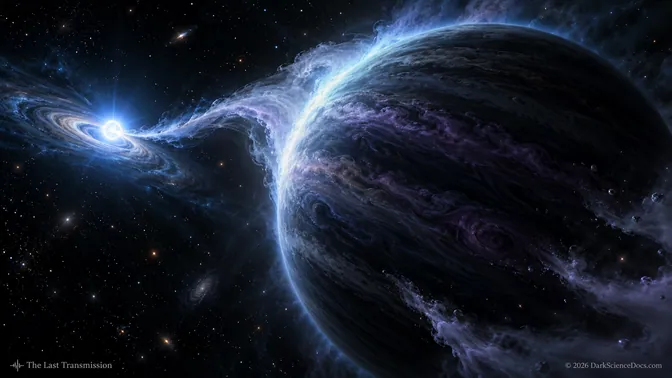
A hypothetical planet and escaping gas near white dwarf HS 0209+0832. Its planet has not been directly confirmed, and the scene is not a reconstruction of a telescope image.
THE OBSERVATION
What we can actually establish.
Reanalysis of archival Hubble ultraviolet spectra identified highly unusual abundances involving nickel, copper, zinc, and niobium. TESS data show an approximately 4.399-day periodic modulation.
THE ILLUSTRATION
What the artwork imagines.
A hypothetical planet and escaping gas near white dwarf HS 0209+0832. Its planet has not been directly confirmed, and the scene is not a reconstruction of a telescope image.
FROM THE SCIENCE STORY
The investigation behind the image.
The independent time-series clue comes from TESS. A very small brightness variation repeats on a roughly 4.4-day timescale, compatible with more than one scenario involving a nearby source. Researchers examined a possible giant planet losing gas under strong irradiation from the white dwarf, with some of that gas reaching the stellar atmosphere.
The periodic brightness pattern and chemical inventory do not directly image a planet or establish exactly how any proposed planet formed.