
EVIDENCE FILE 37 / SOURCE-LED
What Does the Evidence for a Planet at HS 0209+0832 Establish?
Separate the observation from the proposed explanation and its limitations.
THE SHORT ANSWER
Reanalysis of archival Hubble ultraviolet spectra identified highly unusual abundances involving nickel, copper, zinc, and niobium. TESS data show an approximately 4.399-day periodic modulation.
That supports further investigation, but it does not by itself prove every interpretation associated with the discovery.
OBSERVATION / INFERENCE / LIMIT
Follow the chain of reasoning.
The record
Reanalysis of archival Hubble ultraviolet spectra identified highly unusual abundances involving nickel, copper, zinc, and niobium. TESS data show an approximately 4.399-day periodic modulation.
The proposed explanation
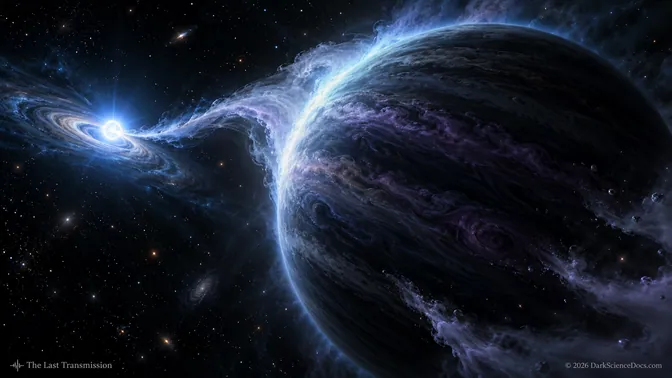
The chemically enriched inflow may originate in a close irradiated planet assembled wholly or partly from stellar material released during a late evolutionary phase.
The limit of the claim
The periodic brightness pattern and chemical inventory do not directly image a planet or establish exactly how any proposed planet formed.
HOW WE GET FROM SIGNAL TO STORY
Compare the evidence with the illustration.
A hot white dwarf acts like a chemical recorder. Elements in its atmosphere can reveal fresh accretion, and previously unexplained ultraviolet absorption lines may become identifiable as atomic models improve. Here, unusual enrichment in several heavy elements points toward material unlike familiar rocky debris.
The independent time-series clue comes from TESS. A very small brightness variation repeats on a roughly 4.4-day timescale, compatible with more than one scenario involving a nearby source. Researchers examined a possible giant planet losing gas under strong irradiation from the white dwarf, with some of that gas reaching the stellar atmosphere.
The second-generation interpretation is scientifically intriguing because it connects nucleosynthesis in an aging star to subsequent planetary assembly. But a surviving older core, a newly accumulated envelope, or other structures could complicate the story. Follow-up spectroscopy and photometry are needed before a formation narrative becomes an established history.
FOLLOW THE NEXT TEST
Return to the investigation.
PRIMARY RESEARCH & FURTHER READING