
FIELD NOTE / Cosmic Mysteries
Antihelium Candidates and the Search for Antistars
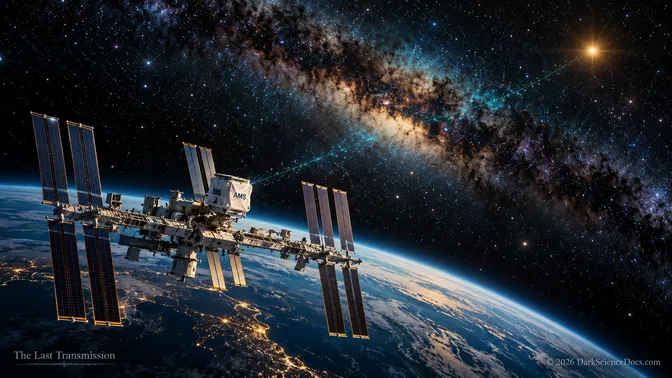
The ISS-mounted AMS-02 instrument has reported intriguing antinucleus candidates. Confirmation and ordinary-production explanations come before any claim that antimatter stars exist.
Antimatter particles are real and have been produced in laboratories. The challenge is to determine whether rare antinuclei arriving from space are genuine, and if so, how they formed. AMS-02 uses magnetic deflection and other measurements to estimate the charge and mass of incoming cosmic rays.
What the evidence shows
Antihelium would be particularly interesting because producing and delivering a detectable heavy antinucleus in ordinary cosmic-ray processes is challenging. But surprising candidate tracks are still candidates, not proof of an antimatter star or an entire antigalaxy.
Where the claim stops
Independent instruments provide valuable cross-checks. The GAPS experiment uses a different detection strategy for low-energy antinuclei, helping researchers test some of the same fundamental questions without relying on a single measurement technique. Gamma-ray constraints also limit speculative antistar populations.
MEASUREMENT / INTERPRETATION / OPEN QUESTION
What is recorded
AMS-02 has collected cosmic-ray particle tracks on the International Space Station. Researchers have discussed unusual possible antihelium events, but a verified astrophysical antihelium population is not yet established.
What it suggests
Confirmed complex antinuclei could inform models of cosmic-ray interactions, antimatter production, and, under far more speculative assumptions, possible primordial antimatter regions.
What is not established
An antihelium candidate is not a confirmed antistar. Instrumental effects and ordinary collisions must be examined before astrophysical explanations are assigned.
FOLLOW THE THREAD
Keep exploring the question.
READ THE SOURCE TRAIL
Research and further reading
These links include the complete published article and the research records cited in the supplied RSS edition.