
VISUAL ARCHIVE / CONCEPTUAL ART
A Particle Detector Above Earth
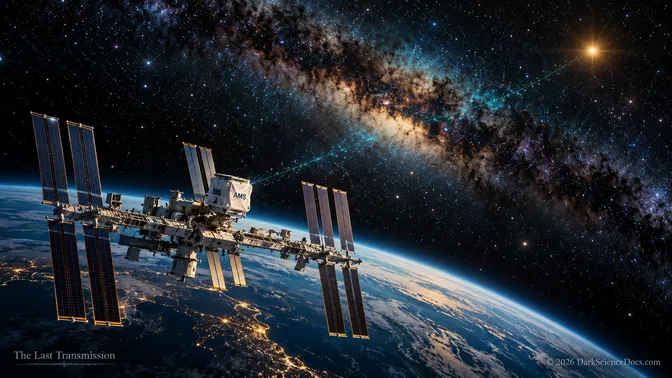
An artistic view of a space-based particle detector, evoking AMS-02. This illustration is not detector data or a photograph of an antimatter star.
THE OBSERVATION
What we can actually establish.
AMS-02 has collected cosmic-ray particle tracks on the International Space Station. Researchers have discussed unusual possible antihelium events, but a verified astrophysical antihelium population is not yet established.
THE ILLUSTRATION
What the artwork imagines.
An artistic view of a space-based particle detector, evoking AMS-02. This illustration is not detector data or a photograph of an antimatter star.
FROM THE SCIENCE STORY
The investigation behind the image.
Antihelium would be particularly interesting because producing and delivering a detectable heavy antinucleus in ordinary cosmic-ray processes is challenging. But surprising candidate tracks are still candidates, not proof of an antimatter star or an entire antigalaxy.
An antihelium candidate is not a confirmed antistar. Instrumental effects and ordinary collisions must be examined before astrophysical explanations are assigned.