
FIELD NOTE / Space & Missions
Arsia Mons: How a Martian Cloud May Form Without Dust Nuclei
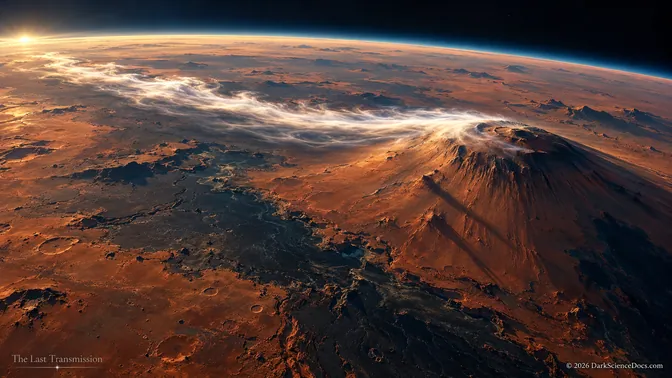
A seasonal water-ice ribbon can extend nearly 1,800 kilometers. Detailed modeling suggests homogeneous ice nucleation, but no spacecraft has sampled its formation directly.
The extraordinary ribbon above Arsia Mons is not a volcanic plume. It forms when wind interacting with the ancient mountain produces atmospheric waves and strong cooling high above the surface, where the planet’s extremely thin air can become supersaturated in water vapor.
What the evidence shows
Scientists have traditionally modeled Martian water-ice clouds as forming on airborne dust. A 2026 study showed that adding direct homogeneous ice nucleation from vapor can better reproduce the cloud’s sharp, trailing structure. Wind then transports the new particles away from the localized region where they first formed.
Where the claim stops
The result is a testable model-based interpretation, not a direct microscopic observation. The proposed mechanism may matter for other cold atmospheres, but researchers must establish when the necessary conditions occur. The related Mars atlas explores Olympus Mons, a different volcano from the Arsia Mons cloud source.
MEASUREMENT / INTERPRETATION / OPEN QUESTION
What is recorded
Mars Express and other orbiters have tracked a seasonal water-ice formation extending up to about 1,800 kilometers from the Arsia Mons region.
What it suggests
Models incorporating intense orographic cooling and homogeneous nucleation of ice directly from vapor reproduce important features of the elongated tail.
What is not established
The simulations do not perfectly match every measurement; the proposed nucleation process has not been confirmed by sampling the crystals as they form.
FOLLOW THE THREAD
Keep exploring the question.
READ THE SOURCE TRAIL
Research and further reading
These links include the complete published article and the research records cited in the supplied RSS edition.