
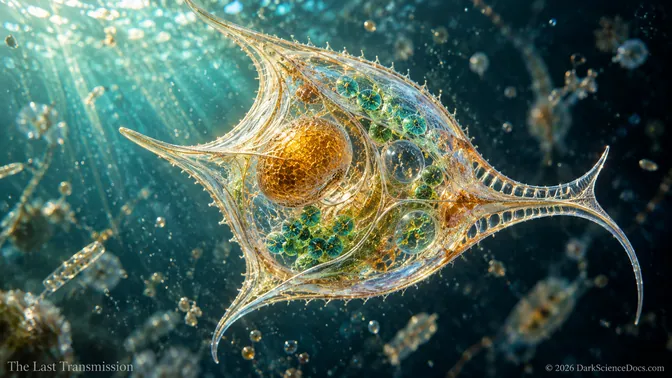
FIELD NOTE / Hidden Systems & Earth
Sukunaarchaeum: Where a Minimal Cell Meets Dependence
An archaeal genome of roughly 238 kilobases suggests profound dependence on another organism. It opens a question about cellular autonomy, not proof that the cell is a virus.
A genome is not a complete picture of an organism, but it provides a powerful inventory of its possible capabilities. In Sukunaarchaeum, that inventory is unusually small for a cell and lacks many of the ordinary pathways expected in an autonomous microbe.
What the evidence shows
An organism can remain cellular while leaning heavily on another species for basic needs. Viruses also rely on hosts, but the terms refer to different kinds of biological organization. The discovery therefore invites careful investigation of what the archaeon does itself and what its environment or host must provide.
Where the claim stops
Additional microscopy, experimental study of the host association, and confirmation of predicted protein function are essential. The case is especially valuable for teaching how a genome sequence supports hypotheses about physiology without providing direct observation of every cell process.
MEASUREMENT / INTERPRETATION / OPEN QUESTION
What is recorded
Researchers reported a highly reduced archaeal genome of about 238 kilobases with major gaps in pathways needed for independent metabolism.
What it suggests
The genome suggests extensive host dependence, potentially relying on another organism to supply components essential for cellular maintenance.
What is not established
Genome reduction alone does not establish the complete life cycle, host relationship, or how to redefine the boundary between cells and viruses.
FOLLOW THE THREAD
Keep exploring the question.
READ THE SOURCE TRAIL
Research and further reading
These links include the complete published article and the research records cited in the supplied RSS edition.