
VISUAL ARCHIVE / IMAGE STORY
An Imagined Horizon in Curved Spacetime
The curved environment surrounding a black-hole horizon remains one of general relativity’s most demanding theoretical settings.
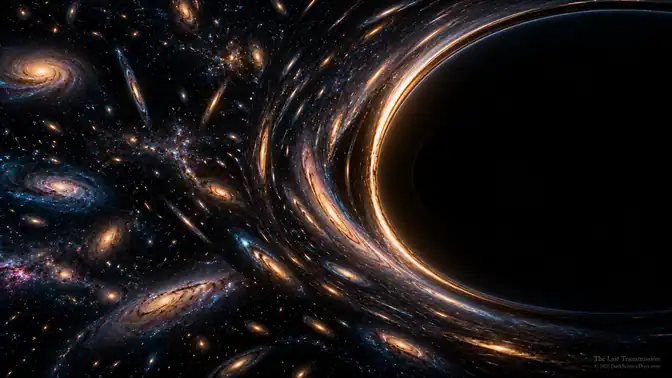
The curved environment surrounding a black-hole horizon remains one of general relativity’s most demanding theoretical settings. A March 2026 preprint describes exact mathematical solutions that avoid an unwanted curvature singularity at the horizon when a black hole is embedded in an expanding universe. AI-generated conceptual illustration; not a direct astronomical observation or mission photograph.
THE OBSERVATION
What we can actually see.
Astronomers infer accelerated cosmic expansion from several kinds of observation. Black holes also grow through accretion and mergers. Published cosmological-coupling analyses offer an additional mechanism, while independent theoretical and observational work disputes whether its required strength is supported.
THE ILLUSTRATION
What the artwork imagines.
The curved environment surrounding a black-hole horizon remains one of general relativity’s most demanding theoretical settings. A March 2026 preprint describes exact mathematical solutions that avoid an unwanted curvature singularity at the horizon when a black hole is embedded in an expanding universe. AI-generated conceptual illustration; not a direct astronomical observation or mission photograph. Colors, lighting, viewpoint and simultaneous arrangement are artistic choices. The frame supplies no instrument measurement, site survey or confirmation of a proposed mechanism.
FROM THE ILLUSTRATED ARTICLE
The story that inspired it.
A proposed link between black-hole growth and cosmic expansion connects stellar remnants with dark energy. The question is whether that model survives independent observations and competing accounts of black-hole growth. This artwork provides visual context for the illustrated article while its scientific claims remain tied to the linked research and mission records.
Read What If the Universe Is Accelerating Because Stars Die?CHECK THE RECORD
The image interprets the research below. Follow the original work for the measurements and limits behind the scene.
Farrah et al. (2023): cosmological coupling hypothesis Cadoni et al.: Cosmological coupling of nonsingular black holes Cadoni et al.: Cosmologically Coupled Black Holes with Regular Horizons DESI DR2: BAO measurements and cosmological constraintsOTHER IMAGE STORIES
 A Black Hole Against the Cosmic Web
 An Elliptical Galaxy and Its Dark Center
 The Mark Shared by Titan and Pluto