
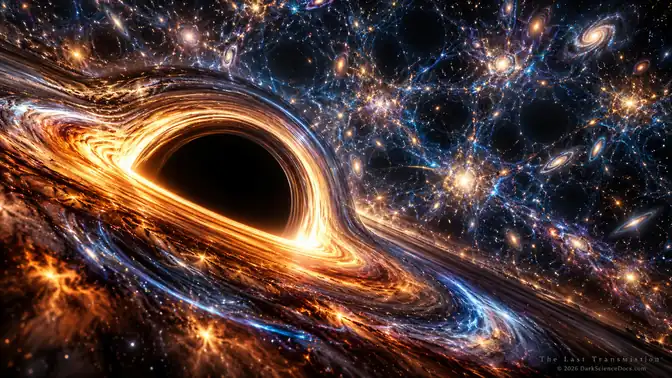
05 / Dark energy / a contested connection
Can Dead Stars Help Explain Cosmic Acceleration?
A proposed link between black-hole growth and cosmic expansion connects stellar remnants with dark energy. The question is whether that model survives independent observations and competing accounts of black-hole growth.
The article follows cosmological coupling: a hypothesis in which a black hole’s mass responds to the expansion of the Universe. Comparing black holes in different galaxy populations can motivate a growth law, but translating that comparison into a source of dark energy requires additional assumptions about the objects and their collective gravitational behavior.
The full investigation continues with the evidence, illustrations, and sources at The Last Transmission on Substack.
Continue reading on SubstackTHE EVIDENCE / THE OPEN QUESTION
What we know.
Astronomers infer accelerated cosmic expansion from several kinds of observation. Black holes also grow through accretion and mergers. Published cosmological-coupling analyses offer an additional mechanism, while independent theoretical and observational work disputes whether its required strength is supported.
What remains open.
An apparent change in black-hole populations need not represent expansion-driven growth of individual objects. Selection effects, host-galaxy evolution and ordinary feeding histories complicate the comparison. A mathematically consistent model is not independent evidence that nature uses it.
Why it matters.
The useful test is whether one consistent model explains expansion data and black-hole measurements without failing other constraints. Keep the established evidence for acceleration separate from a proposed astrophysical explanation for it.
GO DEEPER / EVIDENCE FILE
Does black-hole growth establish the physical origin of dark energy?
A proposed link between black-hole growth and cosmic expansion connects stellar remnants with dark energy. The question is whether that model survives independent observations and competing accounts of black-hole growth.
COMPARE THE QUESTIONS
Follow what the light reveals.
These related routes explain different phenomena. They do not establish a common cause for the optical pulses.
FOLLOW THE EVIDENCE
Research behind the field note.
VISUAL EVIDENCE
Inside the investigation.
FOLLOW THE THREAD
Related signals.
A Star Blinked Twice. Whatever Caused It May Be Much Closer to Earth.
Two nearly identical optical disturbances, 4.4 seconds apart, appeared in HD 89389’s light. Follow the unexplained record, a foreground diffraction hypothesis, and the synchronized telescopes proposed to test it.
A Star Died 6.5 Billion Years Ago. Its Explosion Is About to Arrive Again.
NASA is watching for a supernova we have already seen. When that light finally reaches Earth, it could help answer one of the most troubling questions in modern cosmology.
The Black Hole That Couldn’t Stop the Stars
An enormous black hole is blasting energy into the Phoenix Cluster, yet its central galaxy is producing stars at an extraordinary rate.