
VISUAL ARCHIVE / IMAGE STORY
When Differential Gravity Wins
An extreme encounter turns a planet’s survival question into a tidal-disruption problem.
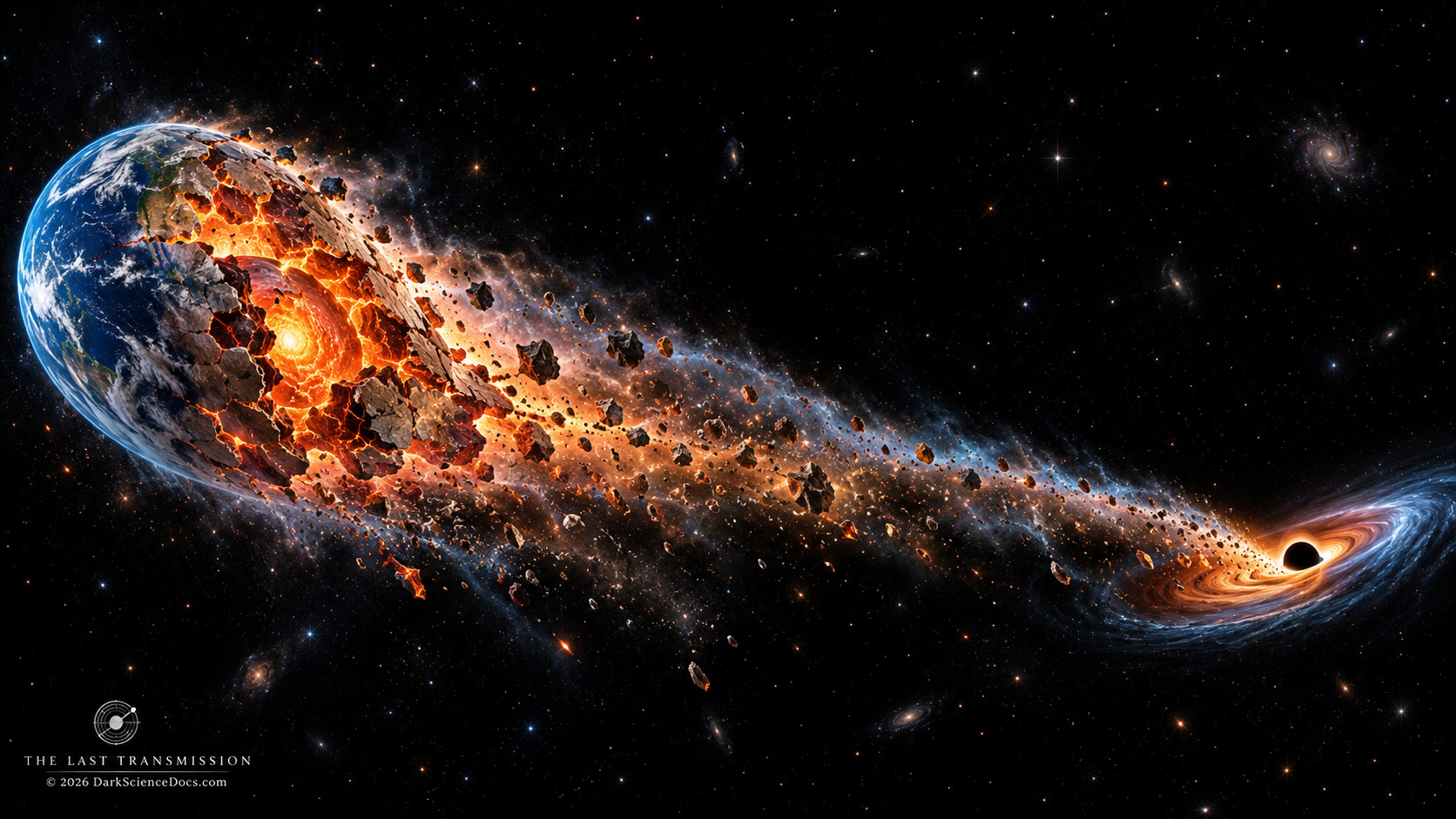
At an extreme closest approach, differential gravity could tear Earth into streams of debris. AI-generated conceptual illustration; the breakup geometry, colors, and disk formation are not a hydrodynamic prediction.
THE OBSERVATION
What we can actually see.
Tidal effects depend on the difference in gravitational acceleration across an object and on its own binding. Determining an actual breakup requires a physical model; the illustrated streams and subsequent disk are not a calculated prediction for Earth.
THE ILLUSTRATION
What the artwork imagines.
The composition visualizes this idea: An extreme encounter turns a planet’s survival question into a tidal-disruption problem. At an extreme closest approach, differential gravity could tear Earth into streams of debris. AI-generated conceptual illustration; the breakup geometry, colors, and disk formation are not a hydrodynamic prediction.
FROM THE ILLUSTRATED ARTICLE
The story that inspired it.
The article uses a hypothetical stellar-mass black-hole encounter to distinguish orbital disruption, loss of sunlight, and extreme tidal destruction. Those are different possibilities, not a prediction that a visitor is on its way to Earth. This frame focuses on an extreme encounter turns a planet’s survival question into a tidal-disruption problem.
Read A Black Hole Could Leave Earth Without a SunCHECK THE RECORD
The image interprets the research below. Follow the original work for the measurements and limits behind the scene.
NASA: Black Holes NASA: Anatomy of a Black Hole NASA: Hubble Determines Mass of Isolated Black Hole Roaming Our Milky Way Galaxy NASA: RXTE Detects “Heartbeat” of Smallest Black Hole Candidate NASA: IXPE’s “Heartbeat Black Hole” Measurements Challenge Current Theories Einstein Online: Schwarzschild Radius Einstein Online: Tidal Effects Malmberg, Davies and Heggie: The Effects of Fly-bys on Planetary Systems Abbot and Switzer: The Steppenwolf, a Proposal for a Habitable Planet in Interstellar SpaceOTHER IMAGE STORIES
Keep looking.
 A Planet Can Lose Its Star
 Finding Darkness by Its Effects
 The Mark Shared by Titan and Pluto
EXPLORE IN 3D / MAP 06
Explore the world that depends on the Sun
Explore Earth and the Moon as they are represented in our planetary atlas, then return to the article’s hypothetical disruption. This map does not forecast a black-hole encounter.
Open Earth & Moon map