
VISUAL ARCHIVE / IMAGE STORY
The Green Smudge Volunteers Noticed
Galaxy Zoo volunteers recognized unusual compact sources; this observer scene is invented.
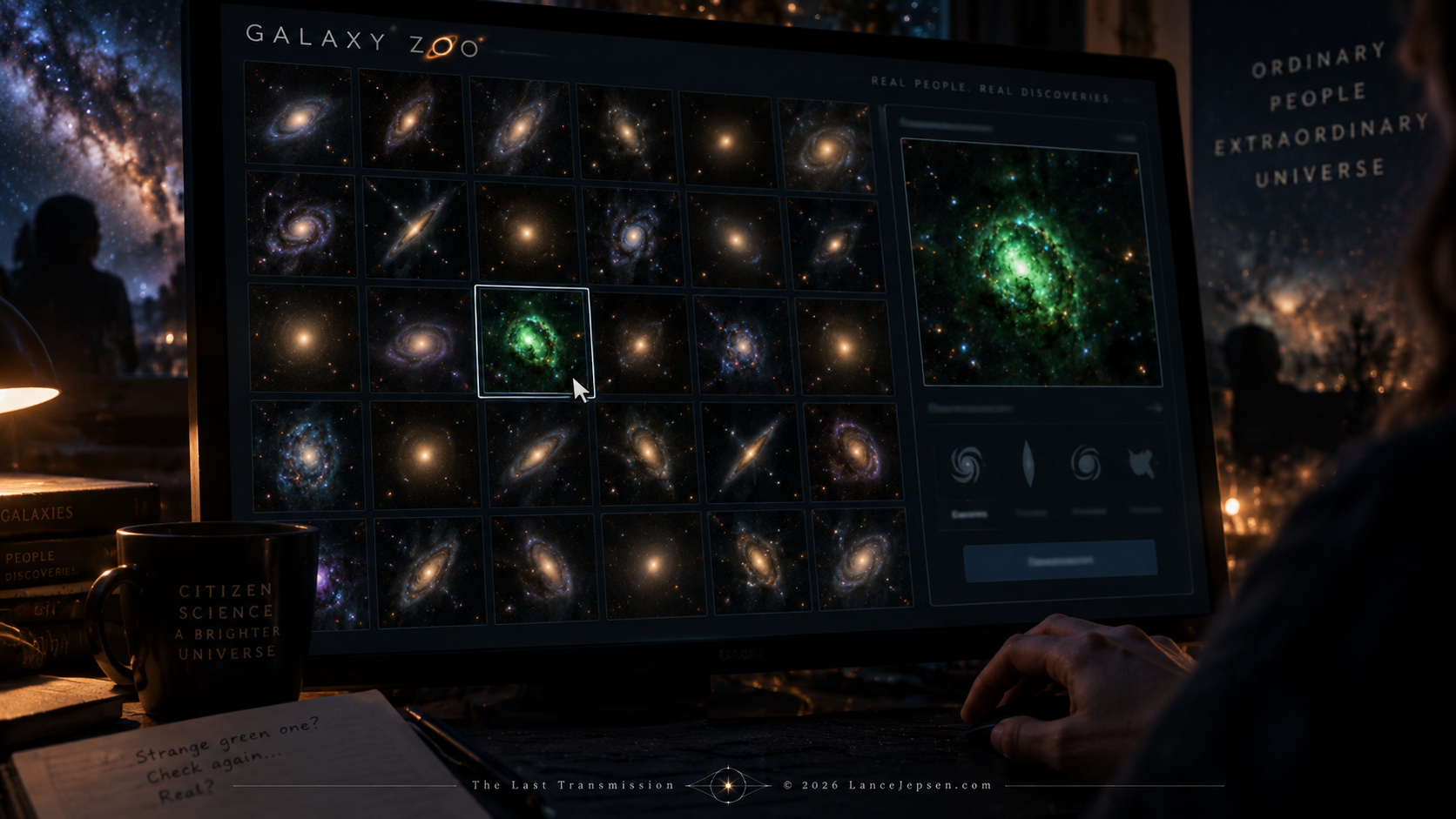
Green Pea galaxies were first recognized by Galaxy Zoo volunteers examining Sloan Digital Sky Survey images. Something that looked like an odd green smudge on a computer screen eventually became an entirely class of extreme star-forming galaxies. AI-generated illustration. The Last Transmission | © 2026 DarkScienceDocs.com
THE OBSERVATION
What we can actually see.
Galaxy Zoo participants flagged small green-looking sources in Sloan Digital Sky Survey images. Follow-up work identified a class of compact galaxies with intense emission lines and rapid star formation. The apparent green color in the survey image has an instrumental and spectral explanation; it is not how the galaxy would look to an eye floating nearby.
THE ILLUSTRATION
What the artwork imagines.
The screen, room, and moment of noticing are an editorial reconstruction, not a portrait of a particular volunteer or the first classification event. They give a human entry point to an unusual astronomical sample.
FROM THE ILLUSTRATED ARTICLE
The story that inspired it.
The article begins with an almost comic visual anomaly that led to a serious way of studying galaxies resembling some young-universe systems.
Read The Galaxies With Ridiculous Names That May Have Turned On the UniverseCHECK THE RECORD
The image interprets the research below. Follow the original work for the measurements and limits behind the scene.
Galaxy Zoo Green Pea discovery paperOTHER IMAGE STORIES
 When Galaxies Cleared the Cosmic Fog
 A Small Galaxy Making Stars Fast
 The Mark Shared by Titan and Pluto