
VISUAL ARCHIVE / IMAGE STORY
A Small Galaxy Making Stars Fast
Some Green Peas form stars rapidly for their size; the apparent starburst is an illustration.
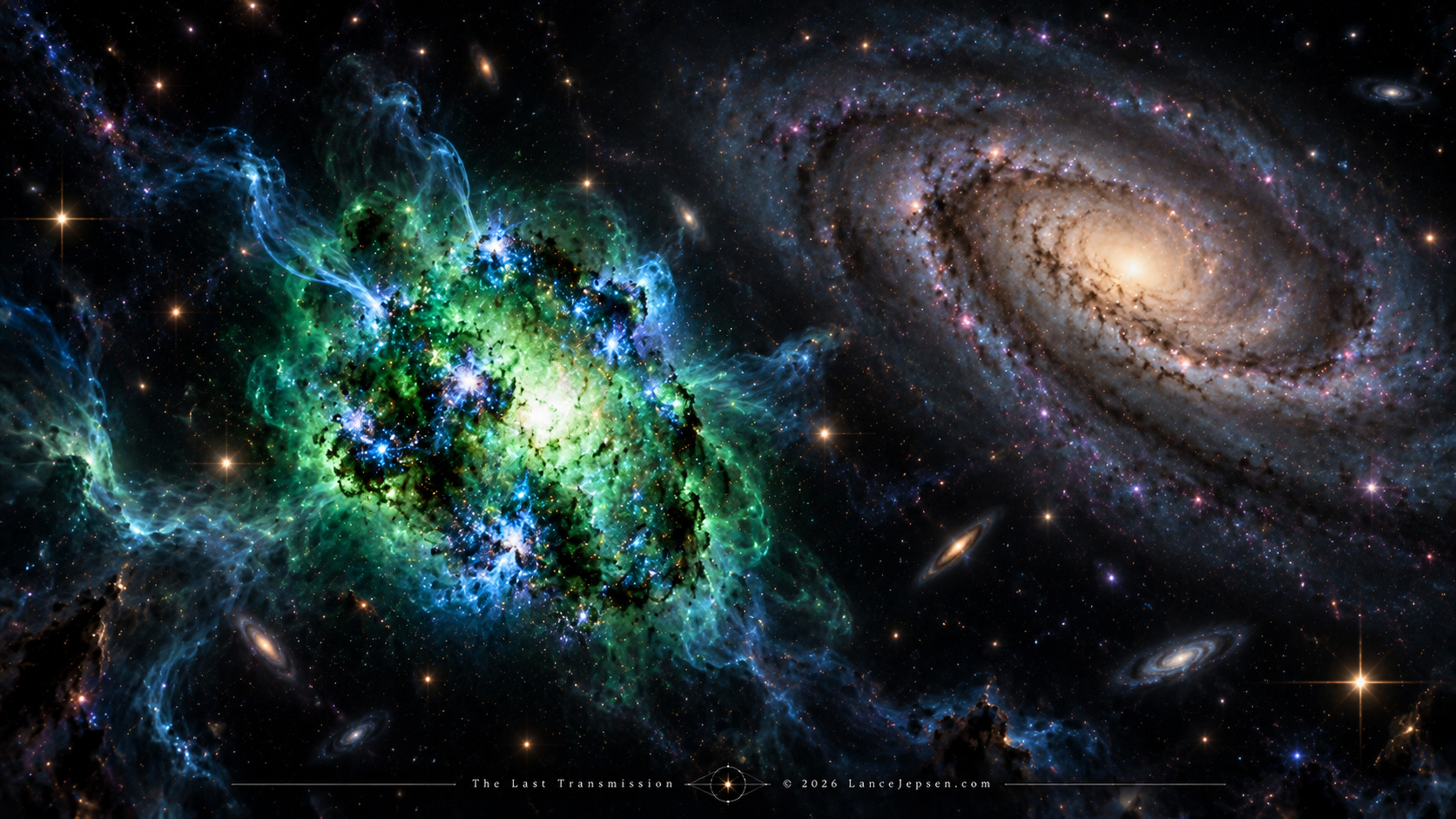
A compact Green Pea-like dwarf galaxy can contain only a fraction of the stellar mass of a large spiral galaxy while forming stars with extraordinary intensity. Their extreme specific star-formation rates are one reason astronomers study them as nearby analogues of galaxies in the young universe. AI-generated illustration. The Last Transmission | © 2026 DarkScienceDocs.com
THE OBSERVATION
What we can actually see.
The original Green Pea sample included low-mass galaxies with unusually high specific star-formation rates and strong emission lines. Their combination of size, chemistry, and activity makes them useful nearby comparisons for some distant galaxies. They are not literal copies of every galaxy from the reionization era.
THE ILLUSTRATION
What the artwork imagines.
Bright knots and gas structures dramatize vigorous star formation. Their shapes, relative sizes, and colors are not a resolved image of a named Green Pea in the sample.
FROM THE ILLUSTRATED ARTICLE
The story that inspired it.
The article asks why small nearby galaxies with a playful name can help test ideas about how the young universe assembled stars.
Read The Galaxies With Ridiculous Names That May Have Turned On the UniverseCHECK THE RECORD
The image interprets the research below. Follow the original work for the measurements and limits behind the scene.
Galaxy Zoo Green Pea discovery paperOTHER IMAGE STORIES
 When Galaxies Cleared the Cosmic Fog
 The Green Smudge Volunteers Noticed
 The Mark Shared by Titan and Pluto