
VISUAL ARCHIVE / IMAGE STORY
A Tug at the Core–Mantle Boundary
The proposed gravitational torque has measurable timing consequences, but no visible arrows.
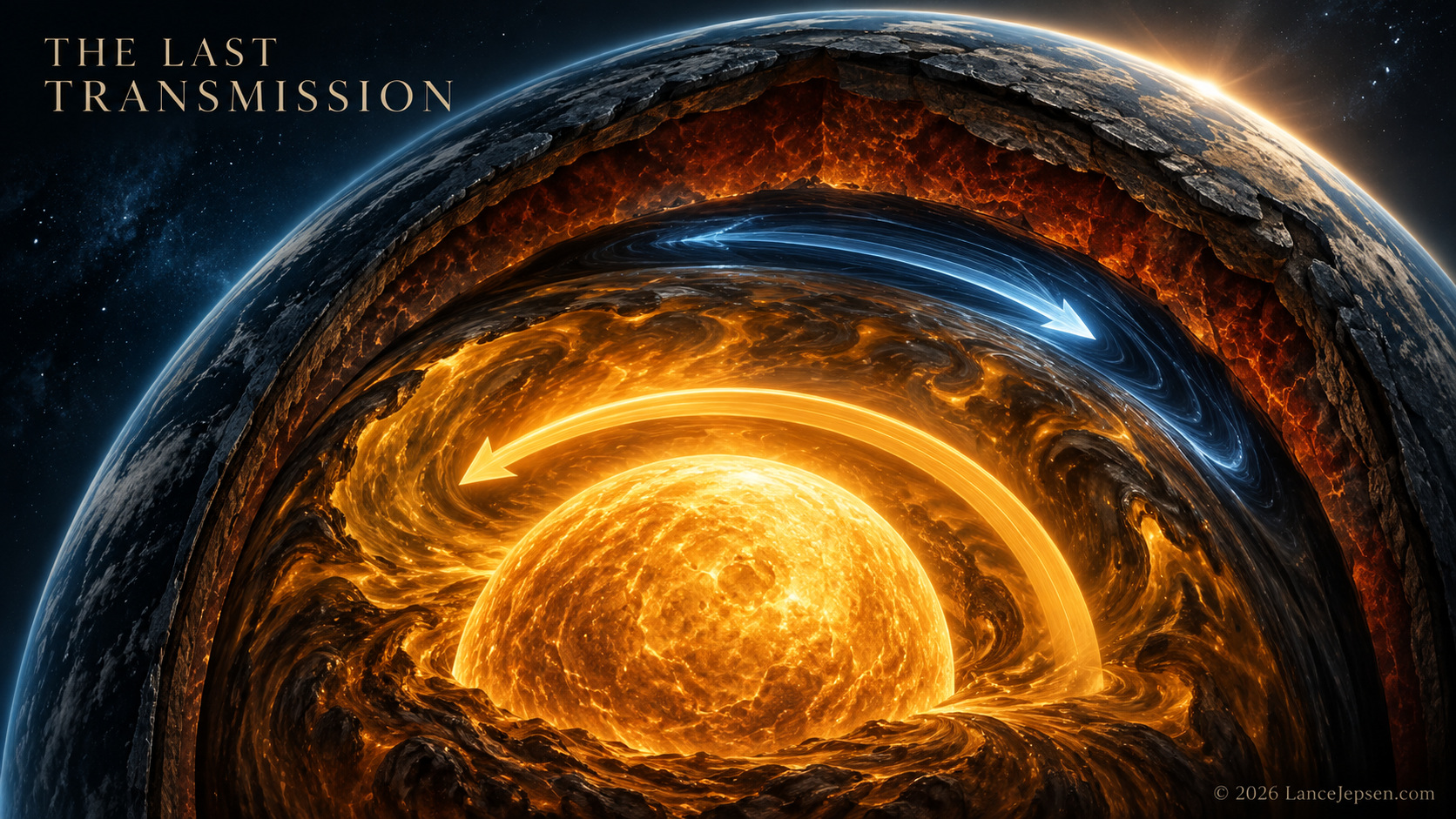
Warm and cool arcs represent the study’s leading gravitational torque and opposing forces at the core–mantle boundary. AI-generated conceptual illustration; arrow size and direction are explanatory, not measured values.
THE OBSERVATION
What we can actually see.
The study models how density structure and a slightly changing orientation of the inner core can exert a gravitational torque on the mantle. Competing forces and the motion of the liquid outer core enter the calculation. The evidence comes from agreement between a physical model and rotation records, not an observed force arrow.
THE ILLUSTRATION
What the artwork imagines.
Warm and cool arcs separate effects that are mathematically related. Their direction and apparent strength are not instrument outputs and cannot be used to read the actual size of the torque.
FROM THE ILLUSTRATED ARTICLE
The story that inspired it.
The article slows down at the proposed mechanism, where a small mismatch in orientation becomes a long-term change in rotation.
Read The Earth Has a Hidden Hand on the ClockCHECK THE RECORD
The image interprets the research below. Follow the original work for the measurements and limits behind the scene.
Zhang and Dumberry, gravitational torque and day lengthOTHER IMAGE STORIES
 The Core’s Small Tug on the Clock
 The Clock Hidden Inside Earth
 The Mark Shared by Titan and Pluto