
VISUAL ARCHIVE / IMAGE STORY
The Living Edge of a Mineral Lake
Microbial mats can alter and trap sediment in layered structures.
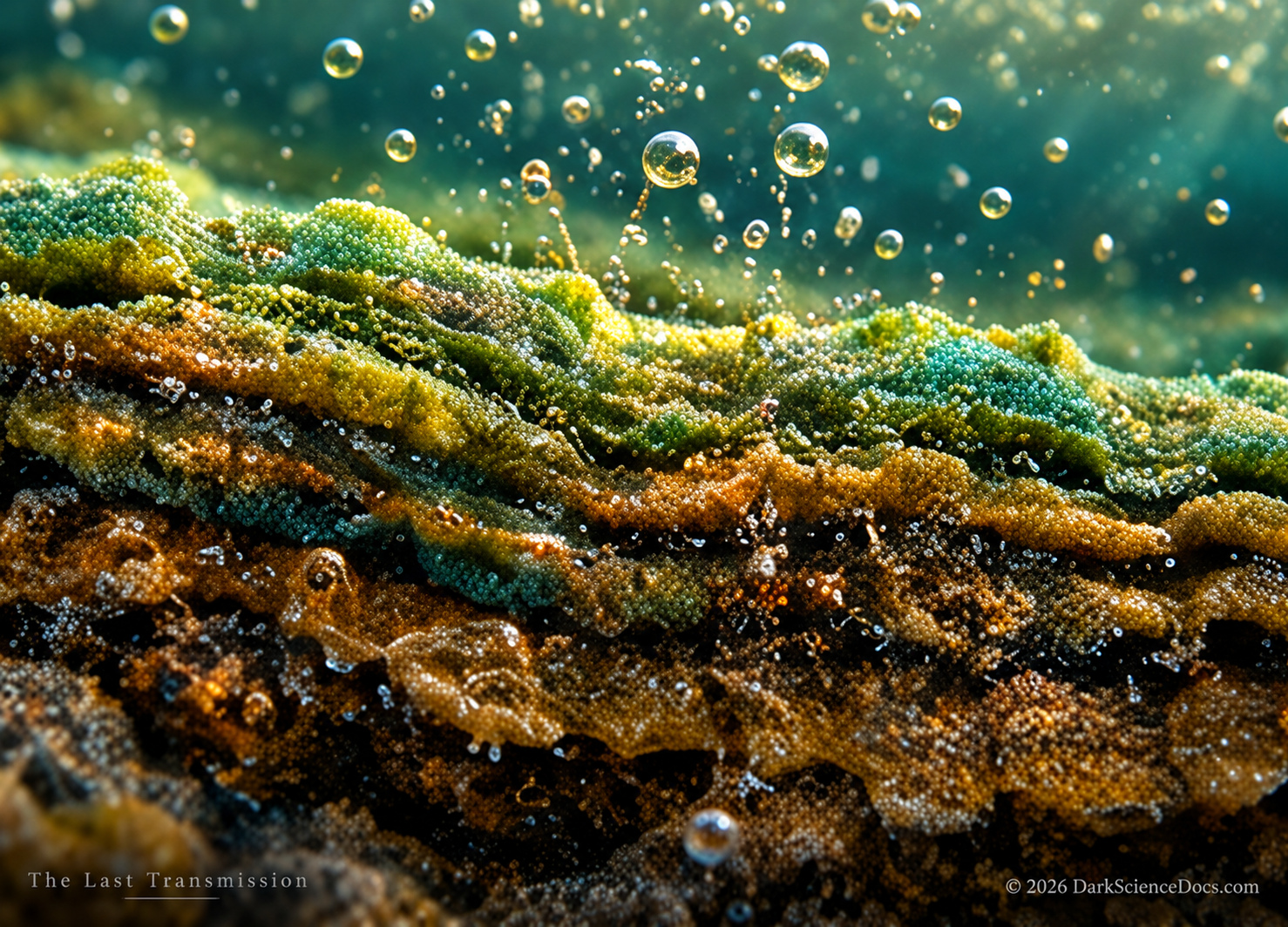
Microbial mats can interact with minerals and sediments to build layered structures over long periods of time. This AI-generated close-up represents the biological interface where water, minerals and microorganisms may have interacted inside the ancient crater lake. The Last Transmission | © 2026 DarkScienceDocs.com
THE OBSERVATION
What we can actually see.
The investigation concerns preserved structures and chemical signatures, which can be compared with processes known from microbial mats. It cannot recover an exact ancient species list or observe the original living surface.
THE ILLUSTRATION
What the artwork imagines.
The close view imagines microbes and minerals interacting through time. Its individual cells, colors, and growth rate are not measured features of the fossils.
FROM THE ILLUSTRATED ARTICLE
The story that inspired it.
The Hapcheon study connects an impact structure, hydrothermal alteration, and stromatolite evidence without claiming that the impact created life. Microbial mats can alter and trap sediment in layered structures.
Read The Crater That Learned to BreatheCHECK THE RECORD
The image interprets the research below. Follow the original work for the measurements and limits behind the scene.
Communications Earth & Environment: Hapcheon impact studyOTHER IMAGE STORIES
 The Basin After the Fire
 When an Impact Opens the Crust
 The Mark Shared by Titan and Pluto