
VISUAL ARCHIVE / IMAGE STORY
Jupiter’s Unseen Core
Juno weighs the planet through radio tracking; a glowing interior gradient illustrates one class of models rather than a direct view.
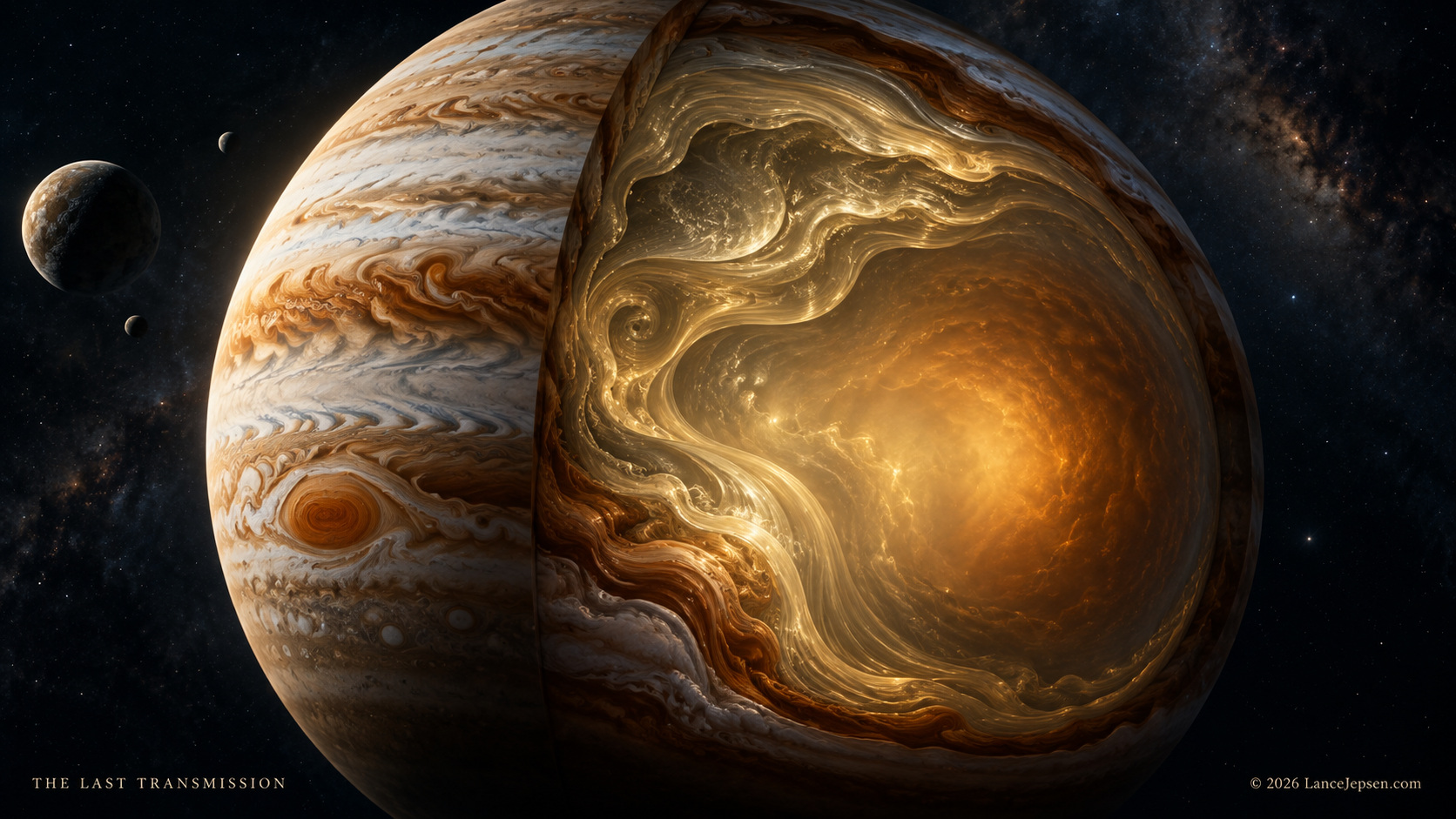
Jupiter’s diffuse core is inferred from gravity data and interior models. The glowing gradient represents a gradual change in composition, not a photographed cavity or a known internal map. AI-generated conceptual illustration; The Last Transmission © 2026 DarkScienceDocs.com
THE OBSERVATION
What we can actually see.
Juno’s trajectory changes slightly in Jupiter’s gravity field, and precise radio tracking turns those changes into constraints on the planet’s mass distribution. Interior models that fit the measurements can spread heavy elements through a broad central region rather than confine them to a sharply bounded core. The precise distribution depends on assumptions about deep winds and the behavior of matter under enormous pressure.
THE ILLUSTRATION
What the artwork imagines.
The glowing gradient visualizes a gradual change in composition. Juno did not look through the clouds to see a luminous interior, a hollow space, or a clean boundary. The color and shape are a way to make an invisible model legible, not a map produced by the spacecraft.
FROM THE ILLUSTRATED ARTICLE
The story that inspired it.
The article follows the difference between a gravity-based inference about Jupiter today and competing accounts of how that interior formed, including a proposed early collision. The artwork gives the modeled core a visual language without turning the collision into an observation.
Read The Planet That Wouldn’t Keep Its CoreCHECK THE RECORD
The image interprets the research below. Follow the original work for the measurements and limits behind the scene.
NASA Juno: gravity scienceOTHER IMAGE STORIES
 A Radio Signal Along Jupiter’s Edge
 Did an Impact Blur Jupiter’s Core?
 The Mark Shared by Titan and Pluto