EVIDENCE FILE 03 / JUPITER
How Can Juno Detect a Core It Cannot See?
Jupiter has no exposed rocky center. How can a spacecraft's orbit reveal a diffuse interior, and what made it that way?
All Evidence FilesTHE SHORT ANSWER
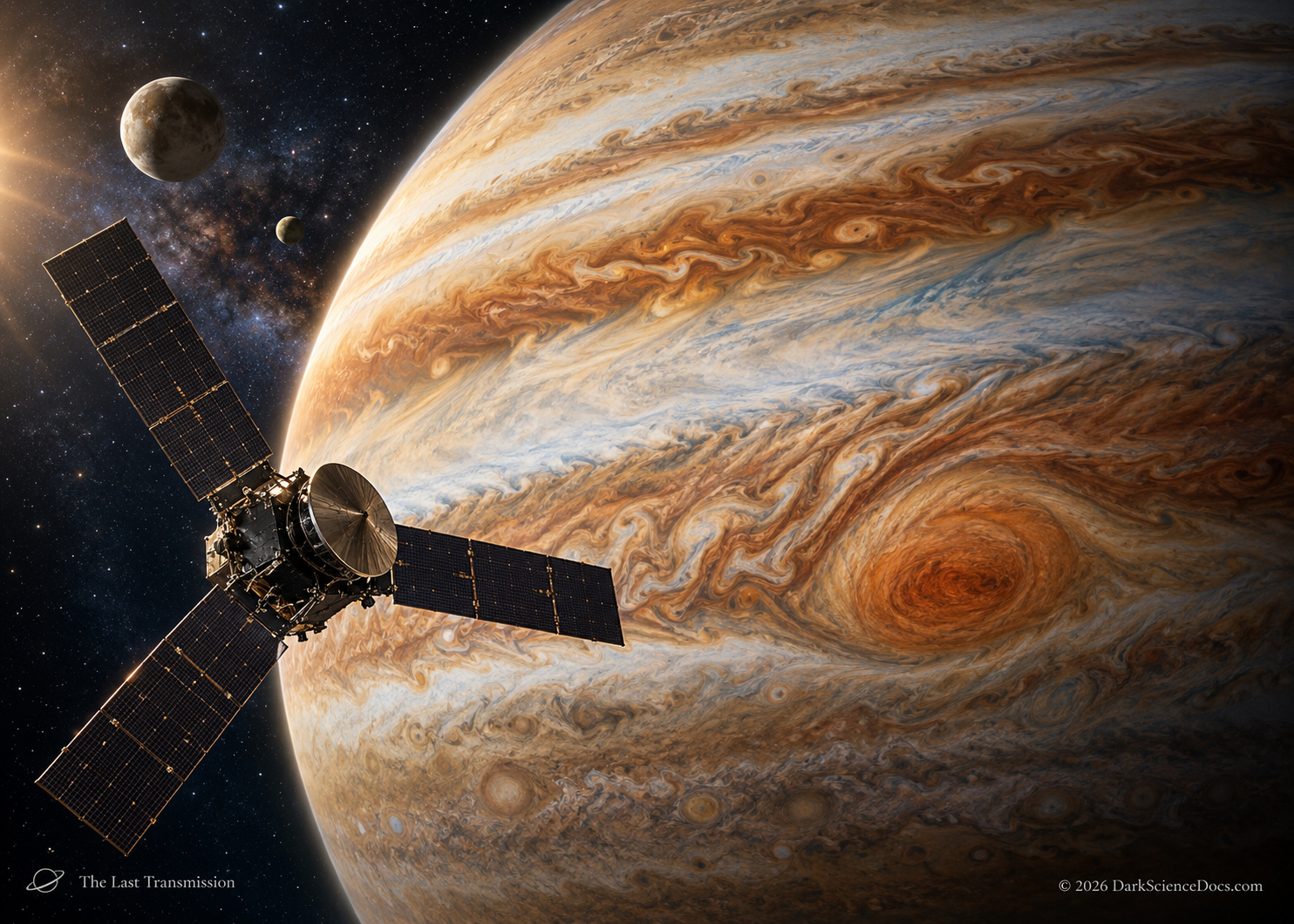
Juno does not look through Jupiter's clouds. Scientists track tiny changes in the spacecraft's radio signal as Jupiter's gravity alters its motion. They fit those measurements with models of a rotating planet containing different amounts and distributions of hydrogen, helium, and heavier elements. Several models favor a broad, diluted region rather than a single sharply bounded core. The data constrain the inside indirectly; they do not supply a photograph or a unique origin story.
THE EVIDENCE MAP / JUPITER
Weighing an invisible interior
The gravity field constrains Jupiter’s interior; its formation history remains a separate inference.
- 01Measurement
Juno’s radio signal shifts
Precise Earth–spacecraft radio tracking detects small changes in Juno’s motion during close passes, revealing Jupiter’s gravity field.
- 02Interpretation
Heavy elements extend outward
Interior models fitting the gravity data can place heavier material across a broad central region instead of inside a sharp compact core.
- 03Competing explanation
How did that region form?
One model invokes a giant early impact; other formation and mixing histories may work. Simulations disagree about whether an impact leaves a lasting dilute core.
- 04Open test
Make one model fit every constraint
Compare gravity, shape, winds, composition, and realistic long-term simulations. No radio measurement can directly record an ancient collision.
OBSERVATION / INFERENCE / LIMIT
Read the signal.
Orbital motion
Radio tracking reveals subtle gravity-field variations during close passes.
Diffuse region
Heavy elements can extend far beyond a compact central core.
Debated
Formation, mixing, and giant-impact explanations remain under study.
INSIDE THE EVIDENCE
The chain of reasoning.
Each step has a different level of certainty. Follow the measured result into the explanation, then see where the trail ends.
A gravity map, not an X-ray
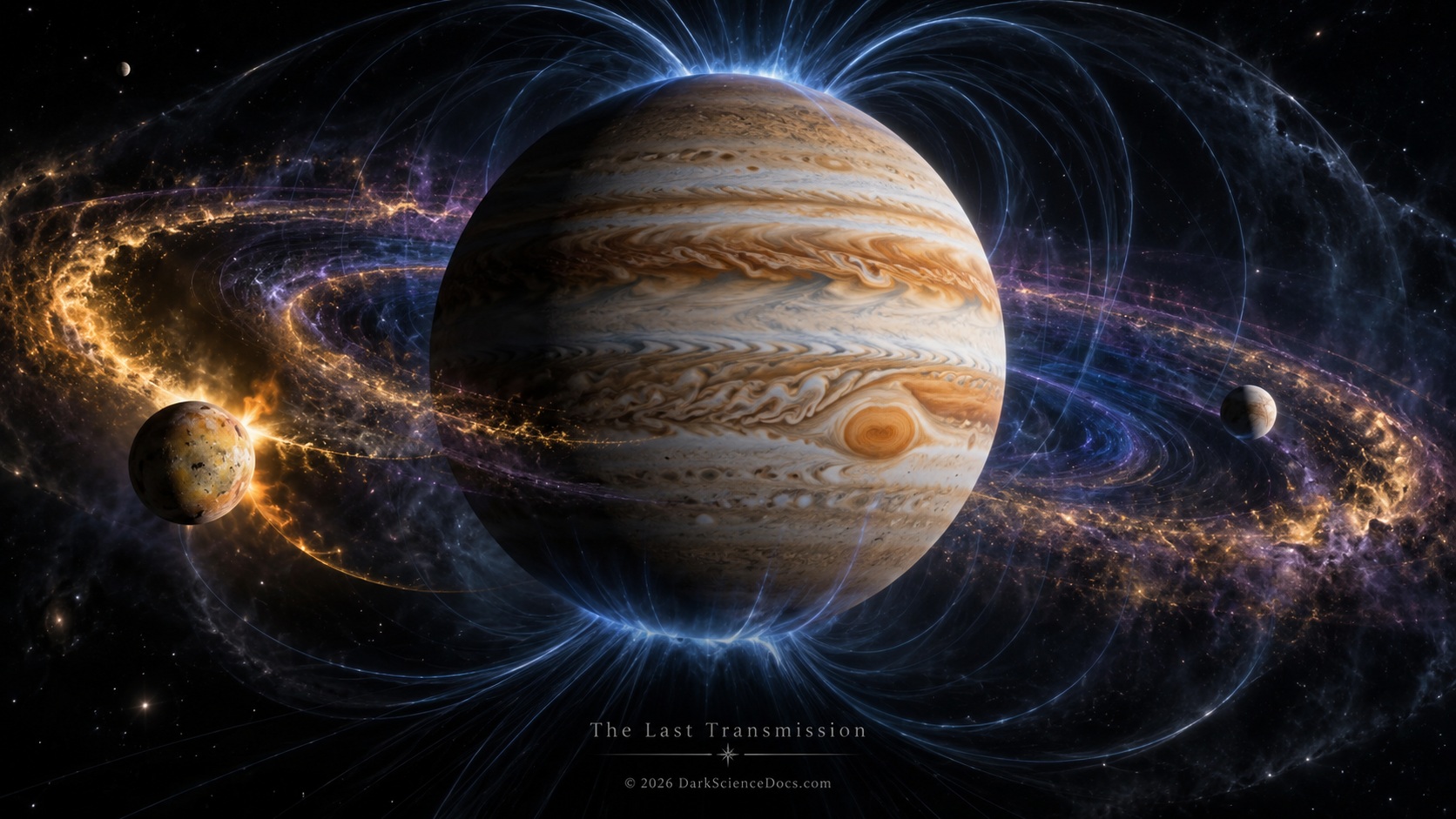
The distribution of mass within Jupiter changes the gravitational pull experienced by Juno. During close passages, precise radio tracking picks up slight changes in the spacecraft's velocity. Scientists express the planet's field through gravitational harmonics, then compare them with predictions from interior models. Rotation, deep winds, and the planet's shape also influence the measurement. Each must be handled in the analysis. What emerges is a constraint on where mass can plausibly be, not a clean image showing a ball of rock at the center.
What 'diffuse core' means
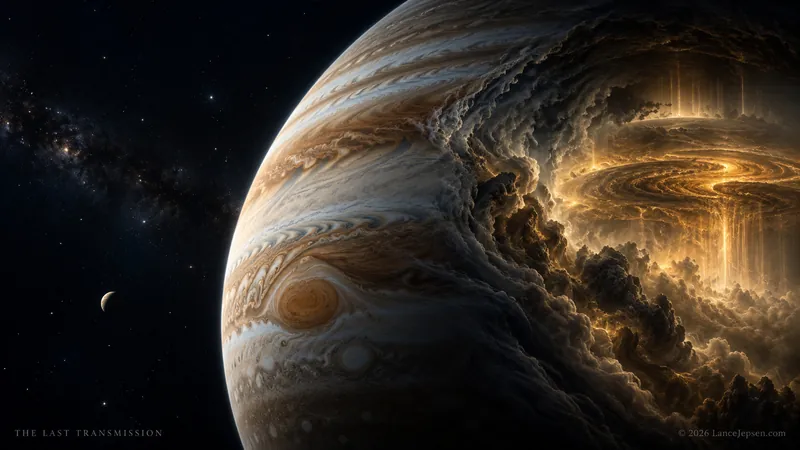
In many fitting models, material heavier than hydrogen and helium is mixed through a large inner region rather than locked in one compact boundary. One influential interpretation extended that enriched region toward nearly half of Jupiter's radius. The exact span and concentration depend on the model, the properties assumed for matter under extreme pressure, and the treatment of winds and layers. A diffuse core does not mean Jupiter has no central material. It means the transition between a heavy-element-rich interior and the surrounding envelope may be gradual.
The collision story is being tested
A 2019 simulation proposed that a sufficiently energetic, nearly head-on impact by a large planetary embryo could have disrupted an initially compact core and mixed heavy material into Jupiter's envelope. It is a possible history, not an observed event. A later simulation study reported that its own giant-impact runs did not leave a lasting dilute core and argued against that single extreme collision as the general explanation. Differences in numerical treatment and initial conditions matter. The important evidence question is whether any proposed formation route consistently produces interiors that match the measured gravity field.
Why size measurements matter too
Juno radio measurements have also refined Jupiter's size and shape, improving the boundary conditions used in planetary models. That is valuable without being a direct core measurement. The tension between gravity data and familiar pictures of gas-giant formation is what makes the interior worth studying. An answer must satisfy several constraints at once: mass distribution, composition, rotation, heat transport, and the histories that could have made them.
The question for the next model
Can one history explain Jupiter's broad heavy-element distribution without requiring a finely tuned accident? That question is sharper than asking whether a probe could simply fly through the planet. Juno can test the weight and shape of the invisible interior from outside. Simulations then have to show how such an interior could form and survive for billions of years. Those are related tasks, and neither should be mistaken for the other.
THE EASY MISREADING
Juno did not observe an ancient impact. A diffuse-core interpretation comes from fitting gravity data, and the impact is one proposed explanation for it.
PRIMARY RESEARCH & MISSION RECORDS
Check the source.
These are the studies and mission records behind this explainer. The illustrated article and Field Note continue the investigation.
EXPLORE IN 3D / MAP 02
Return the gravity data to Jupiter
Explore the giant planet and its moons, then follow Juno’s gravity measurements back into the evidence.
Open Jupiter system mapFOLLOW THE THREAD
Stay with the question.
Juno's gravity measurements favor a broad, mixed interior over the tidy central core once drawn in textbooks. Even Jupiter's familiar outline has needed a measurement.
Watch the related documentaryMORE EVIDENCE FILES
Keep looking.

EVIDENCE FILE 01 / EUROPA
How Do We Know Europa Has an Ocean?
Galileo's magnetic measurements point to a conducting layer beneath Europa's ice. A salty ocean is the leading explanation. Its chemistry and seafloor activity remain open questions.
Read the evidence
EVIDENCE FILE 02 / TITAN & PLUTO
What Is the 5.11-Micrometer Mark on Titan and Pluto?
The 5.11-micrometer absorption is measured on both worlds, but the Pluto feature is broader. A shared wavelength is a clue to investigate, not a chemical identification.
Read the evidence