
VISUAL ARCHIVE / IMAGE STORY
A Search Strategy for Mars
Ancient Martian craters can preserve clues to water and alteration.
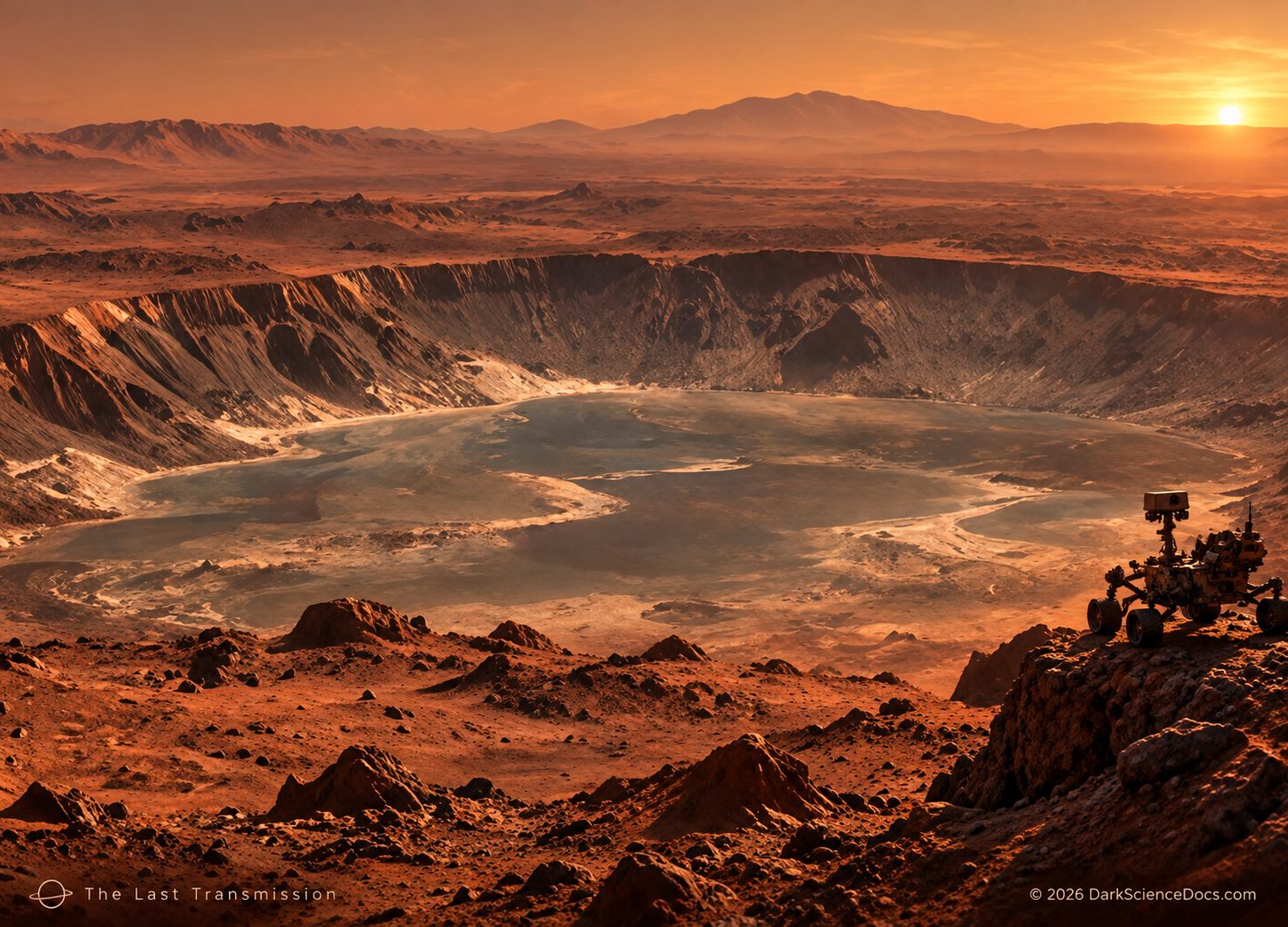
Mars contains countless ancient impact craters, many of which formed when liquid water was more common on the planet. This AI-generated visualization imagines future exploration of a crater where hydrothermal minerals and lake sediments could preserve evidence of ancient biology. The Last Transmission | © 2026 DarkScienceDocs.com
THE OBSERVATION
What we can actually see.
By analogy, investigators can look for impact-related hydrothermal minerals and lake sediments on Mars. Such targets can be scientifically promising without a detected fossil or a proven biological history.
THE ILLUSTRATION
What the artwork imagines.
The rover and possible microbial refuge are AI-generated future imagery. Hapcheon does not establish that Martian craters hosted life or that a mission has found it.
FROM THE ILLUSTRATED ARTICLE
The story that inspired it.
The Hapcheon study connects an impact structure, hydrothermal alteration, and stromatolite evidence without claiming that the impact created life. Ancient Martian craters can preserve clues to water and alteration.
Read The Crater That Learned to BreatheCHECK THE RECORD
The image interprets the research below. Follow the original work for the measurements and limits behind the scene.
Communications Earth & Environment: Hapcheon impact studyOTHER IMAGE STORIES
 The Basin After the Fire
 When an Impact Opens the Crust
 The Mark Shared by Titan and Pluto