
VISUAL ARCHIVE / IMAGE STORY
Measuring a Turning Planet
Celestial references and atomic time reveal tiny variations; the observatory is not a named facility.
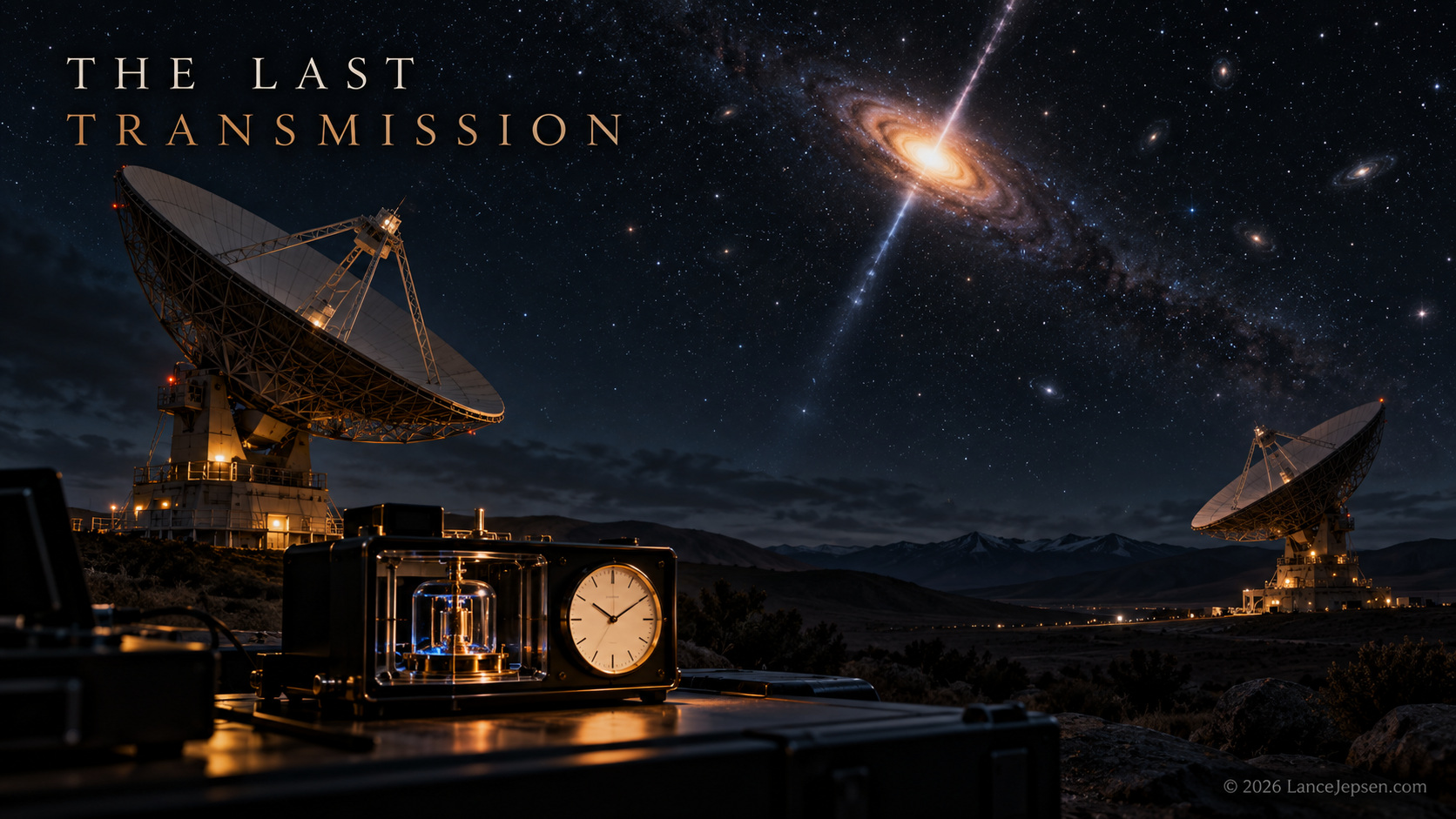
Distant celestial objects give observatories a reference for measuring Earth’s turning, while atomic time provides a steadier clock. AI-generated conceptual illustration; the observatory shown is not a specific facility.
THE OBSERVATION
What we can actually see.
Earth’s orientation can be measured against distant celestial reference sources, while atomic time provides a stable comparison. The resulting difference helps researchers detect changes in rotation that are far too small for a person to feel. These observations establish the timing pattern before a deep-Earth explanation is fitted to it.
THE ILLUSTRATION
What the artwork imagines.
The building, instruments, and visible sky are an illustrative observatory rather than a documented station. A single exposure could not directly show millisecond-scale changes accumulated across decades.
FROM THE ILLUSTRATED ARTICLE
The story that inspired it.
The article asks how scientists could know that Earth’s hidden interior is influencing the clock at all: first they must measure the clock with unusual precision.
Read The Earth Has a Hidden Hand on the ClockCHECK THE RECORD
The image interprets the research below. Follow the original work for the measurements and limits behind the scene.
U.S. Naval Observatory: UT1 and atomic timeOTHER IMAGE STORIES
 The Core’s Small Tug on the Clock
 The Clock Hidden Inside Earth
 The Mark Shared by Titan and Pluto