
VISUAL ARCHIVE / IMAGE STORY
The First Stellar Generations
The universe needed time to form its first stars. The study allows about 200 million years before the first long-lived stellar populations, an interval that must be added when using their ages to estimate cosmic age. AI-generated reconstruction of early star formation.
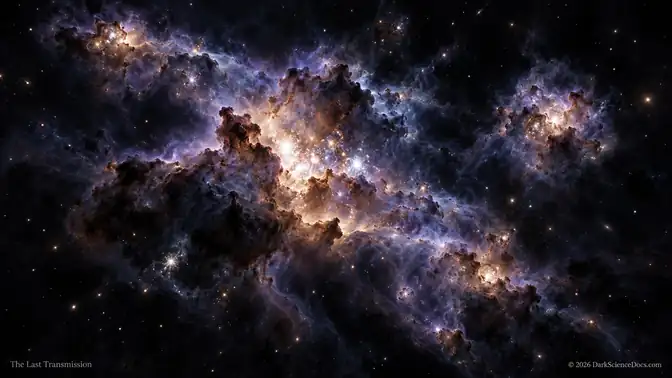
The universe needed time to form its first stars. The study allows about 200 million years before the first long-lived stellar populations, an interval that must be added when using their ages to estimate cosmic age. AI-generated reconstruction of early star formation.
THE OBSERVATION
What we can actually see.
Stellar ages are inferred from observables such as luminosity, temperature and composition using evolutionary models. Cosmological ages are also model-dependent inferences, and changing the expansion history changes the time available for stellar evolution.
THE ILLUSTRATION
What the artwork imagines.
The universe needed time to form its first stars. The study allows about 200 million years before the first long-lived stellar populations, an interval that must be added when using their ages to estimate cosmic age. AI-generated reconstruction of early star formation. The selected artwork is a conceptual reconstruction. Viewpoint, lighting and apparent detail are illustrative, not additional measurements or a confirmed photograph of the depicted event.
FROM THE ILLUSTRATED ARTICLE
The story that inspired it.
Long-lived stars offer a test of proposed changes to cosmic history. Their inferred ages must be compared with cosmological ages while accounting for model assumptions and the time before stars formed.
Read The Oldest Stars May Be Too Old for a Younger UniverseCHECK THE RECORD
The image interprets the research below. Follow the original work for the measurements and limits behind the scene.
Banik, I., Kudakolawa Kaluarachchige, T., Cookson, S. and Desmond, H. — The age of the Universe from a large sample of the oldest Galactic stars Xiang, M. and Rix, H.-W. — A time-resolved picture of our Milky Way’s early formation history Planck Collaboration — Planck 2018 results VI Cosmological parameters Riess, A. G. and colleagues — A Comprehensive Measurement of the Local Value of the Hubble ConstantOTHER IMAGE STORIES
 Ancient Stars as Cosmic Clocks
 A Spectrum Helps Estimate Stellar Age
 The Mark Shared by Titan and Pluto