
VISUAL ARCHIVE / IMAGE STORY
An Active Nucleus in a Disk Galaxy
A quiet-looking disk galaxy can conceal an actively feeding central black hole. Research strengthens the case that major galactic collisions are not required for substantial black-hole growth. Conceptual illustration, not an observed galaxy.
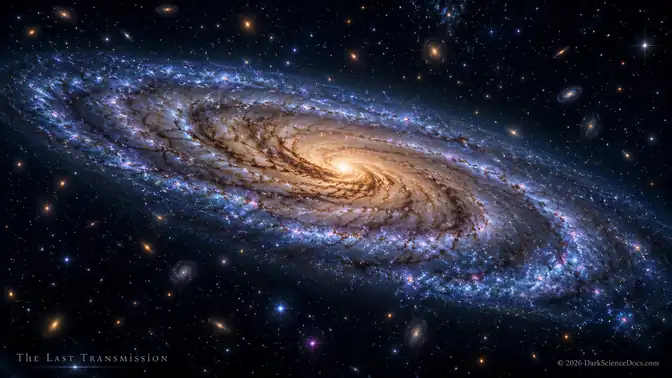
A quiet-looking disk galaxy can conceal an actively feeding central black hole. Research strengthens the case that major galactic collisions are not required for substantial black-hole growth. Conceptual illustration, not an observed galaxy.
THE OBSERVATION
What we can actually see.
The study combines imaging and spectroscopic information about active nuclei in disk-dominated hosts. Separating central nuclear light from extended stellar structure is necessary before classifying a host as lacking a detectable bulge.
THE ILLUSTRATION
What the artwork imagines.
A quiet-looking disk galaxy can conceal an actively feeding central black hole. Research strengthens the case that major galactic collisions are not required for substantial black-hole growth. Conceptual illustration, not an observed galaxy. The selected artwork is a conceptual reconstruction. Viewpoint, lighting and apparent detail are illustrative, not additional measurements or a confirmed photograph of the depicted event.
FROM THE ILLUSTRATED ARTICLE
The story that inspired it.
Active black holes in disk-dominated galaxies test how much growth requires major mergers. Host structure, spectra and sample selection matter when translating a population into a history of fueling.
Read These Black Holes May Have Grown Huge Without a Galactic CollisionCHECK THE RECORD
The image interprets the research below. Follow the original work for the measurements and limits behind the scene.
Jewell et al. (2026), “Galaxy-SMBH co-evolution in 2,435 DESI disk galaxies and merger-free BH growth in bulgeless disks” Simmons, Smethurst & Lintott (2017), “Supermassive black holes in disc-dominated galaxies outgrow their bulges and co-evolve with their host galaxies” McAlpine et al. (2020), “Galaxy mergers in EAGLE do not induce a significant amount of black hole growth yet do increase the rate of luminous AGN” DESI Data Release 1: AGN/Galaxy Classification Value-Added Catalog NASA Science: Anatomy of a Black HoleOTHER IMAGE STORIES
 Spectra Reveal an Accreting Black Hole
 A Bar Can Help Move Gas Inward
 The Mark Shared by Titan and Pluto