
05 / RESEARCH / OBSERVATION & INTERPRETATION
Black-Hole Feeding in Galaxies Without a Prominent Bulge
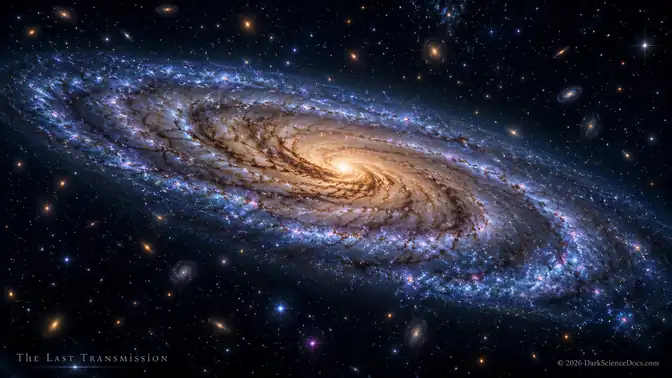
Active black holes in disk-dominated galaxies test how much growth requires major mergers. Host structure, spectra and sample selection matter when translating a population into a history of fueling.
The study combines imaging and spectroscopic information about active nuclei in disk-dominated hosts. Separating central nuclear light from extended stellar structure is necessary before classifying a host as lacking a detectable bulge. A missing prominent bulge does not establish a galaxy has never interacted or that every black hole grew through one quiet mechanism. Accretion estimates, host decomposition and the selection of active objects limit the histories that can be reconstructed.
What a missing bulge actually measures
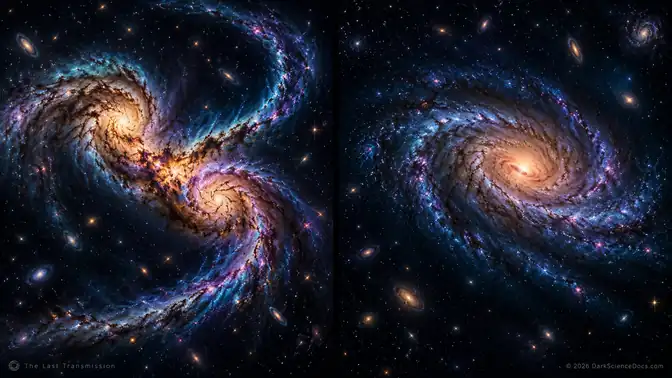
Astronomers have long known that the mass of a central black hole is related to properties of the galaxy around it. One especially influential relationship connects black-hole mass with the mass of a galaxy’s stellar bulge, the rounded concentration of stars that can rise above and below its disk. That connection helped make mergers an attractive explanation for their shared growth. A collision can rearrange stellar orbits, contribute to building a bulge, and disturb gas in ways that help feed the central black hole. Over cosmic time, the galaxy and its dark center might grow together through repeated episodes of upheaval.
A population is not a complete history
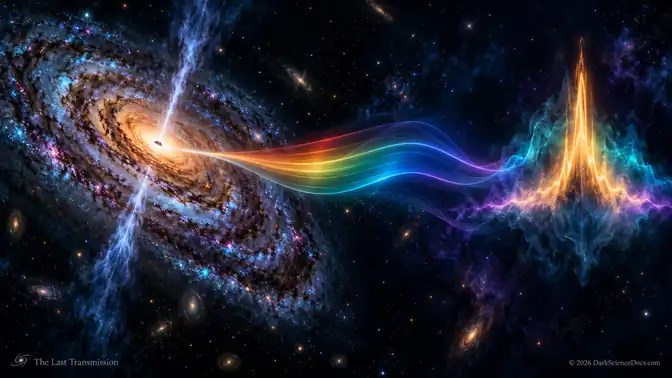
Sophie M. Jewell and colleagues assembled a sample of 2,435 disk-dominated galaxies hosting broad-line active galactic nuclei, using data from the Dark Energy Spectroscopic Instrument, or DESI. An active nucleus is powered by material feeding a central black hole. The light comes from its surroundings, where infalling matter releases energy before crossing the event horizon. In this study, the broadening of a hydrogen emission line helped the researchers estimate black-hole masses, using a model of rapidly moving gas near the center. The team also modeled the galaxies’ light distributions to distinguish their disks, central point sources, and additional structures such as bulges and bars.
Gas can lose angular momentum without a major merger
Gas cannot simply fall straight into a black hole whenever gravity pulls on it. Much of that gas is orbiting, and it must lose angular momentum to move substantially inward. A major collision can help rearrange it, but a galaxy has other ways to transfer angular momentum and redistribute material. Elongated stellar bars can exert gravitational torques on gas. Spiral structures can also help move material inward while angular momentum is transferred outward. Such processes do not guarantee that gas will travel all the way from the outer galaxy to the black hole; that journey crosses many scales and remains a difficult problem.
Read the illustrated companion article for the full narrative and its source trail. The selected passages above follow that article’s investigation.
Continue reading on SubstackTHE EVIDENCE / THE OPEN QUESTION
What we know.
The study combines imaging and spectroscopic information about active nuclei in disk-dominated hosts. Separating central nuclear light from extended stellar structure is necessary before classifying a host as lacking a detectable bulge.
What remains open.
A missing prominent bulge does not establish a galaxy has never interacted or that every black hole grew through one quiet mechanism. Accretion estimates, host decomposition and the selection of active objects limit the histories that can be reconstructed.
Why it matters.
Bars, spiral structures and less conspicuous inflow provide alternatives to a simple merger-only picture. Comparing populations can test those contributions while avoiding the claim that current morphology records every past event.
COMPARE THE QUESTIONS
Follow what the light reveals.
Follow the relevant evidence and teaching models. Each model explains a mechanism and retains its own stated assumptions and limits.
FOLLOW THE EVIDENCE
Research behind the field note.
EXPLORE IN 3D / MAP 12
Explore the related science model
Bars, spiral structures and less conspicuous inflow provide alternatives to a simple merger-only picture. Comparing populations can test those contributions while avoiding the claim that current morphology records every past event.
Open Milky Way mapVISUAL EVIDENCE
Inside the investigation.
FOLLOW THE THREAD
Related signals.
These Black Holes May Have Grown Huge Without a Galactic Collision
A study of 546 galaxies with no detected stellar bulge strengthens an unsettling possibility: some of the universe’s giants can grow through the ordinary workings of a galaxy.
The Black Hole Hid Its Light. The Neutrinos Escaped.
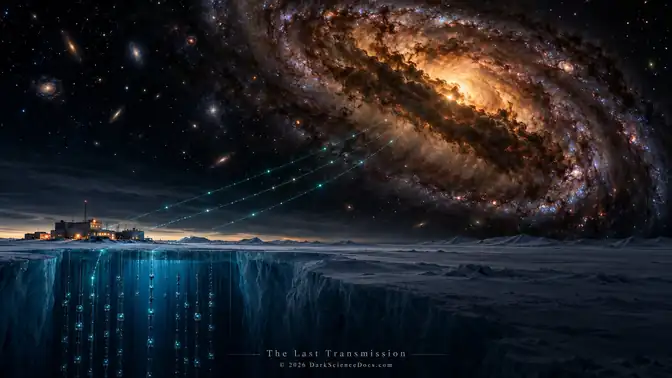
Scientists buried a telescope beneath Antarctica to catch particles from the universe’s most violent places. What they discovered is shocking.
A Signal Crossed 10 Billion Years of Darkness. We Still Don't Know What Sent It.
The James Webb Space Telescope has traced an extraordinarily powerful radio flash to a galaxy so small that Earth's largest telescopes couldn't see it.