
VISUAL ARCHIVE / IMAGE STORY
An Observatory for Invisible Particles
Deep Antarctic ice becomes an observatory when buried sensors record light from the charged products of neutrino interactions. IceCube's high-energy astronomy and its monitoring for nearby supernova bursts probe different neutrino regimes. Conceptual cutaway, not a photograph or recorded event display.
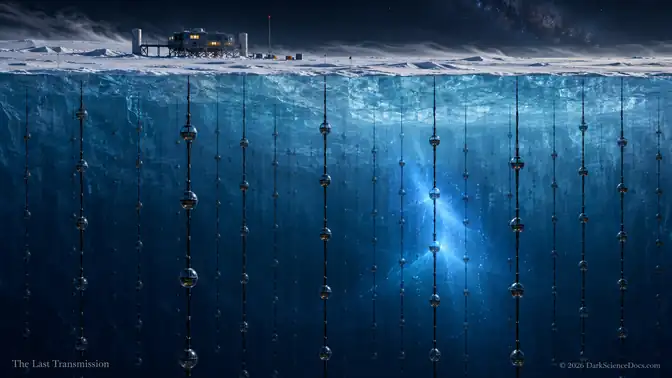
Deep Antarctic ice becomes an observatory when buried sensors record light from the charged products of neutrino interactions. IceCube's high-energy astronomy and its monitoring for nearby supernova bursts probe different neutrino regimes. Conceptual cutaway, not a photograph or recorded event display.
THE OBSERVATION
What we can actually see.
Neutrinos transport energy through a collapsing stellar core, and heating behind the shock can affect whether the shock revives. Numerical models compare how assumed flavor conversion changes that transport and the simulated outcome.
THE ILLUSTRATION
What the artwork imagines.
Deep Antarctic ice becomes an observatory when buried sensors record light from the charged products of neutrino interactions. IceCube's high-energy astronomy and its monitoring for nearby supernova bursts probe different neutrino regimes. Conceptual cutaway, not a photograph or recorded event display. The selected artwork is a conceptual reconstruction. Viewpoint, lighting and apparent detail are illustrative, not additional measurements or a confirmed photograph of the depicted event.
FROM THE ILLUSTRATED ARTICLE
The story that inspired it.
Simulations investigate how neutrino flavor conversion can alter energy transfer during core collapse. The result concerns modeled explosion conditions and remnant properties, not direct observation of every collapsing star.
Read Some Stars May Be Dying Into DarknessCHECK THE RECORD
The image interprets the research below. Follow the original work for the measurements and limits behind the scene.
https://doi.org/10.1103/pz3y-3lv5 https://arxiv.org/abs/2605.16504v3 https://www.nobelprize.org/prizes/physics/2026/press-release/ https://www.nobelprize.org/prizes/physics/2026/halzen/facts/ https://icecube.wisc.edu/science/real-time-alerts/OTHER IMAGE STORIES
 A Core Approaches Collapse
 Two Modeled Endings for a Massive Star
 The Mark Shared by Titan and Pluto