
11 / RESEARCH / OBSERVATION & INTERPRETATION
Neutrino Flavor and the Outcome of Stellar Collapse
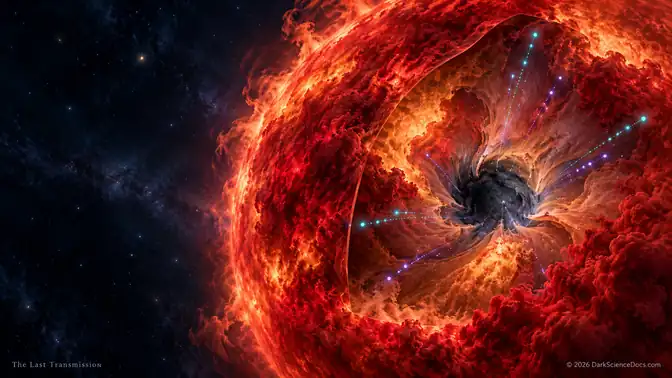
Simulations investigate how neutrino flavor conversion can alter energy transfer during core collapse. The result concerns modeled explosion conditions and remnant properties, not direct observation of every collapsing star.
Neutrinos transport energy through a collapsing stellar core, and heating behind the shock can affect whether the shock revives. Numerical models compare how assumed flavor conversion changes that transport and the simulated outcome. Flavor conversion is not a single universal switch that determines all supernovae. Stellar structure, multidimensional fluid motion and the treatment of transport influence the result; the missing-red-supergiant problem can have more than one contributor.
The stalled shock needs a source of energy
The familiar picture of a dying massive star is almost too efficient. Its core collapses, a shock races outward, and the star explodes. In that picture, the collapse seems to contain its own inevitable escape route. The actual sequence is more precarious. When an iron core can no longer support itself, it collapses until matter reaches extraordinary densities. The inner core stiffens, an outward shock forms, and the star briefly acquires the beginnings of an explosion. But the shock loses energy as it travels through the surrounding material. Breaking apart atomic nuclei costs energy, and neutrino emission carries energy away.
One set of assumptions can change the result
Gogilashvili and Tamborra simulated stars with initial masses ranging from nine to 120 times the Sun’s mass. They used a general-relativistic hydrodynamics code with an approximate treatment of turbulence and added a schematic prescription for neutrino flavor conversion. The crucial experiment was to change how far inward the conversion operated. The researchers used matter-density thresholds to stand in for the uncertain region where the flavor mixture might change. That let them ask how sensitive the explosion was to the location of the transformation. Without flavor conversion, their population-weighted fraction of failed explosions was about 27 percent. With conversion included, that fraction ranged from approximately 48 percent to 88 percent, depending on the assumed threshold.
The remnant depends on the timing
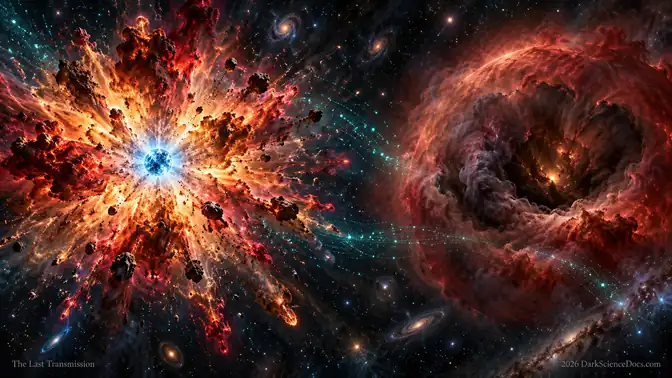
The study also found a consequence for the stars that successfully explode. If flavor conversion helps revive the shock sooner, it can cut short the flow of additional matter onto the proto-neutron star. The resulting remnant is lighter than it would have been after a longer period of accretion. After allowing for the difference between baryonic mass and gravitational mass, the researchers found better agreement with the low-mass portion of the observed neutron-star population. That offers another potential test of the role of flavor conversion: the particles may leave a statistical imprint on the masses of the objects that survive.
Read the illustrated companion article for the full narrative and its source trail. The selected passages above follow that article’s investigation.
Continue reading on SubstackTHE EVIDENCE / THE OPEN QUESTION
What we know.
Neutrinos transport energy through a collapsing stellar core, and heating behind the shock can affect whether the shock revives. Numerical models compare how assumed flavor conversion changes that transport and the simulated outcome.
What remains open.
Flavor conversion is not a single universal switch that determines all supernovae. Stellar structure, multidimensional fluid motion and the treatment of transport influence the result; the missing-red-supergiant problem can have more than one contributor.
Why it matters.
Comparing model outcomes with remnant masses, transient searches and neutrino observations gives the hypothesis multiple tests. A visualization can explain the mechanism without turning simulated branches into observed stellar destinies.
COMPARE THE QUESTIONS
Follow what the light reveals.
Follow the relevant evidence and teaching models. Each model explains a mechanism and retains its own stated assumptions and limits.
FOLLOW THE EVIDENCE
Research behind the field note.
EXPLORE IN 3D / ATLAS S-01
Explore the related science model
Comparing model outcomes with remnant masses, transient searches and neutrino observations gives the hypothesis multiple tests. A visualization can explain the mechanism without turning simulated branches into observed stellar destinies.
Explore Stellar Fates in 3DVISUAL EVIDENCE
Inside the investigation.
FOLLOW THE THREAD
Related signals.
Some Stars May Be Dying Into Darkness
Ghost particles could explain why massive stars collapse into black holes without the brilliant explosions we expect
The Black Hole Hid Its Light. The Neutrinos Escaped.
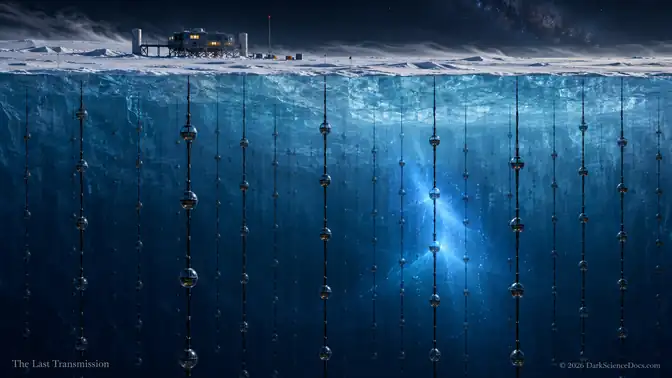
Scientists buried a telescope beneath Antarctica to catch particles from the universe’s most violent places. What they discovered is shocking.
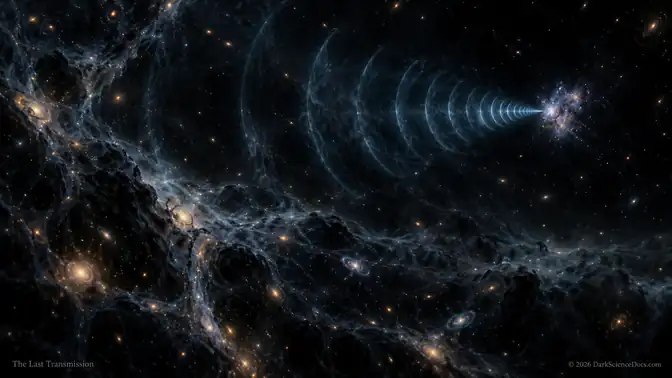
A Signal Crossed 10 Billion Years of Darkness. We Still Don't Know What Sent It.
The James Webb Space Telescope has traced an extraordinarily powerful radio flash to a galaxy so small that Earth's largest telescopes couldn't see it.