
VISUAL ARCHIVE / IMAGE STORY
Clocks Need a Rule to Agree
Clock synchronization across distance requires a chosen reference frame.
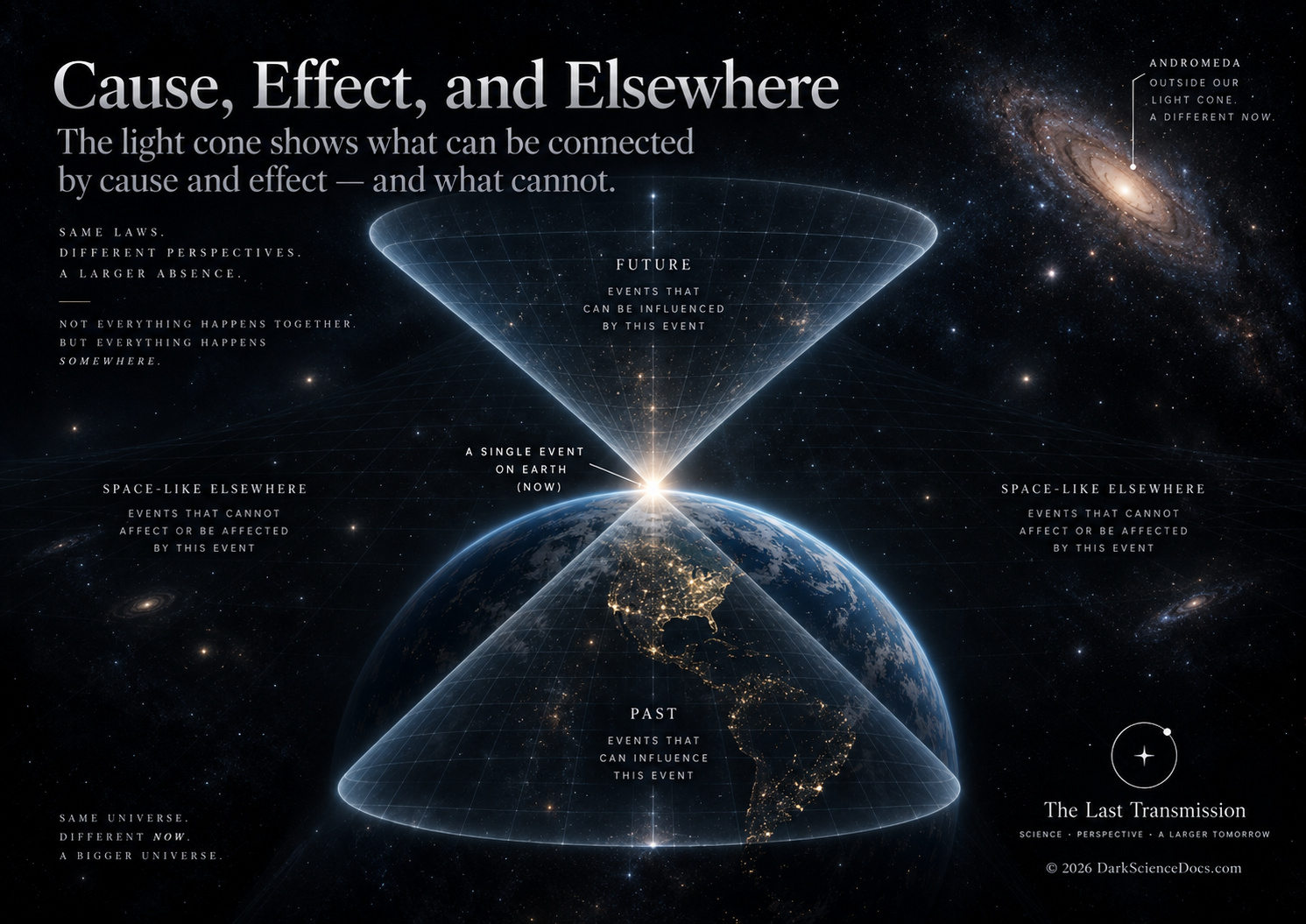
Synchronizing clocks separated by enormous distances requires a specific definition of simultaneity. Observers moving relative to those clocks can apply the same physical laws and still construct different, internally consistent relationships between the distant readings.
THE OBSERVATION
What we can actually see.
Observers can synchronize separated clocks using light signals and a stated convention within a frame. Another observer in relative motion obtains a different relation between those clock readings while using the same physical laws.
THE ILLUSTRATION
What the artwork imagines.
The visible beams and clock faces simplify a mathematical convention. They do not show a master clock whose reading every observer is forced to accept.
FROM THE ILLUSTRATED ARTICLE
The story that inspired it.
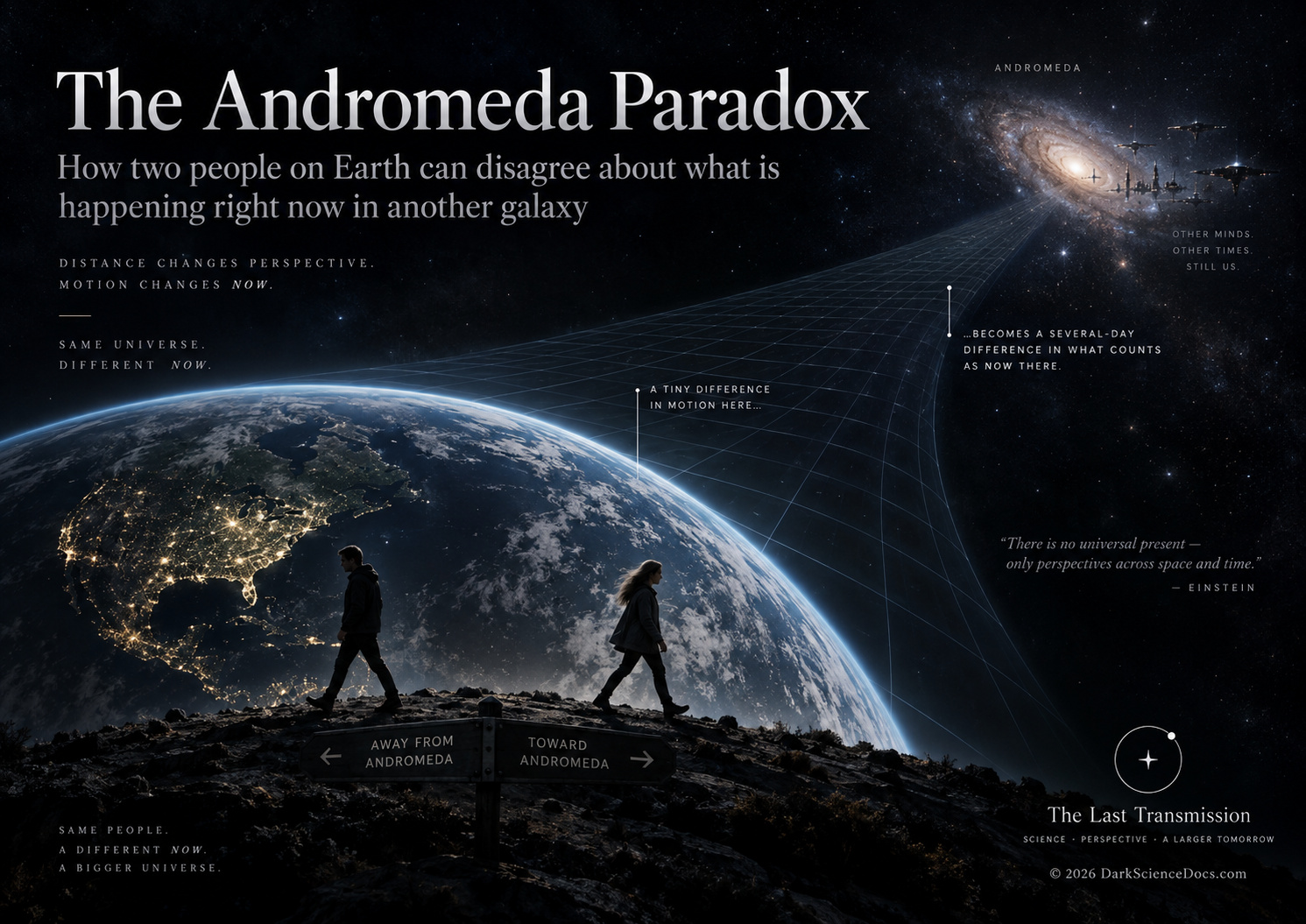
The Andromeda thought experiment distinguishes the delay of light from the relativity of assigning a distant event to a local present. Clock synchronization across distance requires a chosen reference frame.
Read There Is No Such Thing as “Right Now” Across the UniverseCHECK THE RECORD
The image interprets the research below. Follow the original work for the measurements and limits behind the scene.
Einstein Online: the relativity of the presentOTHER IMAGE STORIES
 Two Ways to Draw the Distant Present
 The Galaxy We See Is Already History
 The Mark Shared by Titan and Pluto