
VISUAL ARCHIVE / IMAGE STORY
The Tardigrade’s Limits in Space
Some tardigrades survived orbital vacuum exposure; unfiltered solar UV was much harsher.
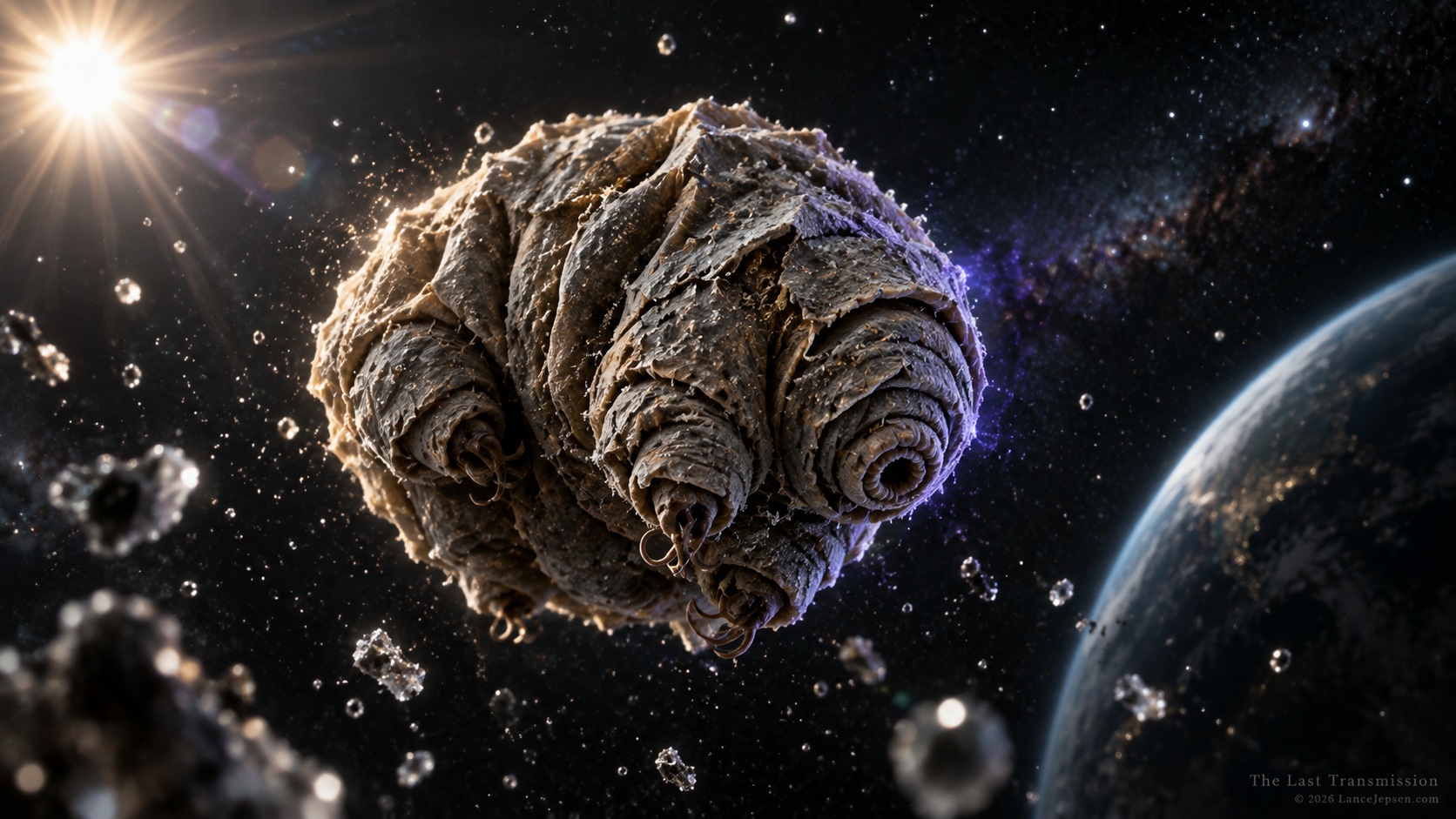
A tardigrade in its dehydrated cryptobiotic state, conceptually depicted during exposure to space. Tardigrades have survived vacuum in orbital experiments, although direct solar ultraviolet radiation proved far more destructive. AI-generated illustration for The Last Transmission.
THE OBSERVATION
What we can actually see.
An orbital experiment reported tardigrade survival in vacuum, with much poorer results when some specimens faced solar radiation. That animal experiment is separate from the later moss-spore work. Both show that survival depends on exactly what was exposed, for how long, and behind which protection.
THE ILLUSTRATION
What the artwork imagines.
The oversized, isolated tardigrade makes a microscopic test subject into a character. It is not a photograph from the FOTON-M3 mission or evidence that tardigrades live and reproduce in space.
FROM THE ILLUSTRATED ARTICLE
The story that inspired it.
The article compares famous hardy organisms with moss and asks what each experiment really establishes about endurance beyond Earth.
Read Life May Not Need a Spaceship to Cross Between WorldsCHECK THE RECORD
The image interprets the research below. Follow the original work for the measurements and limits behind the scene.
Jönsson et al., tardigrade orbital exposure Maeng et al., moss-spore exposureOTHER IMAGE STORIES
 A Spore on a Journey No One Has Seen
 A Natural Capsule Around a Spore
 The Mark Shared by Titan and Pluto