
SCIENCE COUNTDOWNS / SKYWATCHING / URSIDS
2026 Ursid Meteor Shower Countdown
A quiet northern shower closes the year
A northern-sky meteor watch after the Geminids, with strong moonlight likely to hide fainter trails in 2026.
To the start-date marker for the predicted peak night; not a local observing hour
WHAT TO FOLLOW
Patience matters more than a spectacular forecast.
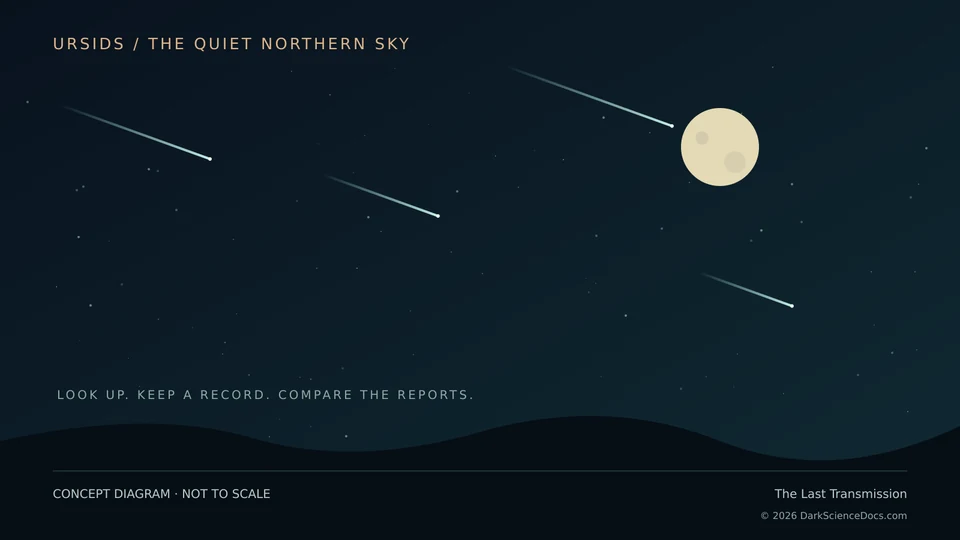
The Ursids offer a different kind of meteor watch from the usually stronger Geminids. The American Meteor Society lists a December 21–22 peak night for 2026 and warns of substantial moonlight. This is primarily a northern-hemisphere event; southern observers should not assume the same opportunity.
Plan a short, comfortable watch only if your local sky and conditions make it worthwhile. Keep direct glare out of your eyes, use a broad view and note when clouds interrupt the session. Do not treat a published ideal rate as the count you will personally see.
Returning to the event file is part of the experiment. Compare reports from different places, ask which observations had darker skies, and distinguish a low observed count from evidence that the shower itself was unusually weak.
QUESTIONS TO RETURN FOR
Keep the evidence in view.
Why might I see fewer meteors?
Moonlight, cloud and nearby lighting can hide faint streaks. Record those limits alongside the time you spend looking.
Where is this most useful?
The Ursids are mainly a northern-hemisphere shower. Check a local sky chart and forecast before planning a watch.
What should I compare afterward?
Compare observing conditions and time spent outdoors before comparing counts. Leave room for uncertainty in a short session.
CONTINUE THE INVESTIGATION
Follow the thread.
DATE & SCIENCE SOURCES
The American Meteor Society lists December 21–22 as the 2026 Ursid peak night. December 21 at 00:00 UTC is a date marker, not the predicted instant of maximum or a local appointment to go outside. This northern-hemisphere shower faces substantial moonlight interference in 2026.
Source and schedule review: . Check the mission or observing source for later changes. A clock reaching zero does not confirm an outcome.Remind me to check the outcome
Choose your calendar
Return for reports on at 9:00 a.m. in your calendar’s time zone, two days after the event day or window ends.
This is a return-for-results reminder, not the event time or an observing alarm. Check the date, time and alert before saving. Reports may take longer.
Saved reminders do not update if the schedule changes. Remove the old reminder and add a new one from this page.
Need another way?
Download the calendar file (.ics) and open it in your calendar. For Outlook on the web, choose Add calendar → Upload from file. For Google Calendar on a computer, choose Settings → Import & export → Import.
This reminder date has passed. Read the event file for the latest status.
No email signup. We don’t receive your calendar details.