
SCIENCE COUNTDOWNS / SKYWATCHING / EARTH’S OUTER SHADOW
February 2027 Penumbral Lunar Eclipse Countdown
An eclipse you might almost miss
The Moon passes through Earth’s outer shadow, offering a quieter test of what an eclipse actually looks like.
Predicted sky event; visible only where the Moon is above the horizon during the eclipse.
Until predicted greatest eclipse, approximately 23:13 UT on February 20
Remind me to check the outcome
Choose your calendar
Check for results and the latest update on at 9:00 a.m. in your calendar’s time zone, two days after the listed observing window ends.
This is one reminder with a link to this event file. Review the time and notification before saving. Updates may take longer; the reminder does not mean an outcome has been confirmed.
Saved reminders won’t change if the event is rescheduled. Remove the old reminder and add a new one from this page. Add it once; alerts depend on your calendar and device settings.
Need another way?
Download the calendar file (.ics) and open it in your calendar. For Outlook on the web, choose Add calendar → Upload from file. For Google Calendar on a computer, choose Settings → Import & export → Import.
Check that the reminder date above is still in the future before adding it.
This reminder date has passed. Read the latest status in the event file.
No email signup. We don’t receive your calendar details.
WHERE THE SCIENCE STANDS
A shadow without a red Moon.
NASA’s eclipse catalog predicts a penumbral lunar eclipse spanning February 20–21, 2027. The listed phases run from about 21:12 UT on February 20 to 01:13 UT on February 21, with greatest eclipse around 23:13 UT on February 20. These are predictions rounded to the minute.
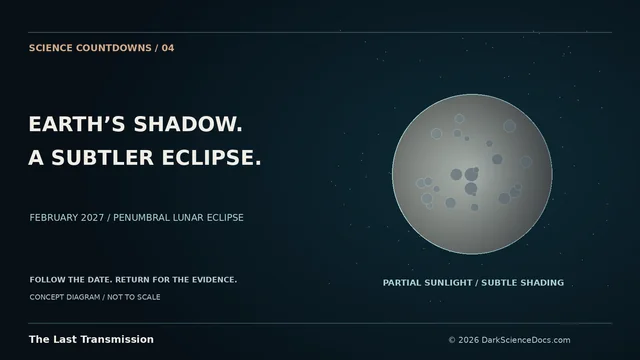
The Moon passes through Earth’s penumbra, where Earth blocks only part of the Sun. It does not enter the darker umbra during this eclipse. Expect subtle shading rather than the dramatic appearance associated with a total lunar eclipse; clouds and atmospheric conditions may make the difference difficult to notice.
Observe only from a location where the Moon is above the horizon during the relevant phases. A lunar eclipse can be viewed directly without solar-eclipse glasses. Compare images with consistent exposure before attributing every change in brightness to Earth’s shadow.
WHY THE SCIENCE MATTERS
Questions worth returning for.
Where does the shadow begin?
The penumbra is a region of partial sunlight rather than a sharply edged dark disk. Think about how much of the Sun Earth would cover as seen from different points on the Moon. That geometry helps explain why the shading can be gradual.
Can an ordinary photo show it?
Automatic exposure can brighten a dimmer scene and conceal a real difference. Conversely, clouds can produce a false one. Use comparable settings and note conditions if you want your before-and-during photographs to serve as evidence.
Why do the dates span two days?
The predicted eclipse continues past midnight in Universal Time. Your local calendar may label the phases differently. Check the time conversion and moonrise rather than assuming that every location shares the same evening or can see the whole event.
CONTINUE THE INVESTIGATION
Follow the thread.
Explore the science before the milestone, then return to compare what the evidence establishes.
DATE & SCIENCE SOURCES
NASA gives the phases in UT, to the nearest minute: February 20 at 21:12, greatest eclipse at 23:13, and ending February 21 at 01:13. The clock represents the predicted maximum at minute precision using the corresponding UTC clock reading; UT and UTC differences below a second do not justify finer precision here. The return reminder is two calendar days after the February 21 end date.
Source and schedule review: . Published precision retained where no firmer target is verified. Check the primary source for later changes; a clock reaching zero does not confirm an outcome.