
SCIENCE COUNTDOWNS / ESA / NASA / SOLAR ORBITER
Solar Orbiter Venus Flyby Countdown
A planet changes our view of a star
Solar Orbiter will borrow a gravitational turn from Venus to look at the Sun from a more revealing angle.
Planned gravity assist; ESA lists December 24 and notes that dates may change.
Until the published flyby day begins at 00:00 UTC; exact encounter time not specified here
Remind me to check the outcome
Choose your calendar
Check for results and the latest update on at 9:00 a.m. in your calendar’s time zone, two days after the listed event day.
This is one reminder with a link to this event file. Review the time and notification before saving. Updates may take longer; the reminder does not mean an outcome has been confirmed.
Saved reminders won’t change if the event is rescheduled. Remove the old reminder and add a new one from this page. Add it once; alerts depend on your calendar and device settings.
Need another way?
Download the calendar file (.ics) and open it in your calendar. For Outlook on the web, choose Add calendar → Upload from file. For Google Calendar on a computer, choose Settings → Import & export → Import.
Check that the reminder date above is still in the future before adding it.
This reminder date has passed. Read the latest status in the event file.
No email signup. We don’t receive your calendar details.
WHERE THE SCIENCE STANDS
The next change of perspective.
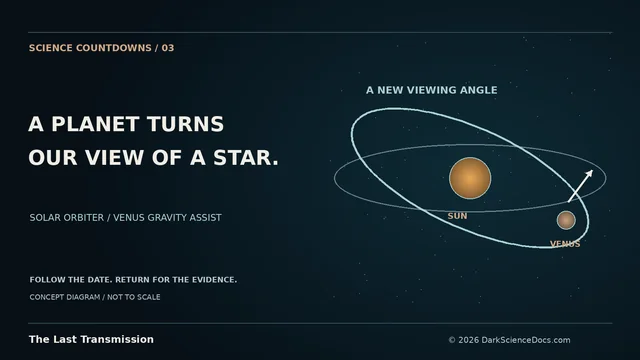
ESA schedules Solar Orbiter’s next Venus gravity assist for December 24, 2026. The encounter is designed to increase the inclination of the spacecraft’s orbit, providing a better view of the Sun’s polar regions. It follows earlier Venus flybys that have already changed the mission’s perspective.
A gravity assist changes a spacecraft’s trajectory through an encounter with a moving planet. Here, the payoff is a new viewing geometry for studying a star. The flyby itself and the later observations enabled by that orbit are separate milestones.
Sharper polar views can help researchers investigate solar magnetism and the changing solar cycle. After the encounter, look for the navigation team’s confirmation of the maneuver, then the observation record. A successful trajectory change does not promise that every scientific question will be answered immediately.
WHY THE SCIENCE MATTERS
Questions worth returning for.
Why not watch from Earth?
A viewing position determines which structures can be seen clearly and which are foreshortened or hidden. Compare a polar view with the view from near the plane of the planets before deciding whether two images are showing a physical change.
What does Venus contribute?
The planet’s gravity redirects the spacecraft relative to the Sun. Check the planned and reconstructed orbit rather than interpreting the encounter as an engine that supplies unlimited energy. A gravity assist is an exchange governed by the motion of the planet.
What counts as a confirmed result?
A flight-dynamics report can establish that the intended trajectory was achieved. The images and analyses that follow answer different questions. Keep those stages separate when reading a headline about a successful flyby or a new view of the poles.
CONTINUE THE INVESTIGATION
Follow the thread.
Explore the science before the milestone, then return to compare what the evidence establishes.
DATE & SCIENCE SOURCES
ESA’s encounter table lists December 24, 2026, and marks dates as subject to change. No exact flyby time is used here. The clock marks 00:00 UTC at the start of the published day; it is not an appointment for closest approach. Follow ESA for the operational confirmation and any revised schedule.
Source and schedule review: . Published precision retained where no firmer target is verified. Check the primary source for later changes; a clock reaching zero does not confirm an outcome.