
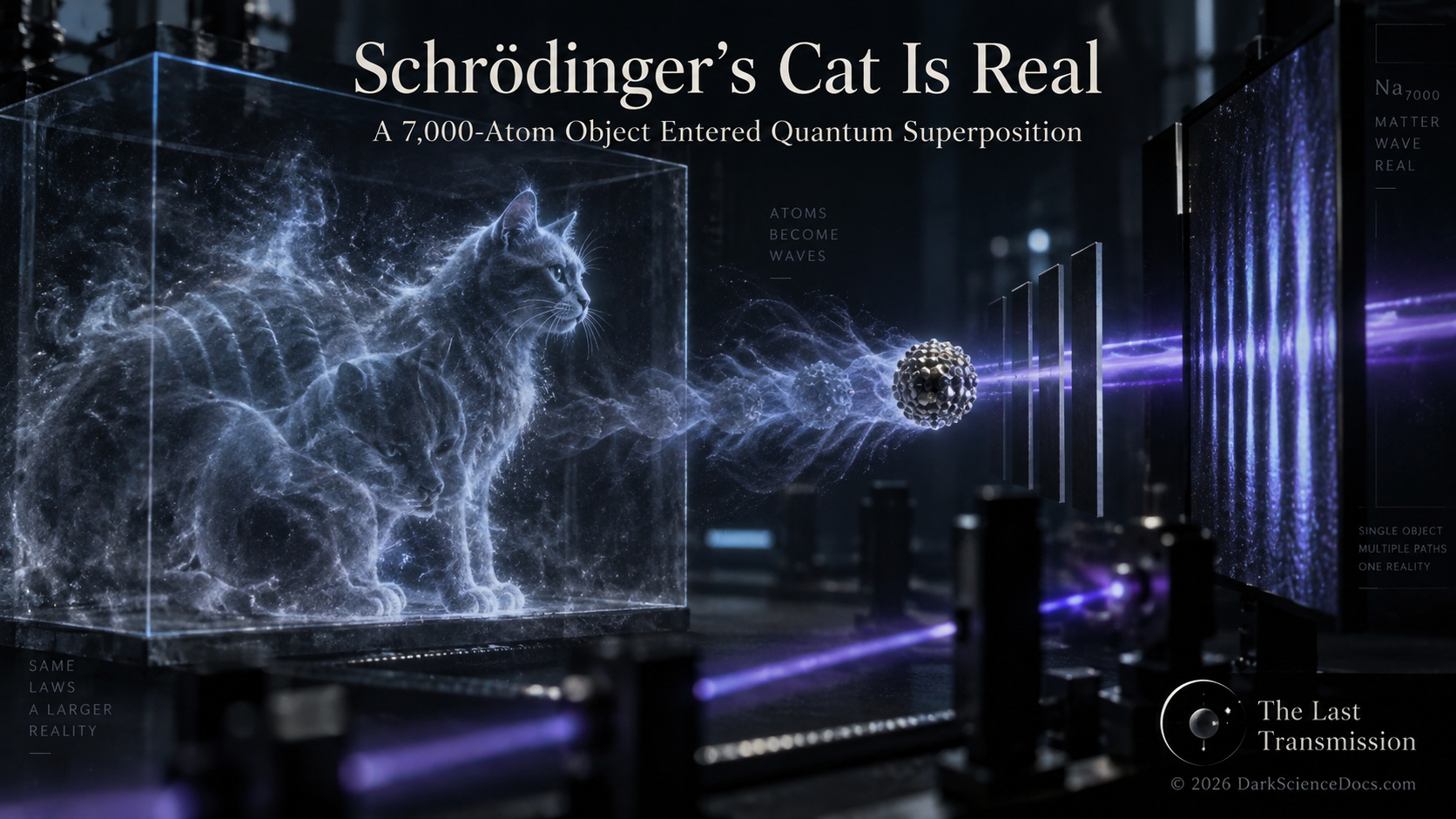
EVIDENCE FILE 09 / QUANTUM MATTER
How Do We Know 7,000 Atoms Interfered?
A striped detector pattern can have a classical cause. What makes this sodium-cluster experiment a test of a matter wave?
All Evidence FilesTHE SHORT ANSWER
The researchers sent sodium clusters through an interferometer, scanned a final grating, and counted transmitted particles to obtain fringe patterns. They then varied the laser power at a central grating and compared how the fringe visibility changed with quantum and classical predictions. For the tested clusters around 172,000 daltons, the measured dependence followed the quantum model and separated from the classical alternative. Larger clusters also produced fringes, but at those settings the team says their apparatus cannot distinguish quantum from classical predictions.
THE EVIDENCE MAP / QUANTUM MATTER
A fringe pattern with a rival explanation
The experiment succeeds because changing the central laser power makes quantum and classical predictions diverge for the measured cluster range.
- 01Measurement
Sodium-cluster counts oscillate
Scanning the final grating records periodic particle counts for clusters containing more than 7,000 atoms, with visibility measured across central-grating laser powers.
- 02Interpretation
Matter waves fit the contrast
For roughly 172-kilodalton clusters the power-dependent visibility follows the quantum prediction for coherent matter-wave propagation through the interferometer.
- 03Competing explanation
A classical shadow can stripe
Gratings and optical forces can create moiré-like patterns from classical trajectories; a stripe by itself is insufficient, and larger-cluster fringes here do not discriminate the models.
- 04Open test
Slow the heavier particles
Reducing cluster speed could restore a measurable difference between quantum and classical power-response curves in the megadalton range, while better controls limit environmental decoherence.
OBSERVATION / INFERENCE / LIMIT
Read the signal.
More than 7,000 atoms
Sodium clusters in the discriminating mass range exceeded 170,000 daltons.
Fringe visibility
Counts oscillated as the final grating was moved across the beam.
Laser-power response
Contrast varied differently from a classical shadow prediction.
INSIDE THE EVIDENCE
The chain of reasoning.
Each step has a different level of certainty. Follow the measured result into the explanation, then see where the trail ends.
A pattern is where the test begins
The apparatus forms a beam of sodium clusters and sends it through three gratings. By shifting the final grating and counting which clusters pass, researchers see a repeating pattern. At a mean mass around 172 kilodaltons they report fringes with visibility near a tenth in representative scans. That is a measurement of counts as a function of grating position, not an image of one cluster in two places. On its own, such a pattern could have a non-quantum explanation.
The classical rival
A sequence of gratings can create a moiré shadow pattern from particles following ordinary trajectories. Optical dipole forces at the central grating can further act like tiny lenses. The paper therefore models both classical motion and quantum matter-wave propagation using the measured distribution of cluster masses and velocities. Merely showing stripes would not establish the wave nature of the beam. The authors vary the central laser power, which changes the predicted contrast in ways that can separate the two descriptions.
What distinguished the models
Across the tested laser powers for the roughly 172-kilodalton clusters, the reported fringe visibility tracks the quantum curve and is clearly separated from the classical curve after the same experimental scaling is applied to both. The model includes grating interactions and effects that wash out contrast, such as misalignment, vibrations, gas collisions, and thermal radiation. This comparison makes the measurement more informative than a dramatic account of a giant Schrödinger cat. It tests a specific predicted response of the instrument.
A heavier fringe with a weaker claim
The team also observed high-visibility fringes from heavier clusters between roughly 400 kilodaltons and one megadalton. At those masses and beam speeds, however, the de Broglie wavelength is too short for this instrument to tell the quantum and classical predictions apart. The paper explicitly separates the impressive appearance of those fringes from a decisive interference demonstration in that heavier range. It also does not test a living animal or discover a fixed mass at which quantum behavior stops.
The next experiment
The authors calculate that slowing more massive clusters to about 25 meters per second could make the models diverge again in the megadalton range. A future test would repeat the power-dependent contrast comparison there, while measuring the beam's size, speed, and susceptibility to environmental decoherence. Each success constrains some proposed modifications of quantum mechanics; it cannot establish that no modification exists at any scale. The point of increasing mass is to keep the rival predictions experimentally distinguishable.
THE EASY MISREADING
Fringes alone are not proof of quantum interference. The decisive comparison uses their dependence on grating power, and the heavier-cluster fringes in this apparatus do not yet make that distinction.
PRIMARY RESEARCH & MISSION RECORDS
Check the source.
These are the studies and mission records behind this explainer. The illustrated article and Field Note continue the investigation.
EXPLORE IN 3D / ATLAS I-07
Build the scanned 7,000-atom signal
Explore three standing-light gratings and watch synthetic counts accumulate as G3 moves, then return to the evidence that separates quantum fringes from classical moiré.
Explore Matter-Wave Interferometer in 3DFOLLOW THE THREAD
Stay with the question.
A sodium cluster containing more than 7,000 atoms produced matter-wave interference. The result pushes a controlled quantum test toward greater mass without settling where the classical world begins.
Watch the related documentaryMORE EVIDENCE FILES
Keep looking.

EVIDENCE FILE 01 / EUROPA
How Do We Know Europa Has an Ocean?
Galileo's magnetic measurements point to a conducting layer beneath Europa's ice. A salty ocean is the leading explanation. Its chemistry and seafloor activity remain open questions.
Read the evidence
EVIDENCE FILE 02 / TITAN & PLUTO
What Is the 5.11-Micrometer Mark on Titan and Pluto?
The 5.11-micrometer absorption is measured on both worlds, but the Pluto feature is broader. A shared wavelength is a clue to investigate, not a chemical identification.
Read the evidence