EVIDENCE FILE 01 / EUROPA
How Do We Know Europa Has an Ocean?
A spacecraft never entered Europa's water. What evidence lets scientists infer a sea beneath the ice, and what does it say about life?
All Evidence FilesTHE SHORT ANSWER
The strongest clue is a magnetic response. As Europa moves through Jupiter's changing magnetic environment, Galileo measured a field consistent with electrical currents induced inside the moon. A conductive, global layer of salty water beneath the ice explains that behavior. The spacecraft did not photograph the water, sample it, or detect life.
THE EVIDENCE MAP / EUROPA
The magnetic clue beneath Europa’s ice
A spacecraft measures a field. The ocean is an inference. The next flybys can separate the moon’s response from its magnetic surroundings.
- 01Measurement
Galileo detects a changing field
Its magnetometer recorded a magnetic response near Europa as the moon passed through Jupiter’s changing field.
- 02Interpretation
A conductor answers back
A changing field can drive currents in a global, salty liquid layer. Those currents generate a secondary field: strong evidence for an ocean beneath the ice.
- 03Competing explanation
Plasma can bend the signal
Charged particles around Europa and its ionosphere also affect local magnetic readings. Their contribution must be separated before the interior response is pinned down.
- 04Open test
Measure field and plasma together
Europa Clipper’s magnetometer and plasma instrument can compare many flybys, isolate the induced response, and constrain the conducting layer. They cannot detect life from this signal.
OBSERVATION / INFERENCE / LIMIT
Read the signal.
Magnetic response
Galileo recorded changes in the field near Europa during flybys.
Conductive layer
A global salty ocean beneath the ice fits the magnetic observations.
Seafloor stress
A recent rock-mechanics model finds little present-day fault slip.
INSIDE THE EVIDENCE
The chain of reasoning.
Each step has a different level of certainty. Follow the measured result into the explanation, then see where the trail ends.
A moon answering Jupiter
Jupiter's magnetic field changes around Europa. In a conductor, a changing magnetic field can drive electrical currents; those currents create a secondary field. Galileo's magnetometer saw behavior that scientists interpret as this kind of induction. Water carrying dissolved salts is a plausible conductor, and Europa's icy exterior makes a subsurface ocean the leading explanation. This is a chain of inference from a spacecraft measurement, rather than a picture of an open sea. The distinction matters because it tells us both why confidence is high and what the instrument could not tell us.
The ice adds context, not a census of life
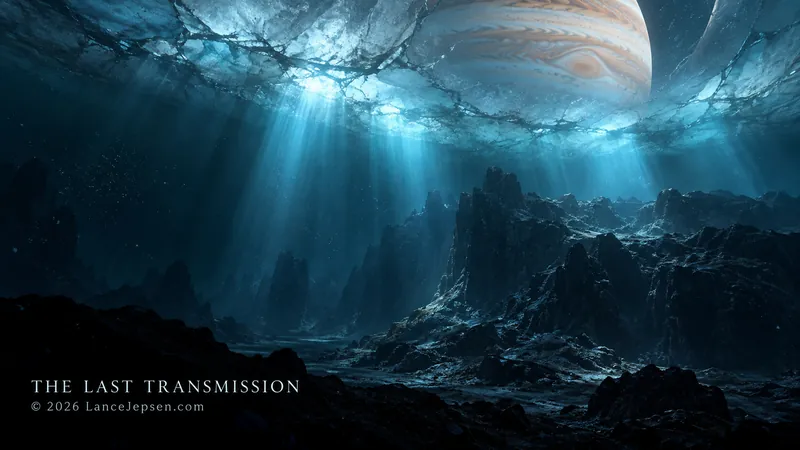
Europa's fractured surface and evidence of geologic reshaping make the ocean story more compelling, yet the ice does not reveal the composition of the water below. Surface material is exposed to intense radiation from Jupiter. Even if ocean-derived compounds reach the surface, they can be changed along the way. A photograph of a reddish crack cannot establish whether the ocean contains usable chemical energy, whether seawater reaches fresh rock, or whether organisms have ever existed there. Those are separate questions that require different measurements.
The quieter seafloor hypothesis
A 2026 modeling study tested whether tides, cooling, mantle convection, and water-driven alteration could move faults in Europa's rocky seafloor today. Under the authors' assumptions, none was likely to produce frequent slip on favorably oriented fractures. That result complicates a familiar Earth analogy: on our planet, fracturing can expose rock to water and help maintain chemical gradients. The study did not observe Europa's ocean floor. It also did not establish that every possible source of chemical energy is absent; the authors discuss shallower flow and other mechanisms that still need examination.
Three different thresholds
An ocean is one threshold. A habitable environment is another. A detection of life would be a third. The first has strong indirect support. The second depends on energy, nutrients, exchange between rock and water, and conditions over time. The third would require evidence we do not possess. Keeping those thresholds separate protects the most exciting part of this investigation: Europa is a real target where better instruments can change the answer, and where an absence of one favored process would not settle the whole case.
What would sharpen the picture
Europa Clipper is designed to investigate the ice shell, composition, interior, and potential habitability through repeated flybys. Measurements of magnetic and plasma conditions, radar sounding, and surface chemistry can constrain the thickness and nature of the conducting layer and look for signs of exchange. They cannot, by themselves, turn a modeled seafloor into an observed one. The eventual test of seafloor ecology would demand far more direct access than any current Europa spacecraft can provide.
THE EASY MISREADING
A quiet seafloor model is not a detection of a sterile ocean. Likewise, an inferred ocean is not a detection of organisms.
PRIMARY RESEARCH & MISSION RECORDS
Check the source.
These are the studies and mission records behind this explainer. The illustrated article and Field Note continue the investigation.
EXPLORE IN 3D / MAP 02
Place Europa’s signal in its system
Explore Europa among Jupiter’s moons, then compare the map’s ocean file with the measured magnetic response.
Open Jupiter system mapFOLLOW THE THREAD
Stay with the question.
Europa has an ocean under its frozen exterior. What that ocean contains, and whether its chemistry can sustain life, are questions still waiting for direct evidence.
Watch the related documentaryMORE EVIDENCE FILES
Keep looking.

EVIDENCE FILE 02 / TITAN & PLUTO
What Is the 5.11-Micrometer Mark on Titan and Pluto?
The 5.11-micrometer absorption is measured on both worlds, but the Pluto feature is broader. A shared wavelength is a clue to investigate, not a chemical identification.
Read the evidence
EVIDENCE FILE 03 / JUPITER
How Can Juno Detect a Core It Cannot See?
Juno measures Jupiter's gravity. Interior models that fit those measurements favor heavy elements spread through a broad region, while the origin of that distribution is disputed.
Read the evidence