
30 / A heavier quantum wave
The Nanoparticle That Interfered With Itself
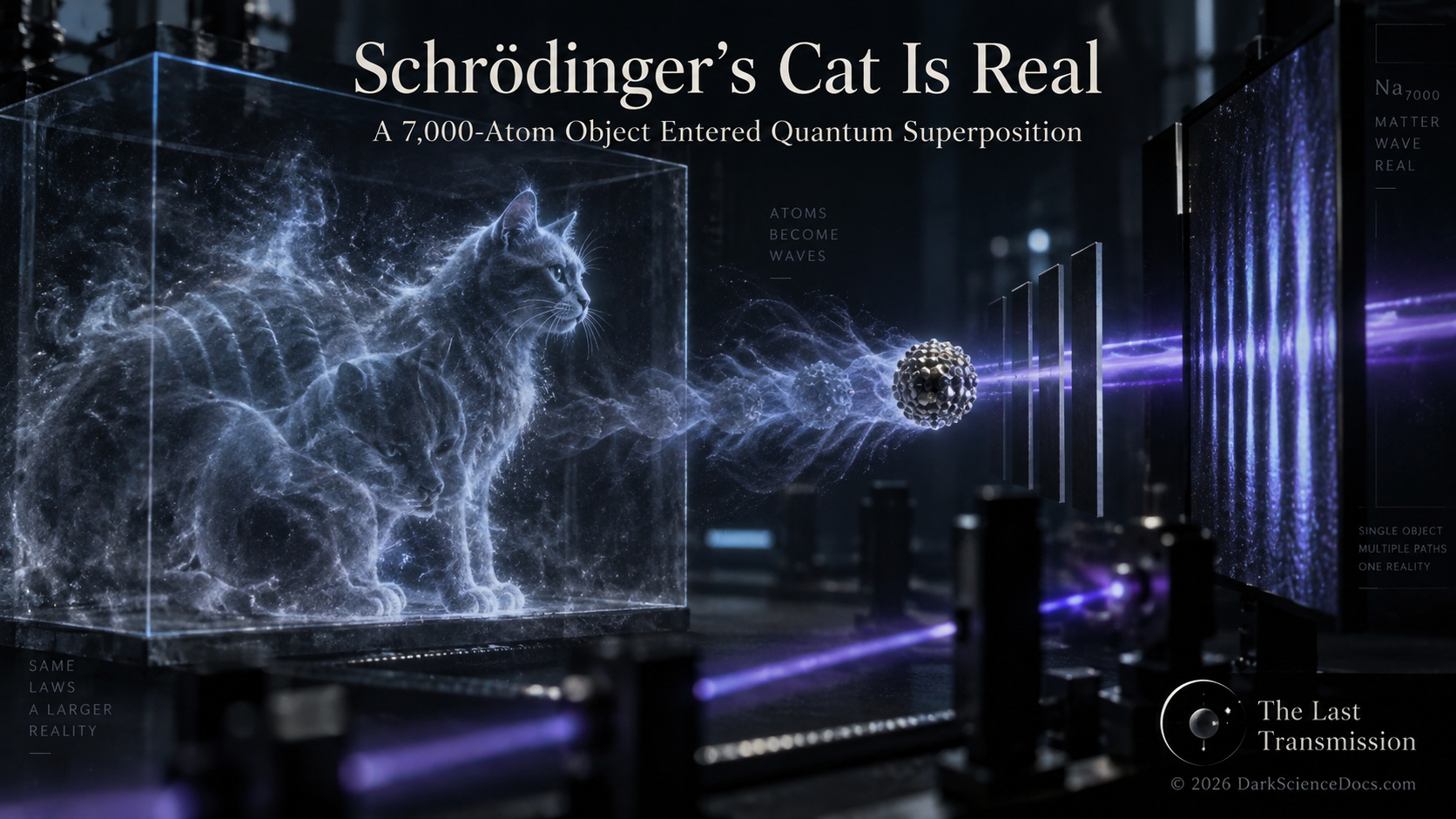
A sodium cluster containing more than 7,000 atoms produced matter-wave interference. The result pushes a controlled quantum test toward greater mass without settling where the classical world begins.
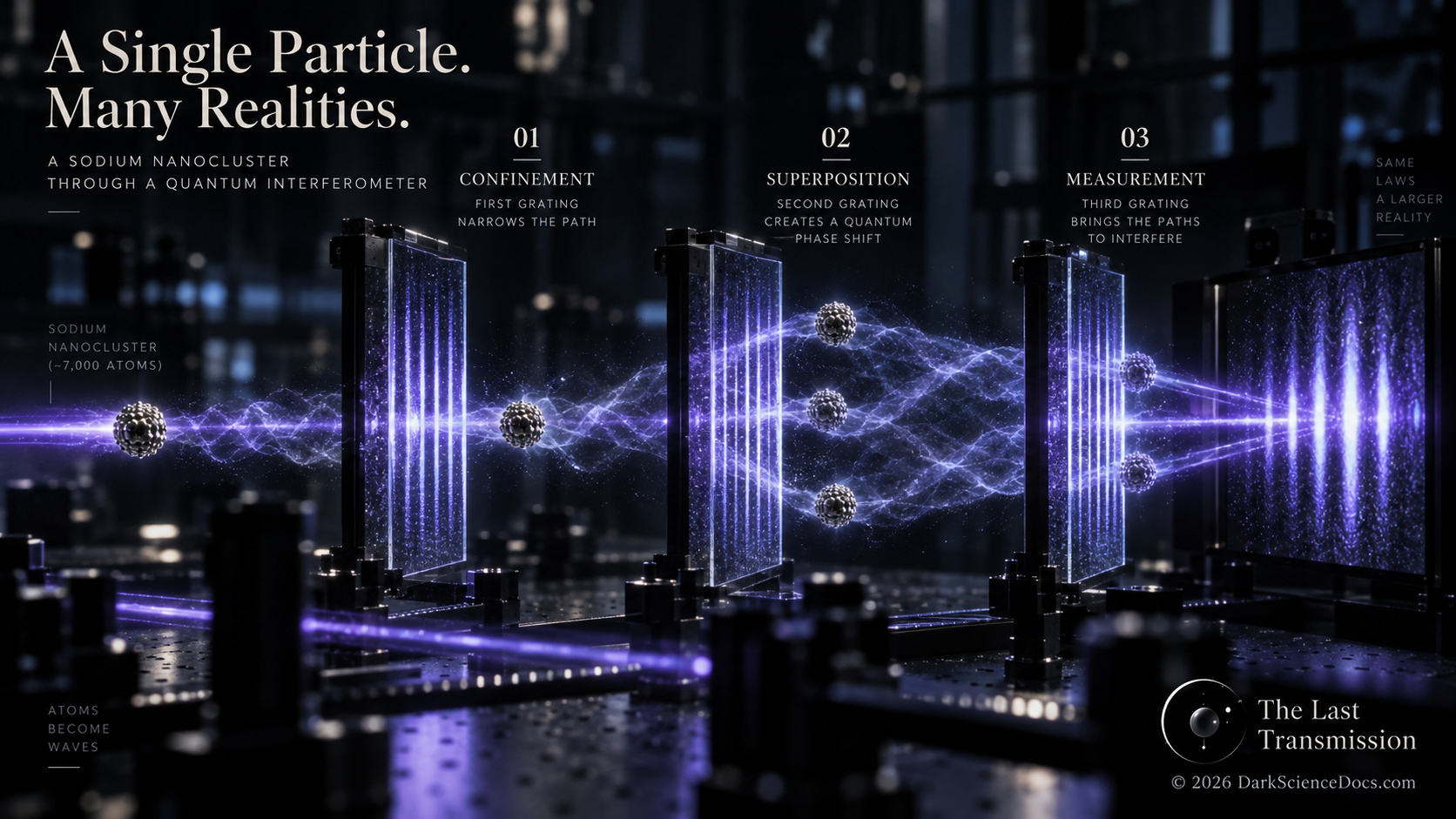
The word 'cat' gives this experiment a theatrical shape, but the instrument measured something more exact. Nanoparticles passed through an interferometer designed so their possible paths could contribute to a fringe pattern. The pattern is evidence for coherence in the motion of individual massive clusters, not evidence that a living organism occupied two visible places. Increasing the mass makes the test harder because collisions and other environmental interactions can erase the delicate relationship between alternatives.
The full investigation continues with the evidence, illustrations, and sources at The Last Transmission on Substack.
Continue reading on SubstackTHE EVIDENCE / THE OPEN QUESTION
What we know.
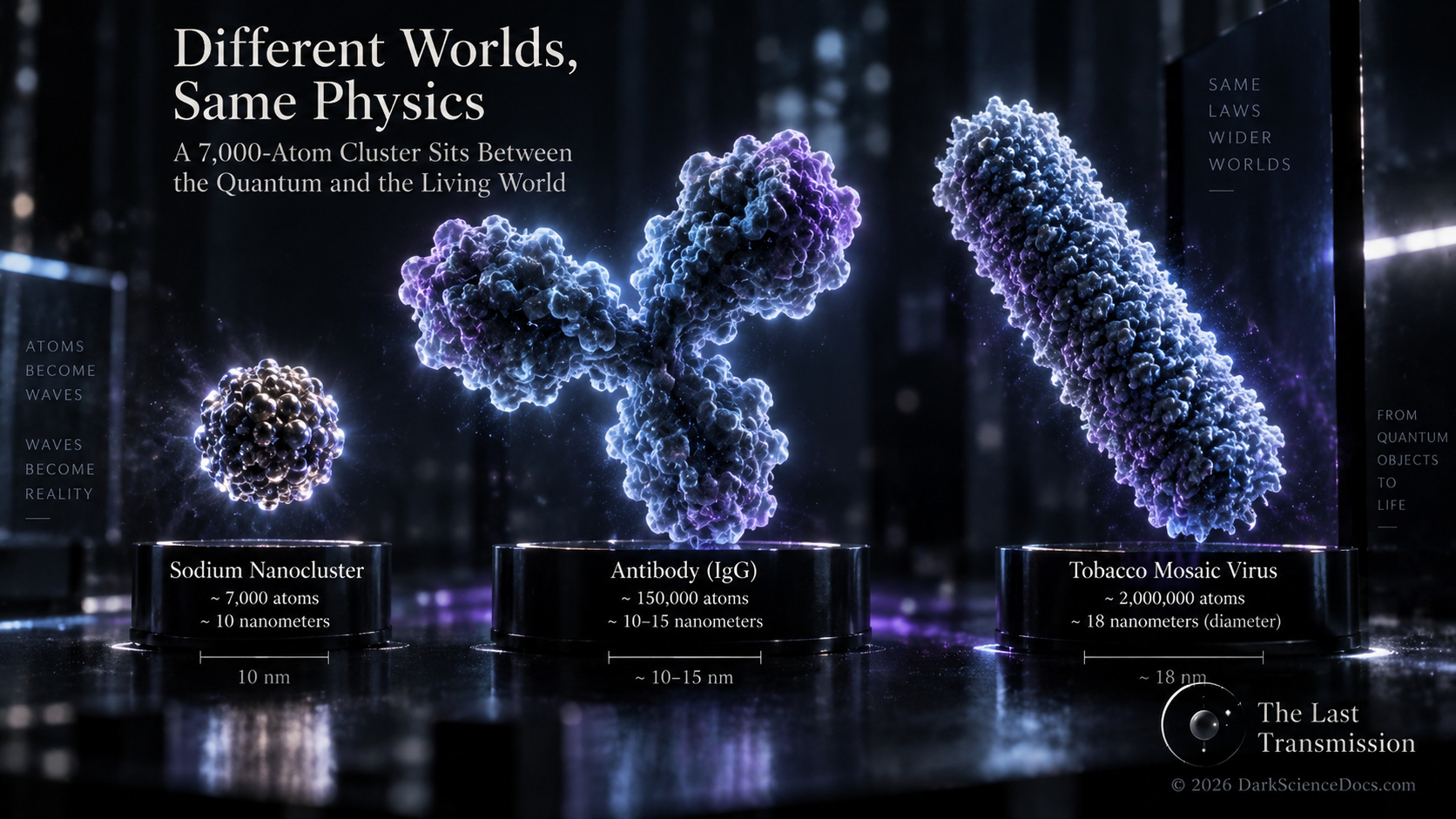
The published experiment reports interference from sodium nanoparticles with masses above 170,000 daltons and more than 7,000 atoms per cluster. Its matter-wave result extends a family of tests that began with much smaller particles.
What remains open.
No experiment has located a final size where quantum mechanics ceases to work. One larger cluster does not prove that all macroscopic objects can be held in the same state, and the observed fringe pattern is not an image of a particle physically split in half.
Why it matters.
The boundary between quantum and familiar behavior becomes a question for apparatus and evidence rather than a slogan about tiny things. Each increase in complexity gives competing ideas about that boundary another measurable target.
GO DEEPER / EVIDENCE FILE
How Do We Know 7,000 Atoms Interfered?
The measured fringe contrast changes with grating laser power as the quantum model predicts. A stripe alone would not distinguish wave interference from a classical shadow.
FOLLOW THE EVIDENCE
Research behind the field note.
EXPLORE IN 3D / ATLAS I-07
Enter the matter-wave interferometer
See the light gratings and let individual illustrative transmitted counts build a fringe signal. The scan is a teaching model, not a replay of measured events.
Explore Matter-Wave Interferometer in 3DWATCH THE RELATED DOCUMENTARY
The story in motion.
VISUAL EVIDENCE
Inside the investigation.
FOLLOW THE THREAD
Related signals.
A Star Blinked Twice. Whatever Caused It May Be Much Closer to Earth.
Two nearly identical optical disturbances, 4.4 seconds apart, appeared in HD 89389’s light. Follow the unexplained record, a foreground diffraction hypothesis, and the synchronized telescopes proposed to test it.
What If the Universe Is Accelerating Because Stars Die?
For nearly three decades, scientists have struggled to identify the mysterious force accelerating the expansion of the universe. Now a radical theory suggests the answer.
A Star Died 6.5 Billion Years Ago. Its Explosion Is About to Arrive Again.
NASA is watching for a supernova we have already seen. When that light finally reaches Earth, it could help answer one of the most troubling questions in modern cosmology.