
EVIDENCE FILE 27 / GRAVITATIONAL LENSING
How can the same stellar explosion arrive at different times?
How can the same stellar explosion arrive at different times?
All Evidence FilesTHE SHORT ANSWER
A gravitational lens produces multiple images whose light follows different paths through the gravitational field. Relative arrival times can constrain a lens and cosmic distances when combined with a mass model.
THE EVIDENCE MAP / GRAVITATIONAL LENSING
How can the same stellar explosion arrive at different times?
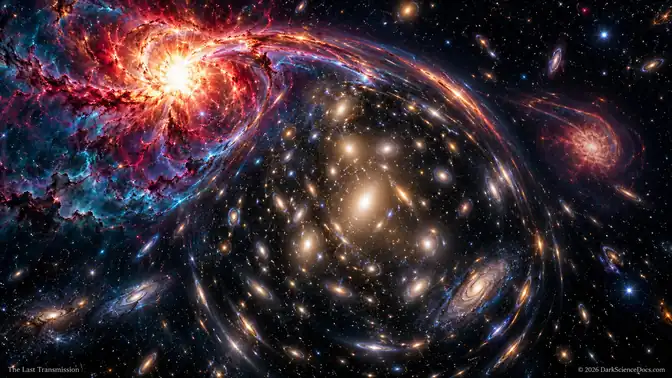
A foreground cluster can send the light of one supernova toward Earth along several routes. Comparing their arrival times turns a repeated appearance into a test of the lens and cosmic distances.
- 01Measurement
Identify one event in several images
Strong gravitational lensing can produce multiple images with different arrival times. NASA’s September 2026 report describes Athena monitoring and a predicted return window extending to early March 2027. That published forecast is a model prediction, not a confirmed arrival date or a reported second detection.
- 02Interpretation
Explain the unequal travel times
The article follows supernova Athena behind MACS J0417. Webb detected an image of the explosion in 2025. Monitoring other images of its host galaxy offers a way to look for the same event after a gravitational time delay. This is one explosion viewed along different light paths, rather than a star exploding repeatedly.
- 03Competing explanation
Combine timing with the mass distribution
The delay depends on the cluster’s mass distribution, the source geometry and the distance model. The observing window and brightness are uncertain. Timing alone does not remove all lens-model degeneracies or settle the disagreement between expansion-rate measurements.
- 04Open test
Connect the observation to Light Lab
Repeated observations can compare a forecast with arriving light. Light Lab lets visitors explore the underlying principle with an explicitly simplified lens; its interactive example does not calculate Athena’s actual arrival time.
OBSERVATION / INFERENCE / LIMIT
Read the signal.
One supernova
Multiple appearances can represent the same physical explosion.
MACS J0417
The galaxy cluster supplies the gravitational lens in the Athena observations.
Relative arrival time
A measured delay must be interpreted together with a lens model.
INSIDE THE EVIDENCE
The chain of reasoning.
Each step has a different level of certainty. Follow the measured result into the explanation, then see where the trail ends.
Identify one event in several images
A massive foreground cluster changes the paths by which light from a background galaxy reaches an observer. Several images can therefore correspond to the same galaxy, and a supernova within it can appear in more than one place. Establishing that connection requires interpreting the image configuration and comparing observations. A bright point appearing at another location is not automatically a second image of the same explosion. The proposed identification must fit the host galaxy and the lens geometry.
Explain the unequal travel times
Light traveling through a gravitational lens acquires relative delays from both the geometry of its route and propagation through the gravitational potential. A longer-looking line in a drawing is therefore an incomplete explanation of the observed timing. Different images can carry light emitted during the same stage of the explosion but received at different observing dates. This does not require light to change its local vacuum speed or the source to undergo a second stellar death.
Treat a forecast as a testable statement
NASA’s September 2026 account describes monitoring Athena after its discovery in Webb data and gives a predicted reappearance window extending to early March 2027. A window expresses uncertainty and observing expectations; it is not a guaranteed appointment. The durable scientific question is whether subsequent observations agree with the predicted ordering, timing and properties of the images. This page records that forecast as a dated source statement and does not claim that a further appearance has already been detected.
Combine timing with the mass distribution
The cluster contains galaxies, diffuse matter and dark matter, all contributing to its gravitational effect. Reconstructing that distribution from lensed images is an inference with uncertainties and possible degeneracies. A measured delay can help test the reconstruction and constrain a cosmological distance combination, but the result depends on the model used. Additional images, source information and independent observations help evaluate whether different mass distributions could account for similar image configurations while predicting different delays.
Connect the observation to Light Lab
The gravitational-lensing experiment demonstrates the relationship between mass placement, image geometry and relative arrival times within a stated teaching model. Moving its lenses illustrates why several appearances are possible and why their delays need not match. Real Athena analysis requires a detailed cluster reconstruction and astronomical data that the lab does not contain. Use the interactive supernova button to explore the principle, then return to the research record to see how a forecast is tested with telescope observations.
THE EASY MISREADING
The star does not explode again. The lab’s delay is a teaching calculation, and an astronomical forecast is not a confirmed observation.
PRIMARY RESEARCH & MISSION RECORDS
Check the source.
These are the studies and mission records behind this explainer. The illustrated article and related research pages continue the investigation.
FOLLOW THE THREAD
Stay with the question.
A foreground cluster can send the light of one supernova toward Earth along several routes. Comparing their arrival times turns a repeated appearance into a test of the lens and cosmic distances.
MORE EVIDENCE FILES
Keep looking.

EVIDENCE FILE 01 / EUROPA
How Do We Know Europa Has an Ocean?
Galileo's magnetic measurements point to a conducting layer beneath Europa's ice. A salty ocean is the leading explanation. Its chemistry and seafloor activity remain open questions.
Read the evidence
EVIDENCE FILE 02 / TITAN & PLUTO
What Is the 5.11-Micrometer Mark on Titan and Pluto?
The 5.11-micrometer absorption is measured on both worlds, but the Pluto feature is broader. A shared wavelength is a clue to investigate, not a chemical identification.
Read the evidence