
06 / Gravitational lensing / supernova Athena
One Explosion, Several Arrivals
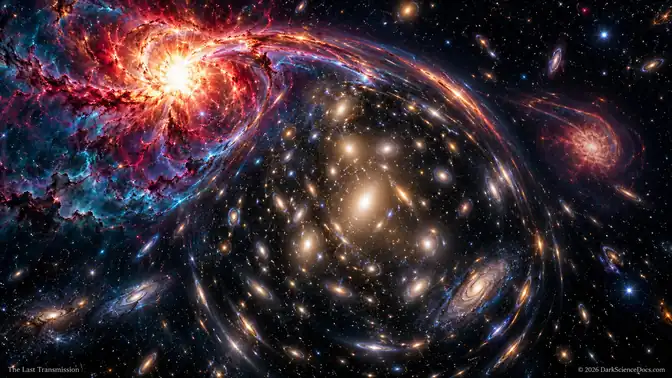
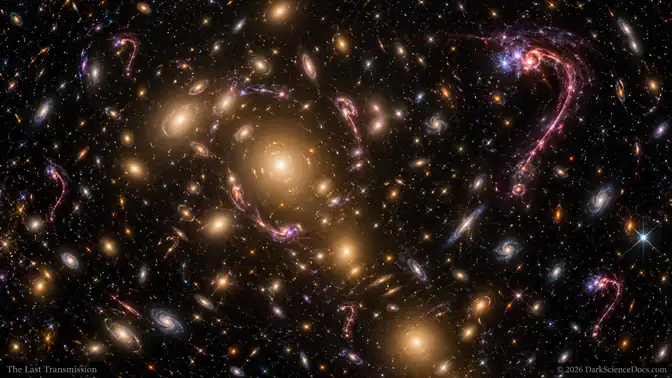
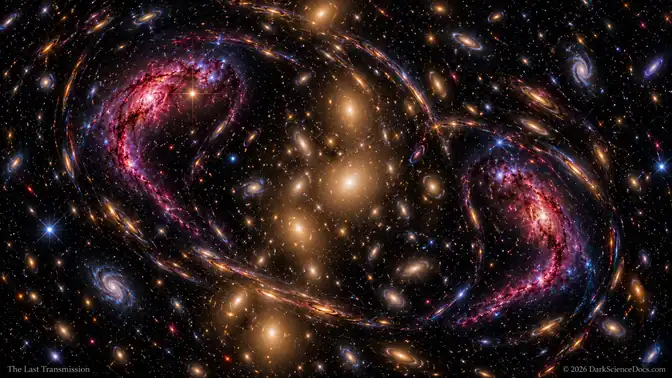
A foreground cluster can send the light of one supernova toward Earth along several routes. Comparing their arrival times turns a repeated appearance into a test of the lens and cosmic distances.
The article follows supernova Athena behind MACS J0417. Webb detected an image of the explosion in 2025. Monitoring other images of its host galaxy offers a way to look for the same event after a gravitational time delay. This is one explosion viewed along different light paths, rather than a star exploding repeatedly.
The full investigation continues with the evidence, illustrations, and sources at The Last Transmission on Substack.
Continue reading on SubstackTHE EVIDENCE / THE OPEN QUESTION
What we know.
Strong gravitational lensing can produce multiple images with different arrival times. NASA’s September 2026 report describes Athena monitoring and a predicted return window extending to early March 2027. That published forecast is a model prediction, not a confirmed arrival date or a reported second detection.
What remains open.
The delay depends on the cluster’s mass distribution, the source geometry and the distance model. The observing window and brightness are uncertain. Timing alone does not remove all lens-model degeneracies or settle the disagreement between expansion-rate measurements.
Why it matters.
Repeated observations can compare a forecast with arriving light. Light Lab lets visitors explore the underlying principle with an explicitly simplified lens; its interactive example does not calculate Athena’s actual arrival time.
GO DEEPER / EVIDENCE FILE
How can the same stellar explosion arrive at different times?
A foreground cluster can send the light of one supernova toward Earth along several routes. Comparing their arrival times turns a repeated appearance into a test of the lens and cosmic distances.
COMPARE THE QUESTIONS
Follow what the light reveals.
These related routes explain different phenomena. They do not establish a common cause for the optical pulses.
FOLLOW THE EVIDENCE
Research behind the field note.
VISUAL EVIDENCE
Inside the investigation.
FOLLOW THE THREAD
Related signals.
A Star Blinked Twice. Whatever Caused It May Be Much Closer to Earth.
Two nearly identical optical disturbances, 4.4 seconds apart, appeared in HD 89389’s light. Follow the unexplained record, a foreground diffraction hypothesis, and the synchronized telescopes proposed to test it.
What If the Universe Is Accelerating Because Stars Die?
For nearly three decades, scientists have struggled to identify the mysterious force accelerating the expansion of the universe. Now a radical theory suggests the answer.
The Black Hole That Couldn’t Stop the Stars
An enormous black hole is blasting energy into the Phoenix Cluster, yet its central galaxy is producing stars at an extraordinary rate.