
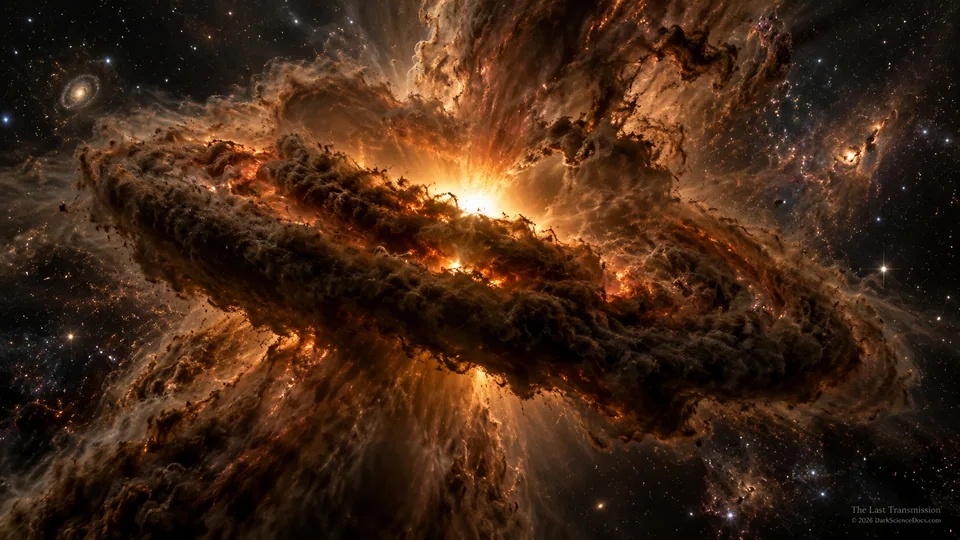
EVIDENCE FILE 23 / A REHEATING REMNANT
How Do Astronomers Measure a Star Hidden by Its Own Dust?
What can a carbon-rich wind reveal when the central star is obscured?
All Evidence FilesTHE SHORT ANSWER
Spectral features from a carbon-rich wind, interpreted with atmosphere models, support a reheating [WC]-type central star. The dust and surrounding ejecta complicate the measurement, and the inferred temperature depends on the model rather than a direct photograph of the stellar surface.
THE EVIDENCE MAP / A REHEATING REMNANT
What can a carbon-rich wind reveal when the central star is obscured?
Trace Sakurai’s spectral features through expanding-atmosphere models into a reheating inference, keeping low-mass stellar evolution separate from a massive-star explosion.
- 01Measurement
Record spectra and the surrounding ejecta
Optical line measurements, infrared dust emission and millimeter molecular observations sample different parts of the system. Their observing dates and resolutions remain part of the record.
- 02Interpretation
Fit a carbon-rich wind and central-star atmosphere
An expanding-atmosphere model connects the line pattern to a low-mass [WC]-type remnant. The temperature estimate follows from that model fit rather than direct imaging.
- 03Competing explanation
Test geometry and atmospheric assumptions
Obscuration, distance and wind physics can affect the inferred properties. A companion proposed to explain the geometry is not thereby a detected star.
- 04Open test
Compare later observations with the predicted change
Continued spectroscopy can test the direction and rate of reheating. Agreement across wind, dust and molecular data would strengthen a single evolutionary interpretation.
OBSERVATION / INFERENCE / LIMIT
Read the signal.
2023 optical spectra
The study published in 2026 analyzes a particular observing record; publication and observing dates are different.
About 30,500 K
The favored atmosphere temperature is an inferred fit with uncertainties, not an exact surface thermometer reading.
Low-mass [WC] remnant
The bracketed central-star classification differs from a massive Wolf–Rayet star and does not establish a supernova resurrection.
INSIDE THE EVIDENCE
The chain of reasoning.
Each step has a different level of certainty. Follow the measured result into the explanation, then see where the trail ends.
A late thermal pulse changes the observable star
An evolved low-mass star can undergo a very late helium-shell thermal pulse after its earlier giant stage. The renewed episode of burning can drive expansion, cooling and expulsion of carbon-rich material, creating the unusual born-again evolution associated with Sakurai’s Object. This physical history must be specified before interpreting the phrase came back from the dead. It is a late evolutionary change in a surviving remnant, not evidence that a star destroyed by a supernova has returned as the same intact object.
Dust changes which evidence reaches the telescope
Carbon-rich ejecta can block direct visible light from the central source while reradiating energy and revealing other structures at infrared or millimeter wavelengths. An observer therefore sees different components of the system depending on the instrument. The obscured star, expanding dust and molecular flows cannot be collapsed into one temperature or one image. Comparisons across those data constrain a geometry, but do not turn an artistic equatorial ring and hourglass into a directly measured three-dimensional colored scene.
The wind leaves a spectroscopic fingerprint
The 2026 study analyzes optical spectra obtained in 2023 and identifies features consistent with a carbon-rich [WC]-type wind. Expanding-atmosphere calculations connect those features with plausible physical conditions of the central star and outflow. The classification belongs to a low-mass central star of a planetary-nebula system, despite its resemblance to terminology for massive Wolf–Rayet stars. The observed line pattern and its modeled explanation are distinct steps that should both remain visible in the inference.
Temperature is estimated through a model fit
The favored atmospheric model gives a temperature near 30,500 kelvin, within a range of acceptable interpretations. Wind properties, distance, luminosity and the treatment of the normalized spectrum influence what can be inferred. The result can be compared with the pace of reheating predicted by stellar-evolution calculations, with some rapid scenarios challenged by the fitted temperature. That comparison tests the model clock without making the estimated temperature exact or pretending that a telescope directly resolved the hidden surface.
The next spectrum tests the evolutionary trajectory
A changing spectral pattern can reveal whether the system continues along the proposed reheating path and whether its wind develops as expected. Further observations of dust and molecular material can test whether one geometry accommodates the different data. A companion invoked to shape the outflow remains a hypothesis until supported by appropriate evidence. Repeated measurements are especially valuable here because they can confront a predicted change within a human observing program, rather than relying only on comparisons among different stars.
THE EASY MISREADING
Born again describes a late helium-shell pulse in an evolved low-mass remnant. It does not mean a supernova-destroyed star has returned or that an unseen companion is confirmed.
PRIMARY RESEARCH & MISSION RECORDS
Check the source.
These are the studies and mission records behind this explainer. The illustrated article and related research pages continue the investigation.
EXPLORE IN 3D / ATLAS S-01
Compare stellar evolutionary pathways
Explore a teaching model of stellar stages and remnants. It is not a fitted simulation of this particular star or the unidentified isotope source.
Explore Stellar Fates in 3DFOLLOW THE THREAD
Stay with the question.
Continue through the original Field Note, the complete illustrated article and the relevant explorer. Each route keeps the measurement distinct from the artistic reconstruction.
MORE EVIDENCE FILES
Keep looking.
EVIDENCE FILE 19 / CORTICAL GRAFTS
What Did Human Cortical Grafts in Mice Actually Demonstrate?
Separate the developmental model, the cortical-volume denominator, neural integration and the limited behavioral inference in a human-organoid mouse experiment.
Read the evidence
EVIDENCE FILE 20 / INTERSTELLAR ISOTOPES
How Can Plutonium and Missing Curium Date a Galactic Event?
Follow plutonium detection, a curium limit, unequal radioactive decay and crust uptake into a qualified age constraint for an unidentified r-process source.
Read the evidence