
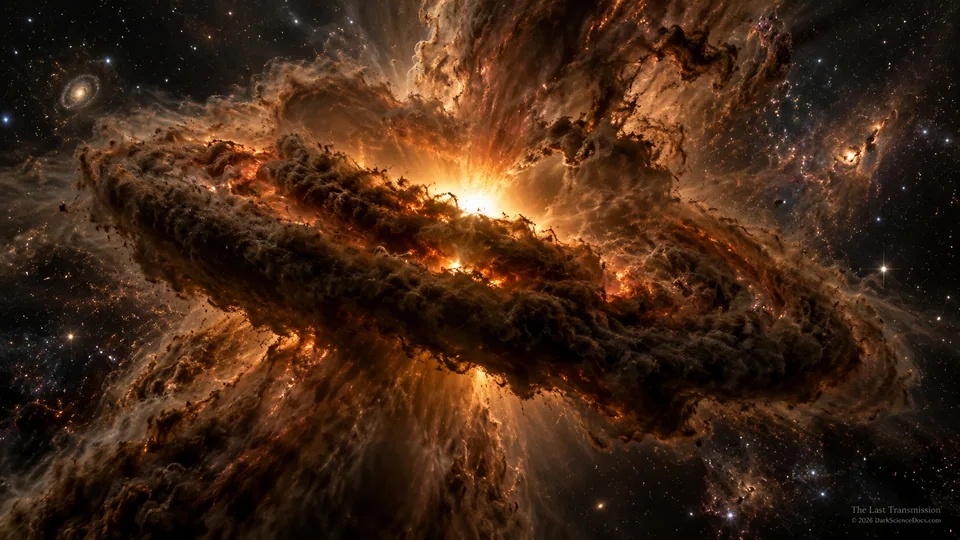
14 / Sakurai’s Object / evolution in real time
A Buried Star Reheats Behind Its Own Dust
Sakurai’s Object returned briefly to a swollen giant-like state after a late helium-shell pulse. A identified carbon-rich wind now offers evidence that the obscured remnant is moving into another stage of evolution.
The phrase born-again star describes a particular stellar history rather than a reversal of every kind of stellar ending. An evolved low-mass remnant can undergo a very late helium-shell thermal pulse, expand and cool, and surround itself with expelled carbon-rich material. That dust then makes the central star difficult to observe directly. Researchers have to combine the light that escapes, molecular observations and atmosphere calculations to reconstruct the changing engine. Spectral features in a wind can become a more useful diagnostic than the apparent brightness of the hidden star.
The full investigation continues with the evidence, illustrations, and sources at The Last Transmission on Substack.
Continue reading on SubstackTHE EVIDENCE / THE OPEN QUESTION
What we know.
The 2026 study models optical spectra taken in 2023 and identifies a carbon-rich [WC]-type central-star wind. Its favored atmosphere model has a temperature near 30,500 kelvin, with a range reflecting the analysis. Earlier infrared and millimeter observations constrain surrounding dust and molecular outflows. These observations make different parts of the evolution accessible on human observing timescales.
What remains open.
The bracketed [WC] classification belongs to a low-mass central star and must not be confused with a massive Wolf–Rayet star. Distance, luminosity, geometry and atmosphere assumptions affect the reconstruction. A companion proposed to shape the ejecta is not automatically a detected companion. The outflow illustration cannot supply missing orbital or three-dimensional measurements.
Why it matters.
A rapid transition provides an unusually direct test of stellar-evolution calculations. Continued spectroscopy can check whether temperature, wind composition and surrounding emission change together as the models predict. The value of the story lies in observing an uncertain transformation while its next measurable stage is still approaching.
GO DEEPER / EVIDENCE FILE
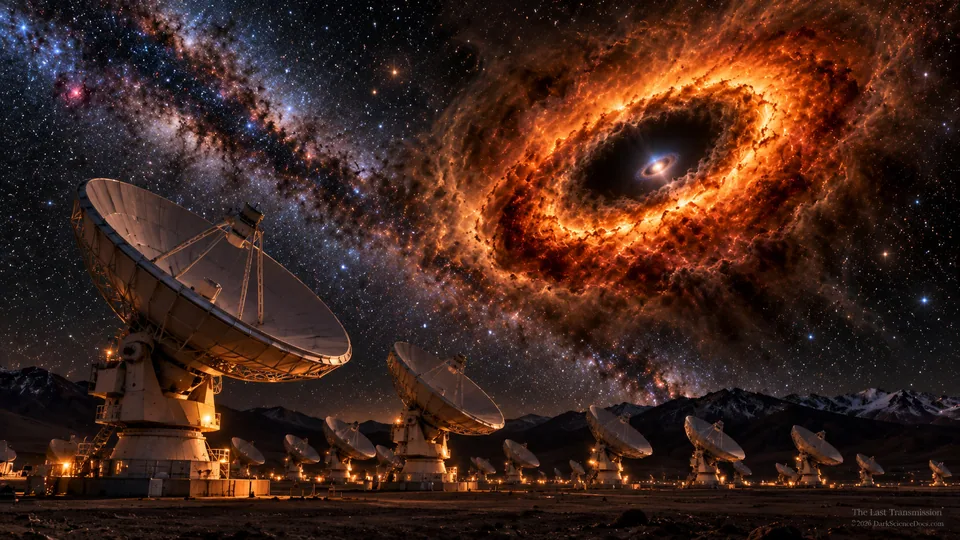
How Do Astronomers Measure a Star Hidden by Its Own Dust?
Trace Sakurai’s spectral features through expanding-atmosphere models into a reheating inference, keeping low-mass stellar evolution separate from a massive-star explosion.
FOLLOW THE EVIDENCE
Research behind the field note.
EXPLORE IN 3D / ATLAS S-01
Compare stellar evolutionary pathways
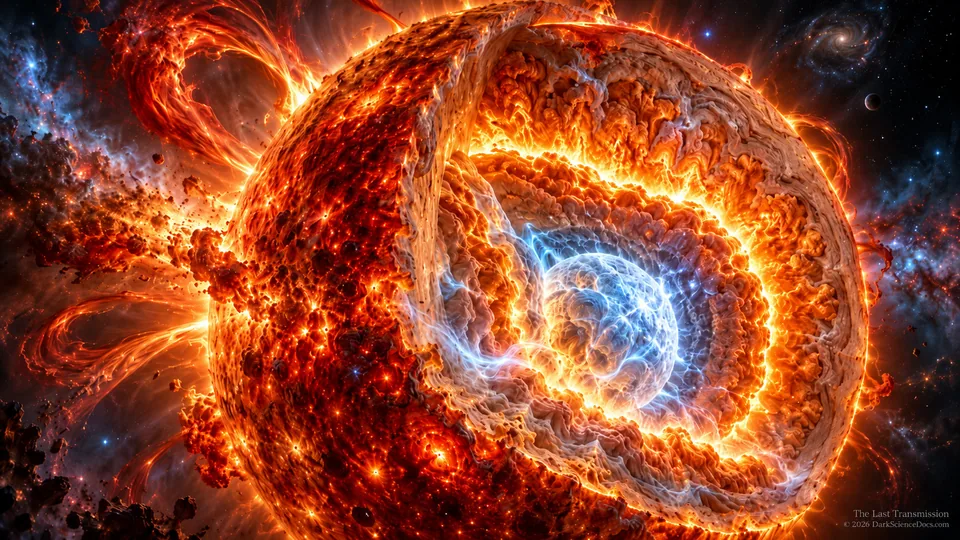
Explore a teaching model of stellar stages and remnants. It is not a fitted simulation of this particular star or the unidentified isotope source.
Explore Stellar Fates in 3DVISUAL EVIDENCE
Inside the investigation.
FOLLOW THE THREAD
Related signals.
A Star Blinked Twice. Whatever Caused It May Be Much Closer to Earth.
Two nearly identical optical disturbances, 4.4 seconds apart, appeared in HD 89389’s light. Follow the unexplained record, a foreground diffraction hypothesis, and the synchronized telescopes proposed to test it.
What If the Universe Is Accelerating Because Stars Die?
For nearly three decades, scientists have struggled to identify the mysterious force accelerating the expansion of the universe. Now a radical theory suggests the answer.
A Star Died 6.5 Billion Years Ago. Its Explosion Is About to Arrive Again.
NASA is watching for a supernova we have already seen. When that light finally reaches Earth, it could help answer one of the most troubling questions in modern cosmology.