THE LAST TRANSMISSION / A LIFE WRITTEN IN MASS

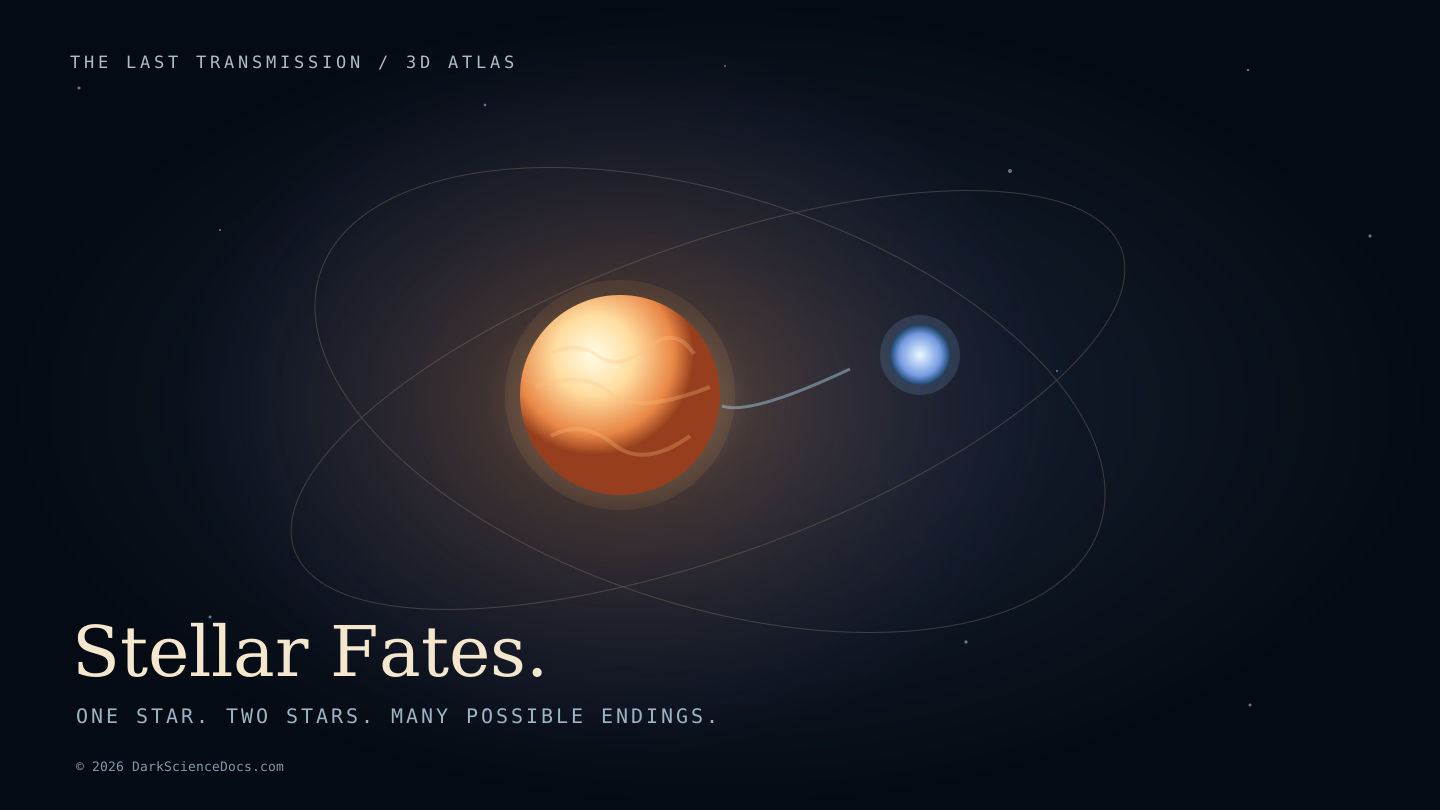
Stellar Fates.

The life and death of a star.

Give a star a starting mass. Watch it spend its fuel, change its shape, and leave something behind. Then add a companion: a second star can change the story.

DRAG TO ROTATE · PINCH TO ZOOM
TIME SINCE CORE HYDROGEN BURNING BEGANBefore hydrogen burning
STAR AA forming starStarting mass: 1.0 M☉

The clock changes pace between chapters. Playback length is not a fraction of the star’s lifespan.

1 M☉ = the Sun’s mass
Sun-like example: planetary nebula → white dwarf.
TRY A LIFE

WHAT YOU ARE WATCHING

A gas cloud contracts and a star takes shape. The clock begins when core hydrogen burning starts.

Starting mass is one ingredient. Composition, rotation, mass loss and companions can change a star’s path.

THE SCIENCE BENEATH THE SCENE

One life.
A companion changes the plot.

01 / THE LONG BURN

More fuel. A shorter life.

A massive star spends its fuel much faster than a Sun-like star. Here, one solar mass gives roughly ten billion years of core hydrogen burning; fifteen gives about twelve million. The clock begins at that burning stage, after the un-timed formation prelude.

The age anchors are rounded, informed by solar-metallicity stellar models. Values between anchors use smooth logarithmic interpolation. The giant phases and aftermath use simplified durations; they are illustrative estimates rather than fitted evolutionary tracks.

Examine the published lifetime grids

02 / THE LAST LIGHT

A cinder, a dense core, or darkness.

The lower-mass route sheds an envelope and leaves a white dwarf. The massive route illustrates core collapse and a selected compact remnant. The control compares possibilities; it does not turn initial mass into a universal neutron-star or black-hole threshold.

The switch near eight solar masses is a storytelling boundary. Real transition cases, mass loss, rotation, composition, and the explosion mechanism complicate it. Small remnants are enlarged, and supernova ejecta are slowed for viewing. A stellar black hole is far smaller than Sagittarius A*. The contraction view reveals an enlarged core inside a fading envelope. The neutron-star beams depict a pulsar-like example. Black-hole disk light follows nonrotating light-bending geometry; gas brightness and inward motion are illustrative, without predicting a returning gas mass or gas history.

Explore the galaxy’s dark heart

03 / THE SECOND STAR

Two clocks. One shared age.

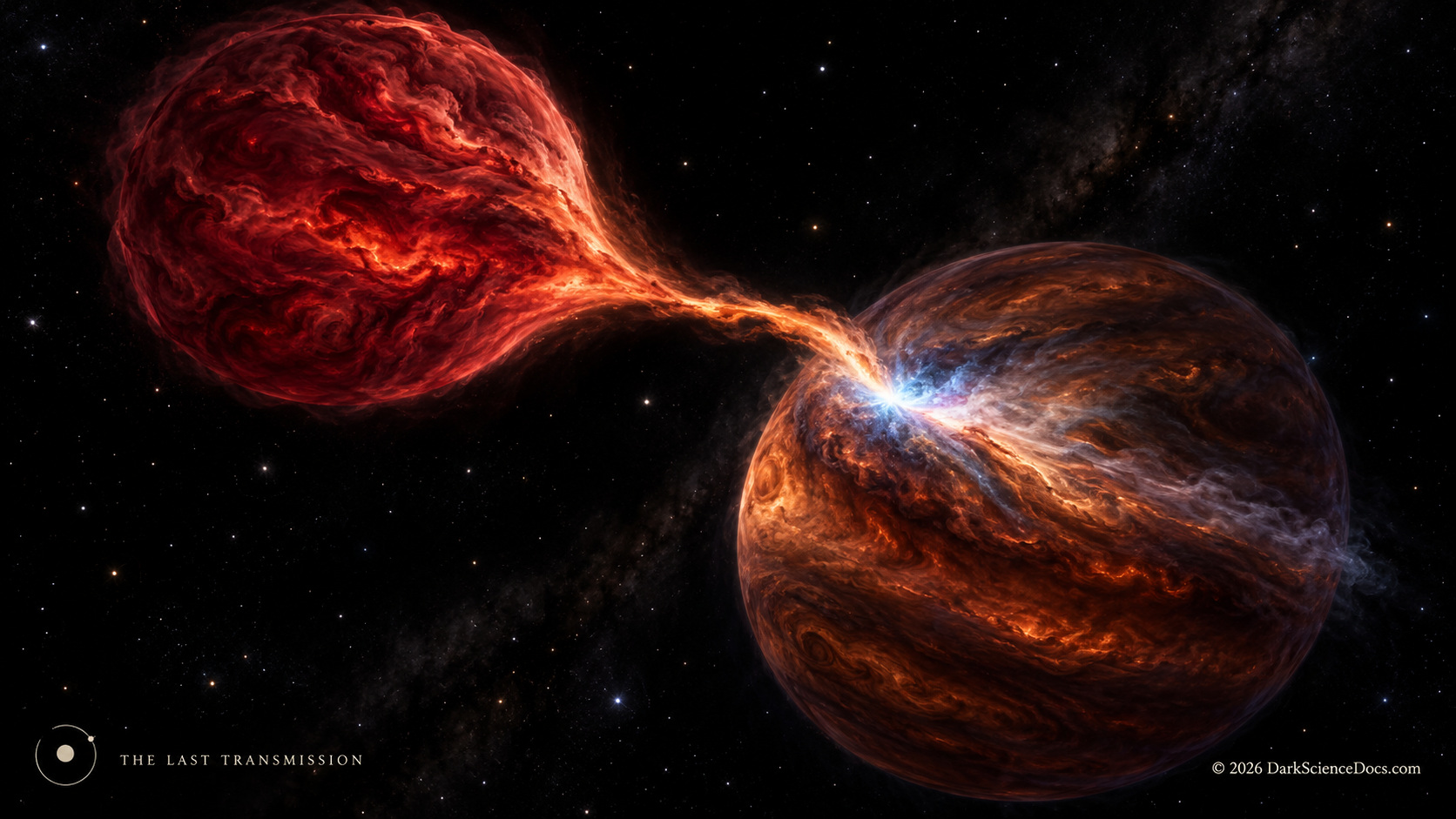
Wide mode lets you choose two starting masses and a separation. Both stars are sampled at the same age, and both orbit their common center of mass: the heavier star traces the smaller orbit. The period readout uses the initial masses and separation, while the visual orbit is accelerated.

The wide example assumes detached stars. The guided 5 + 3 solar-mass pair instead illustrates envelope transfer: four solar masses leave A, two reach B, and two leave the pair. Later donor phases and ages are assumed. Separation changes the initial orbital period, without predicting whether a real system transfers stably or merges.

Follow the binary-star evidence

04 / A DIFFERENT EXPLOSION

A white dwarf can be destroyed.

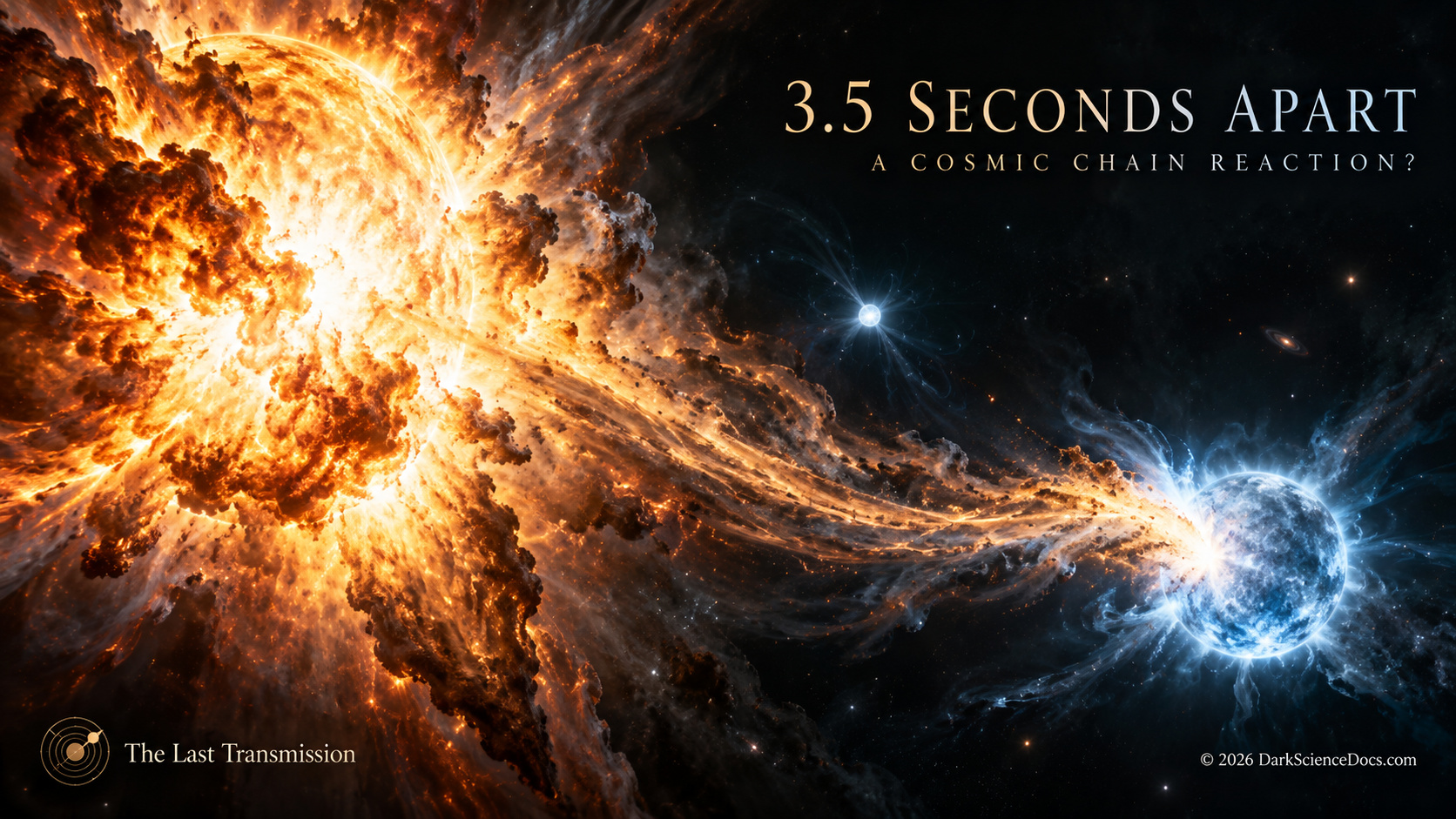
The third binary story begins with an existing white dwarf and a giant, not two newborn stars. An assumed retained transfer rate makes the white dwarf gain 0.27 solar masses in 2.7 million years. At the chosen 1.37-solar-mass trigger, this example ends in a thermonuclear supernova, leaving no white dwarf, neutron star, or black hole at its center.

Those numbers define a teaching scenario, not a measured system or forecast. Other binaries can produce novae, retain different amounts of gas, merge, or avoid an explosion. The initial orbit is held for illustration and stops at the explosion; orbital disruption, donor response, accretor rejuvenation, tides, and later companion evolution are not calculated.

Compare the two supernova mechanisms
Beyond the white dwarf: could it become a black dwarf?

A black dwarf is a theoretical, extremely cold endpoint of white-dwarf cooling. None have been observed; the universe has not been around long enough for that proposed state. This explorer ends with a cooling white dwarf and assigns no black-dwarf arrival date. The 0.8–40 solar-mass range also excludes the smallest red dwarfs and the most extreme massive stars.

Read about white-dwarf cooling

FOLLOW THE SIGNAL INTO THE ARCHIVE

The star is only
the beginning.

EVIDENCE FILE

How we reconstruct a star’s life

Follow measured starlight, cluster ages, binary companions, and compact remnants into the models behind these illustrated routes.

Read the evidence

ILLUSTRATED ARTICLE

The star hiding inside Betelgeuse

A possible companion, an enormous stellar atmosphere, and the difficulty of separating a second star from the shock it might create.

Read the illustrated article

FIELD NOTES

Why sunlight takes the long way out

Before a star leaves a remnant, it must move its energy from core to surface. Follow the difference between photon diffusion and energy transport.

Open the investigation

DOCUMENTARY

The man who waited to touch the Sun

Eugene Parker’s work leads into a close encounter with a living main-sequence star. Continue from the film into its evidence and viewing guide.

Watch the documentary

ILLUSTRATED ARTICLE

The invisible black holes that may be creating stars

Leave the stellar-remnant scale and follow candidate black holes far from galactic centers. Their origins and effects require a different evidence trail.

Read the illustrated article

EVIDENCE FILE

Can an orbit reveal a black hole’s spin?

Compare a possible stellar remnant with our galaxy’s supermassive black hole, then examine what a star’s measured orbit could reveal.

Follow the evidence

DOCUMENTARY

Tabby’s Star and the changing light

A star’s long life and its short-lived dimming are different questions. Explore the observations that challenged the megastructure interpretation.

Watch the documentary

RESEARCH & OBSERVATIONAL RECORDS

Keep the evidence close.

CHANGE SCALE

A stellar life.
A place in a galaxy.

Inspect our Sun Find our place in the Milky Way Return to the 3D Atlas

FROM THE ILLUSTRATED ARCHIVE

Follow this thread further.

FIELD GUIDE / HOW STARS DIE

The light changes.
The story continues.

Follow single stars and interacting companions into white dwarfs, neutron stars and black holes. Compare the physics of the endings with the observations that let us reconstruct a stellar life.

Open How Stars Die
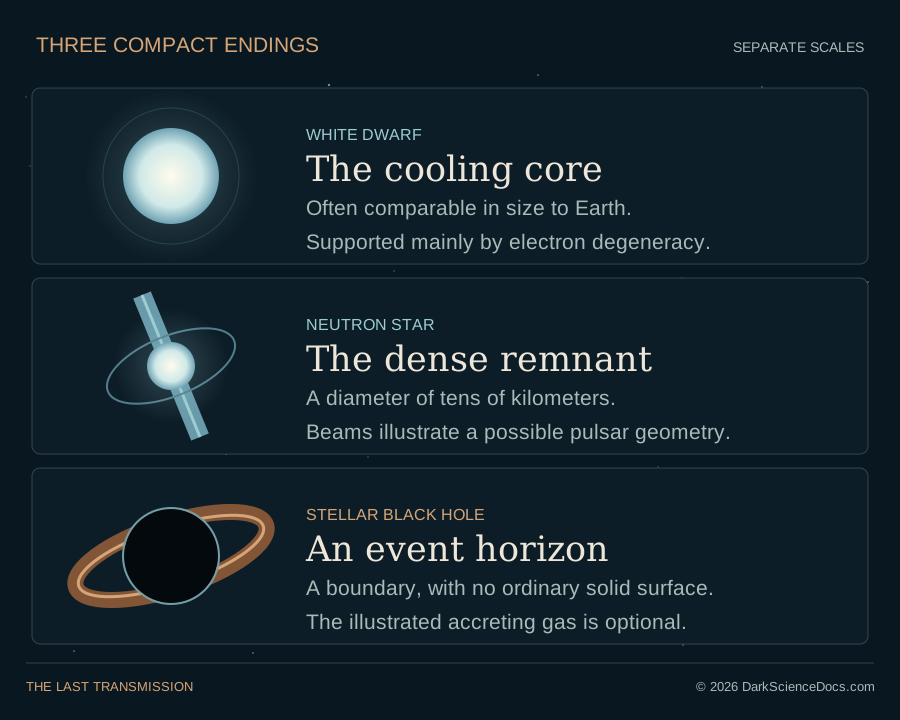
Original schematic portraits compare a white dwarf, a neutron star and a stellar black hole, each drawn at its own illustrative scale

TAKE THE QUESTION OFFSCREEN / PRINTABLE ACTIVITIES

Choose a Star's Fate

A printable stellar-evolution activity using four fictional case cards to compare white dwarfs, neutron stars, black holes, and a possible binary thermonuclear explosion.

Browse the printable exploration guides →
Download Choose a Star's Fate

4 pages · US Letter, 8.5 × 11 inches · 56 KB

Read online and see the sources →

SCIENTIFIC INQUIRY / APPLIED HERE

Explore all twelve principles
06 Uncertainty and limits

Starting mass does not uniquely determine every ending.

Composition, mass loss, rotation, and binary interaction can affect a star’s evolution. The selected modes illustrate possibilities under stated assumptions; their times are approximate. A smooth animation should not make the remnant boundary or a particular binary story look more certain than the science permits.

Ask yourself How large are the uncertainties, and which claim would go beyond the data?

THE SIGNAL CONTINUES

Some discoveries stay with you.

Get the illustrated investigations delivered to your inbox. Then follow the questions that refuse to leave.

Subscribe on Substack