
EVIDENCE FILE 21 / LUNAR IMPACTS
What Does a 140-Kilometer Lunar Disturbance Actually Mean?
How do a crater, a thermal cold spot and localized optical changes give three different measures of an impact?
All Evidence FilesTHE SHORT ANSWER
Orbital comparisons reveal more than the excavated hole. The approximately 140-kilometer figure describes the radial reach of localized subtle optical disturbances, while the smaller thermal cold spot and crater measure different effects. It is not a uniform destruction radius.
THE EVIDENCE MAP / LUNAR IMPACTS
How do a crater, a thermal cold spot and localized optical changes give three different measures of an impact?
Separate McGetchin’s 222-meter crater, approximately seven-kilometer cold-spot diameter and localized optical effects roughly 140 kilometers away.
- 01Measurement
Compare orbital images and thermal measurements
Before-and-after imagery brackets the event and locates optical changes. Thermal observations characterize altered nighttime behavior, adding another kind of evidence about the regolith.
- 02Interpretation
Assign each scale to the property measured
Crater diameter, cold-spot diameter and distal optical reach are three different quantities. Their numbers become meaningful only when the observed property and radial or diameter convention remain explicit.
- 03Competing explanation
Distinguish patchy change from a blast boundary
Localized remote changes do not show that all intervening terrain experienced the same disturbance. Ejecta and regolith mechanisms need models that reproduce the actual distribution.
- 04Open test
Validate models relevant to lunar infrastructure
Future comparisons should connect measured terrain modification with physical transport and equipment response. A habitat safety criterion needs that additional engineering evidence.
OBSERVATION / INFERENCE / LIMIT
Read the signal.
222 meters across
the impact crater is about 43 meters deep; these are excavation dimensions, not the extent of every effect.
About 7 km diameter
The nighttime cold spot concerns altered heat retention around the crater, rather than discovered ice.
Up to roughly 140 km
Localized optical/regolith disturbances reach far from the impact; the figure is radial and does not imply uniform damage.
INSIDE THE EVIDENCE
The chain of reasoning.
Each step has a different level of certainty. Follow the measured result into the explanation, then see where the trail ends.
A before-and-after pair establishes an event
Lunar Reconnaissance Orbiter images show a crater absent from an earlier observation and present in a later one. That comparison brackets its formation between April and May 2024, while its later recognition reflects the time required to identify the change in the archive. The approximately 222-meter diameter and 43-meter depth characterize the excavation. They give a starting point for studying the event, but the surrounding surface can preserve effects that require different kinds of observations to recognize.
Optical changes need their own spatial description
A changed appearance in orbital images can reflect disturbed regolith, ejecta or other modifications of surface texture and reflectance. The research distinguishes more continuous nearby changes from localized effects detected at much greater distance. The roughly 140-kilometer figure describes that distant radial reach. It should not be redrawn as a uniformly altered disk simply because a circle makes a striking graphic. The distribution, detectability and physical cause of each changed patch matter when interpreting the optical measurement.
Thermal observations ask a different question
Nighttime temperature depends on how the upper surface stores and releases heat. A thermal cold spot can therefore reveal regolith modification that is not identical to the brightest optical ejecta. The reported maximum cold-spot extent is about seven kilometers in diameter, a separate scale from the approximately 140-kilometer optical reach. Cooler nighttime measurements do not establish frozen water. They motivate a physical account of altered thermal properties and surface structure under the observed illumination and timing.
Separate mechanism from measured change
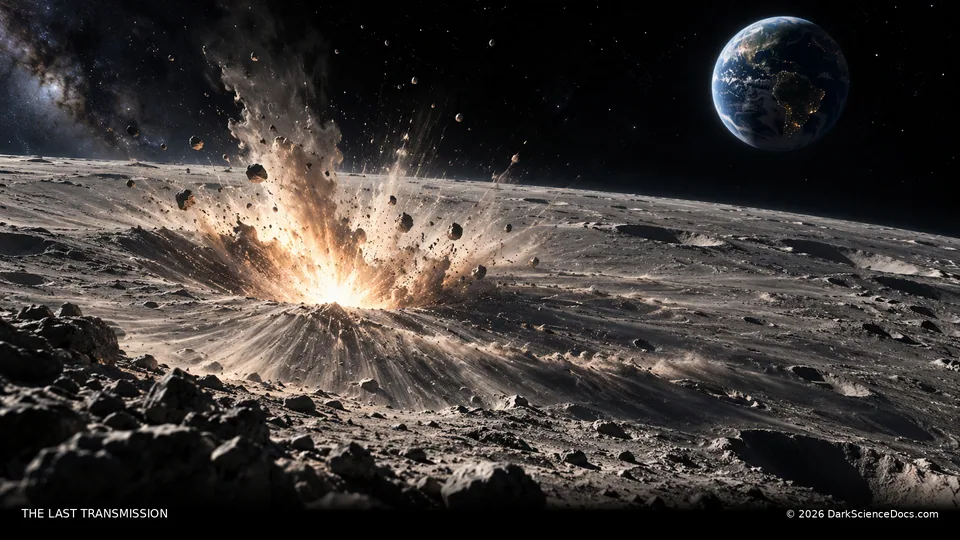
An impact can distribute material and disturb surface layers in several ways. Image differences and thermal signatures constrain what changed without independently deciding the contribution of every proposed mechanism. Matching a physical model requires accounting for the pattern and scale of the observations together. A cinematic eruption makes the event imaginable, but its glowing debris and camera position are invented. The orbital record, rather than an artist’s blast, is what supports the claim of a much broader footprint than the final hole.
Engineering risk requires a further translation
These observations are relevant to lunar infrastructure because a distant impact may affect more terrain than crater dimensions alone suggest. The next step is a validated relationship among impact conditions, ejecta, local disturbances and the vulnerabilities of actual equipment. The study does not by itself establish a lethal radius for astronauts or a universal safe distance for habitats. Keeping that distinction visible allows the science to inform planning without converting a subtle measured surface change into an unsupported prediction of uniform destruction.
THE EASY MISREADING
The 140-kilometer reach is neither a 140-kilometer-wide crater nor a uniformly devastated area, and the thermal cold spot is not an ice discovery.
PRIMARY RESEARCH & MISSION RECORDS
Check the source.
These are the studies and mission records behind this explainer. The illustrated article and related research pages continue the investigation.
EXPLORE IN 3D / MAP 06
Explore Earth and the Moon
Compare the nearby Earth–Moon system in an interactive teaching model. The explorer does not reconstruct the impact event or an unmeasured exoplanet climate.
Open Earth & Moon mapFOLLOW THE THREAD
Stay with the question.
Continue through the original Field Note, the complete illustrated article and the relevant explorer. Each route keeps the measurement distinct from the artistic reconstruction.
MORE EVIDENCE FILES
Keep looking.

EVIDENCE FILE 19 / CORTICAL GRAFTS
What Did Human Cortical Grafts in Mice Actually Demonstrate?
Separate the developmental model, the cortical-volume denominator, neural integration and the limited behavioral inference in a human-organoid mouse experiment.
Read the evidence
EVIDENCE FILE 20 / INTERSTELLAR ISOTOPES
How Can Plutonium and Missing Curium Date a Galactic Event?
Follow plutonium detection, a curium limit, unequal radioactive decay and crust uptake into a qualified age constraint for an unidentified r-process source.
Read the evidence