
EVIDENCE FILE 24 / EXOPLANET CLOUDS
Why Do Astronomers Infer Clouds on Epsilon Indi Ab?
How can a planet’s missing light favor clouds without revealing an actual cloud map?
All Evidence FilesTHE SHORT ANSWER
Webb photometry and earlier data reveal infrared behavior that is difficult to reproduce with a simple cloud-free atmosphere. Thick water-ice clouds are favored, but chemical-abundance alternatives remain relevant and the clouds are not spatially resolved.
THE EVIDENCE MAP / EXOPLANET CLOUDS
How can a planet’s missing light favor clouds without revealing an actual cloud map?
Compare infrared photometry, an ammonia feature and atmospheric alternatives in a cold giant whose spectrum challenges a cloud-free interpretation.
- 01Measurement
Compare repeated infrared observations
Follow-up and archival Webb measurements sample selected spectral bands. The ammonia-related contrast and wider faintness pattern are observations that atmospheric models must explain together.
- 02Interpretation
Test cloud opacity in an atmospheric model
Water-ice clouds can change the emerging radiation and are favored by the combined pattern. Their appearance is inferred rather than resolved into weather photographs.
- 03Competing explanation
Compare metallicity and nitrogen alternatives
Chemical abundances and other atmospheric parameters may partly mimic cloud effects. A successful fit to one band does not uniquely establish a complete environment.
- 04Open test
Observe wavelengths that separate the models
Broader spectra and discriminating bands can test competing predictions. The goal is a consistent atmosphere explanation, not a shortcut from clouds to habitability.
OBSERVATION / INFERENCE / LIMIT
Read the signal.
10.6 and 11.3 µm
A difference between infrared bands helps establish an ammonia-related feature; its strength carries additional atmospheric information.
Unexpectedly weak light
Selected infrared measurements challenge a straightforward cloud-free model rather than establishing the absence of a planet.
Water-ice cloud opacity
Clouds are a favored model explanation, with low metallicity or nitrogen depletion among the alternatives to test.
INSIDE THE EVIDENCE
The chain of reasoning.
Each step has a different level of certainty. Follow the measured result into the explanation, then see where the trail ends.
The instrument measures bands of planetary light
Epsilon Indi Ab is a cold giant planet whose thermal radiation can be studied against the much brighter stellar environment. A measurement in one infrared band samples a limited part of the emerging spectrum, so comparing several bands supplies more useful constraints. The follow-up research combines Webb photometry with earlier observations. These data can establish that an atmosphere model predicts the wrong distribution of light without showing a resolved image of storms, ice crystals or individual cloud structures.
The ammonia feature is a specific clue
The contrast between measurements near 10.6 and 11.3 micrometers helps identify ammonia-related absorption. The size of that contrast then has to be interpreted together with the wider spectral behavior. An atmosphere contains interacting temperature, pressure, chemistry and opacity effects, so detecting a chemical feature does not uniquely determine the rest of the environment. The evidence becomes stronger when one set of atmospheric assumptions explains both the feature and the light measured outside it, rather than matching a single selected point.
A cloud-free picture has difficulty with the pattern
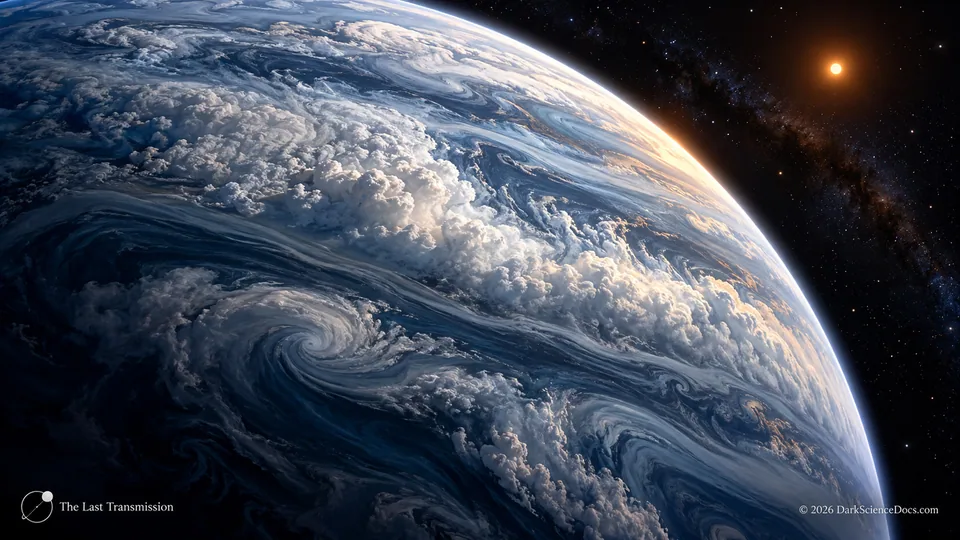
The study finds a combination of a relatively shallow ammonia feature and weak near-infrared emission that favors an important role for clouds. Water-ice particles can affect how radiation leaves a cold atmosphere and change the bands in which the planet appears bright. This is a physical model for the measured pattern, not an observation of the artwork’s swirling surface. The cloud interpretation earns support by explaining several constraints together while retaining the uncertainty in particle properties and atmospheric structure.
Chemistry supplies competing explanations
Low metallicity or nitrogen depletion can also change the predicted spectrum and remain alternatives considered in the research. Atmospheric parameters may compensate for one another when the data cover only a limited set of wavelengths. Evaluating the cloud claim therefore requires comparing complete models and their predictions, not simply choosing the most visually appealing scene. The appropriate question is which additional observation would make those models disagree clearly enough to improve the inference from the available light.
A giant planet can calibrate a wider method
Epsilon Indi Ab is not an inhabited Earth analogue, and ammonia or a proposed water-ice cloud layer is not a biosignature claim here. Its value is a relatively accessible test of atmosphere calculations under cold giant-planet conditions. Further spectra and measurements in discriminating bands could reveal whether the same physical explanation survives a broader test. That work can improve the methods later used on smaller planets while preserving the distinction between a useful calibration target and evidence that another world supports life.
THE EASY MISREADING
A favored water-ice cloud interpretation is not a direct weather photograph, evidence of a surface ocean, or a detection of life.
PRIMARY RESEARCH & MISSION RECORDS
Check the source.
These are the studies and mission records behind this explainer. The illustrated article and related research pages continue the investigation.
EXPLORE IN 3D / MAP 02
Compare a nearby giant planet
Explore Jupiter and its moons as a local comparison. These planetary textures do not depict Beta Pictoris b or Epsilon Indi Ab.
Open Jupiter system mapFOLLOW THE THREAD
Stay with the question.
Continue through the original Field Note, the complete illustrated article and the relevant explorer. Each route keeps the measurement distinct from the artistic reconstruction.
MORE EVIDENCE FILES
Keep looking.
EVIDENCE FILE 19 / CORTICAL GRAFTS
What Did Human Cortical Grafts in Mice Actually Demonstrate?
Separate the developmental model, the cortical-volume denominator, neural integration and the limited behavioral inference in a human-organoid mouse experiment.
Read the evidence
EVIDENCE FILE 20 / INTERSTELLAR ISOTOPES
How Can Plutonium and Missing Curium Date a Galactic Event?
Follow plutonium detection, a curium limit, unequal radioactive decay and crust uptake into a qualified age constraint for an unidentified r-process source.
Read the evidence