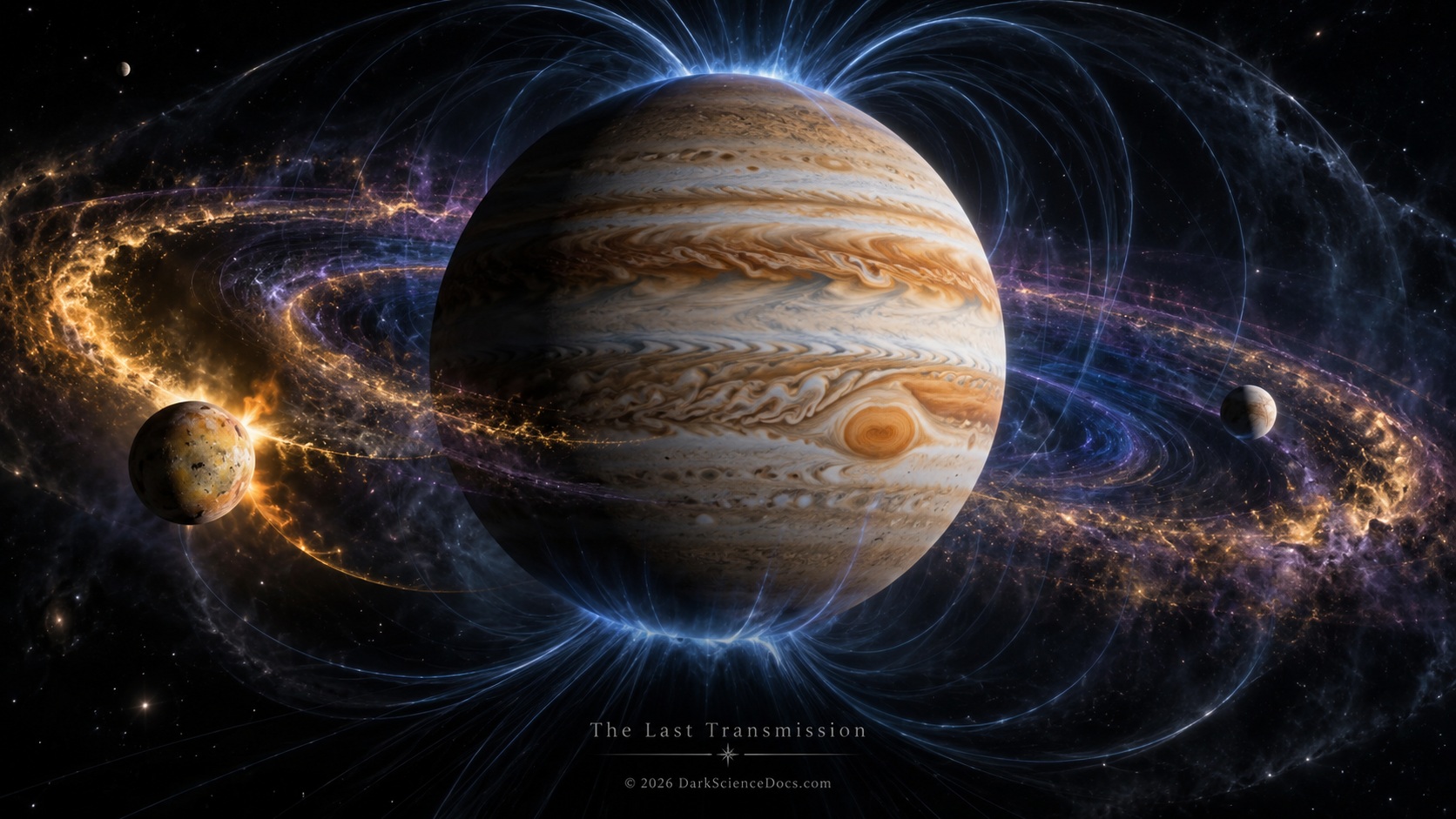
A giant planet. Four moons with entirely different histories. Explore the moons, or descend through cinematic clouds into the planet’s hidden interior.
LOOK / HOLD
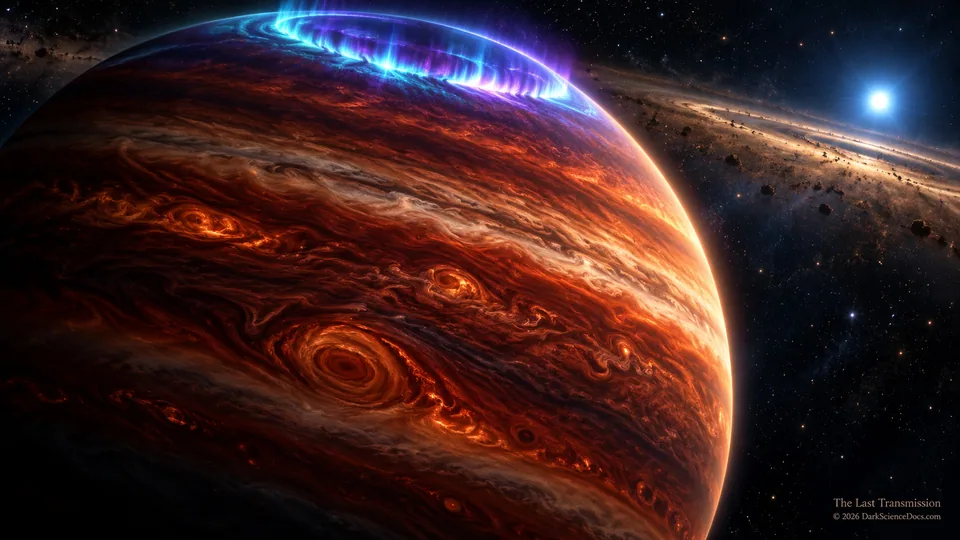
INTO JUPITER / ARTISTIC INTERIOR JOURNEYAbove the stormsCloud appearance: spacecraft observations; close flight: artwork.
Select a destination. Drag to look around; pinch or use the zoom buttons.
DESTINATION 01 / JUPITER SYSTEM
Jupiter
The giant with a diffuse core
How did Jupiter end up with a core that refuses a neat boundary?
Juno tracked tiny changes in its motion around Jupiter to map the planet’s gravity. Those measurements suggest a broad, diluted central region. An ancient impact is one possible history, though the gravity data alone cannot prove the cause.
Jupiter’s gravity and the changing pulls of Europa and Ganymede flex Io’s interior. Heat from that tidal deformation powers widespread volcanism and renews the surface. The map is a spacecraft mosaic; it cannot depict eruptions happening live.
Galileo recorded a changing magnetic response near Europa. One explanation is an electrically conducting layer beneath its ice, consistent with a salty ocean. Europa Clipper will make repeated measurements to test the ocean’s properties; the signal alone cannot tell us whether anything lives there.
Galileo found that Ganymede generates a magnetic field of its own. The way that field responds within Jupiter’s larger magnetosphere also points toward a buried saltwater ocean. A field is a powerful clue about the interior, not a photograph of it.
Callisto preserves a heavily cratered surface. Galileo magnetic measurements suggest an electrically conducting layer beneath it, possibly a salty ocean. The surface and interior tell different parts of the story, and the ocean interpretation still depends on the magnetic evidence.
This illustrated scene arranges the worlds for exploration. Positions, sizes, and distances are not to scale and do not track the moons’ actual orbits. Selecting a world opens its research file and source links.
Jupiter’s globe is an AI-generated artistic cloud map with invented storm detail and enhanced color. It does not show current weather or an exact spacecraft observation. The moon textures are self-hosted NASA/JPL maps from Io, Europa, Ganymede, and Callisto. These are assembled spacecraft maps for visualization, not live imagery.
INTO JUPITER / THE PLANET WITHOUT GROUND
The farther down. The less familiar.
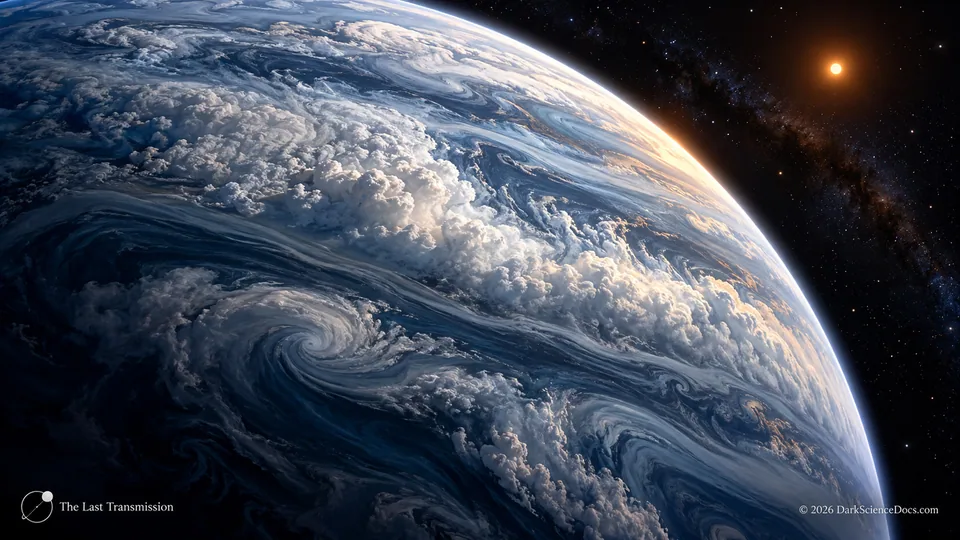
This journey uses AI cloud and fluid artwork with animated, invented interior textures to make the hidden planet visible. Colors, lighting, currents, lightning, motion and camera route are cinematic choices. The deeper scenes are artistic interpretations, not photographs, a transparent view through Jupiter, or a predicted spacecraft flight.
What the science supports
Jupiter has no true surface to land on. Its atmosphere becomes hotter and denser with depth, and hydrogen enters fluid regimes. At extreme pressure it becomes electrically conducting, helping explain the magnetic field. Juno’s gravity measurements favor an extended region enriched in heavier elements, often called a dilute or fuzzy core. Models still differ about its extent, composition and any more compact central component.
The five regions organize the story; their scene boundaries are not measured interfaces. The 150-second playback does not represent real falling time. The depth uses Jupiter’s rounded mean radius as a visual coordinate; pressure and temperature are broad regional guides. A real probe could not survive the journey to the center. Red swirls lead into larger, silver-colored liquid forms. These are invented cues for a mixed interior, not literal silver pools, separated liquid surfaces or calculated deep circulation. It ends without a landing surface.
Galileo’s probe returned atmospheric measurements on December 7, 1995. Those records sample one entry site. Juno’s gravity and magnetic measurements help constrain a much deeper interior through inference. Follow the records below to see where direct measurements end and interpretation begins.
THE DESCENT LEADS BACK TO THE RECORD
Follow the hidden engine.
INVESTIGATION
A core without a clean edge
Follow Juno’s gravity measurements into the competing explanations for Jupiter’s broad central region.
The prettiest giant in the night sky powers a self-reinforcing system of gravity, metallic hydrogen, volcanic plasma, radiation, and storms that destroy everything.
A study traces the signal to a young giant planet and infers a magnetic field of at least 1,250 gauss where the bursts originate. The discovery could open a way to investigate worlds.
Webb found a cold giant just 12 light-years away. Its unexpectedly weak ammonia signature raises a question we need to answer before interpreting another Earth.
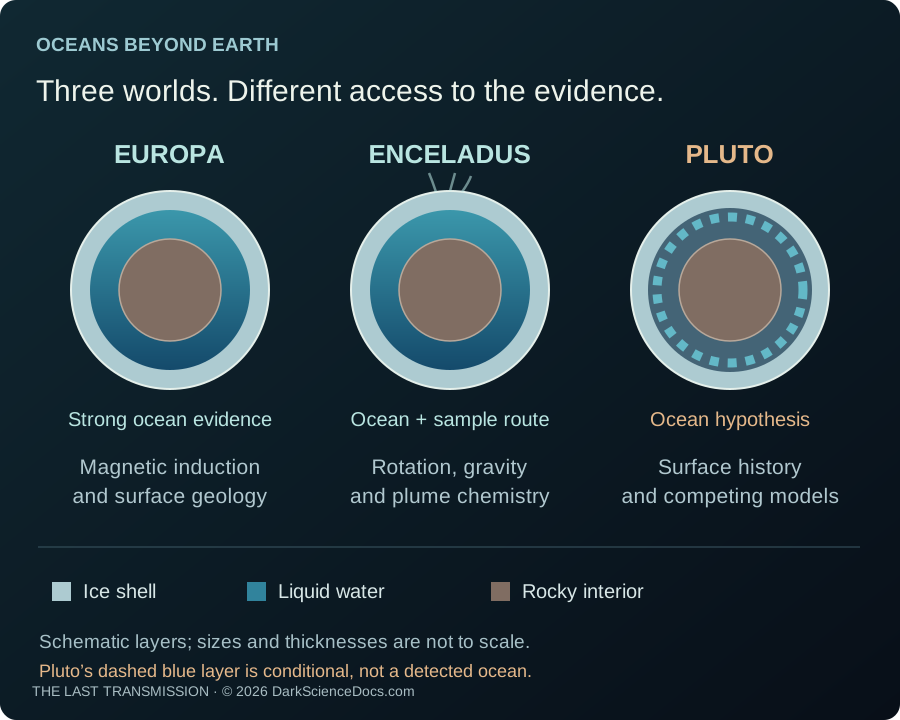
Compare Europa’s magnetic response, Enceladus’s sampled spray, and Pluto’s competing interior models. Follow the measurements into the hidden-ocean question, the search for habitable conditions, and the Atlas.
TAKE THE QUESTION OFFSCREEN / PRINTABLE ACTIVITIES
Investigate an Alien Ocean
A printable ocean-world investigation comparing Europa, Enceladus, and Pluto. Trace observations into inferences, evaluate limits, and propose a useful next measurement.
Spacecraft maps constrain the appearance of the planet and moons. Interior structures and hidden oceans require separate measurements and models. Use the viewer to locate those questions, then follow the Evidence Files to see how their inferences are made.
Ask yourself Which assumptions drive this result, and where would the model stop being useful?
THE SIGNAL CONTINUES
Some discoveries stay with you.
Get the illustrated investigations delivered to your inbox. Then follow the questions that refuse to leave.