
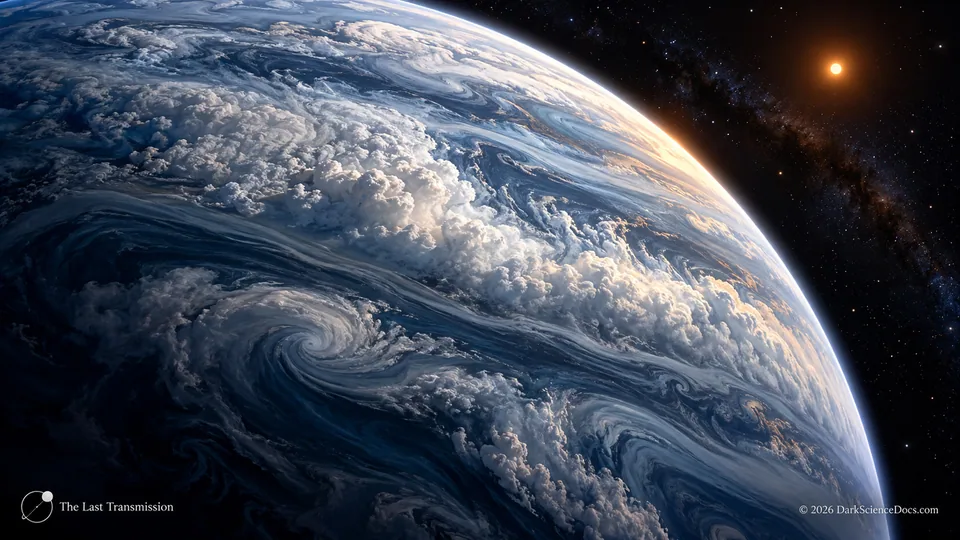
19 / Epsilon Indi Ab / light altered by weather
The Cold Giant That Exposed a Cloud Problem
Webb’s measurements of Epsilon Indi Ab do not match a simple cloud-free atmosphere. Water-ice clouds are a favored explanation for the planet’s infrared behavior, showing how an unseen atmosphere can complicate a measured spectrum.
A planet’s thermal radiation carries information through an atmosphere that may absorb, scatter and redistribute the light. Epsilon Indi Ab is a cold, massive giant whose faint infrared emission can be compared across carefully chosen bands. The contrast between measurements near 10.6 and 11.3 micrometers helps identify ammonia, while the feature’s strength and weak near-infrared emission challenge a straightforward cloud-free picture. Researchers then compare atmospheric models that change clouds, chemical abundances and other properties. The result is a constrained interpretation of light, rather than a photographed cloud deck.
The full investigation continues with the evidence, illustrations, and sources at The Last Transmission on Substack.
Continue reading on SubstackTHE EVIDENCE / THE OPEN QUESTION
What we know.
The follow-up study combines a Webb visit with earlier measurements and favors substantial water-ice cloud opacity. The planet itself is an established cold giant, not an Earth-like biosignature target. Differences among infrared bands make the cloud interpretation testable through additional wavelengths and consistent atmospheric calculations.
What remains open.
Cloud properties have not been resolved into the swirling patterns of the artwork. Low metallicity or nitrogen depletion remain alternative explanations to examine, and model parameters can partly compensate for one another. The result does not establish that habitable planets have been missed or that water clouds imply life.
Why it matters.
A nearby giant offers a demanding calibration problem for methods later applied to smaller worlds. Better models must recover the same atmosphere from different parts of its spectrum and explain when that recovery is ambiguous. The implication is a sharper standard for interpreting exoplanet light, with uncertainty carried forward rather than hidden.
GO DEEPER / EVIDENCE FILE
Why Do Astronomers Infer Clouds on Epsilon Indi Ab?
Compare infrared photometry, an ammonia feature and atmospheric alternatives in a cold giant whose spectrum challenges a cloud-free interpretation.
FOLLOW THE EVIDENCE
Research behind the field note.
EXPLORE IN 3D / MAP 02
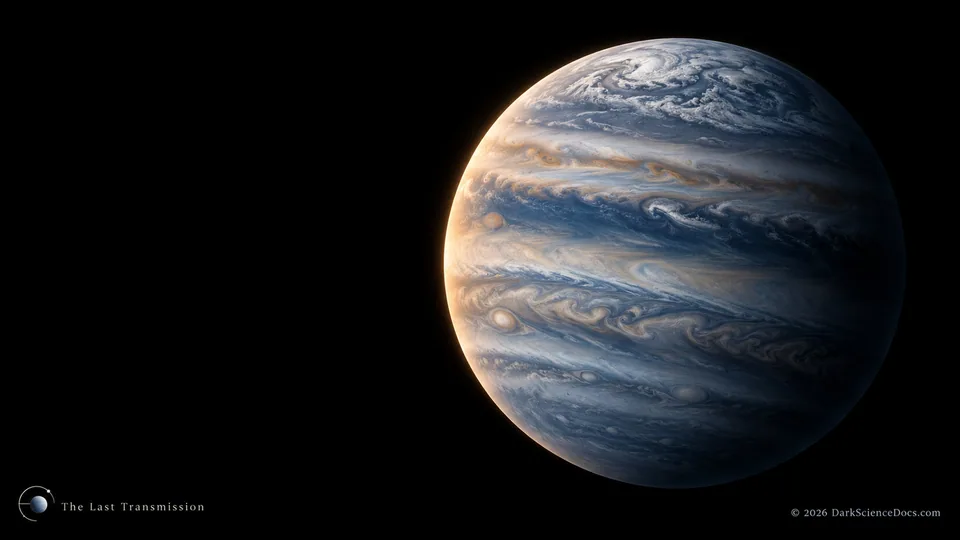
Compare a nearby giant planet
Explore Jupiter and its moons as a local comparison. These planetary textures do not depict Beta Pictoris b or Epsilon Indi Ab.
Open Jupiter system mapVISUAL EVIDENCE
Inside the investigation.
FOLLOW THE THREAD
Related signals.

The Planets That Could Be Better Than Earth Have One Terrifying Problem
Scientists have identified distant worlds that may offer life conditions more favorable than our own. Some could have warmer oceans, longer-lived suns, and billions of extra years for evolution.

A Planet 64 Light-Years Away Is Firing Radio Bursts Into Space
A study traces the signal to a young giant planet and infers a magnetic field of at least 1,250 gauss where the bursts originate. The discovery could open a way to investigate worlds.

The Blows That Nearly Killed Earth May Have Helped Bring It to Life
A model identifies a window for life’s chemistry 4.33 billion years ago. The unsettling question is whether Earth was the only world to take advantage of it.