
VISUAL ARCHIVE / IMAGE STORY
Where the Stream Strikes
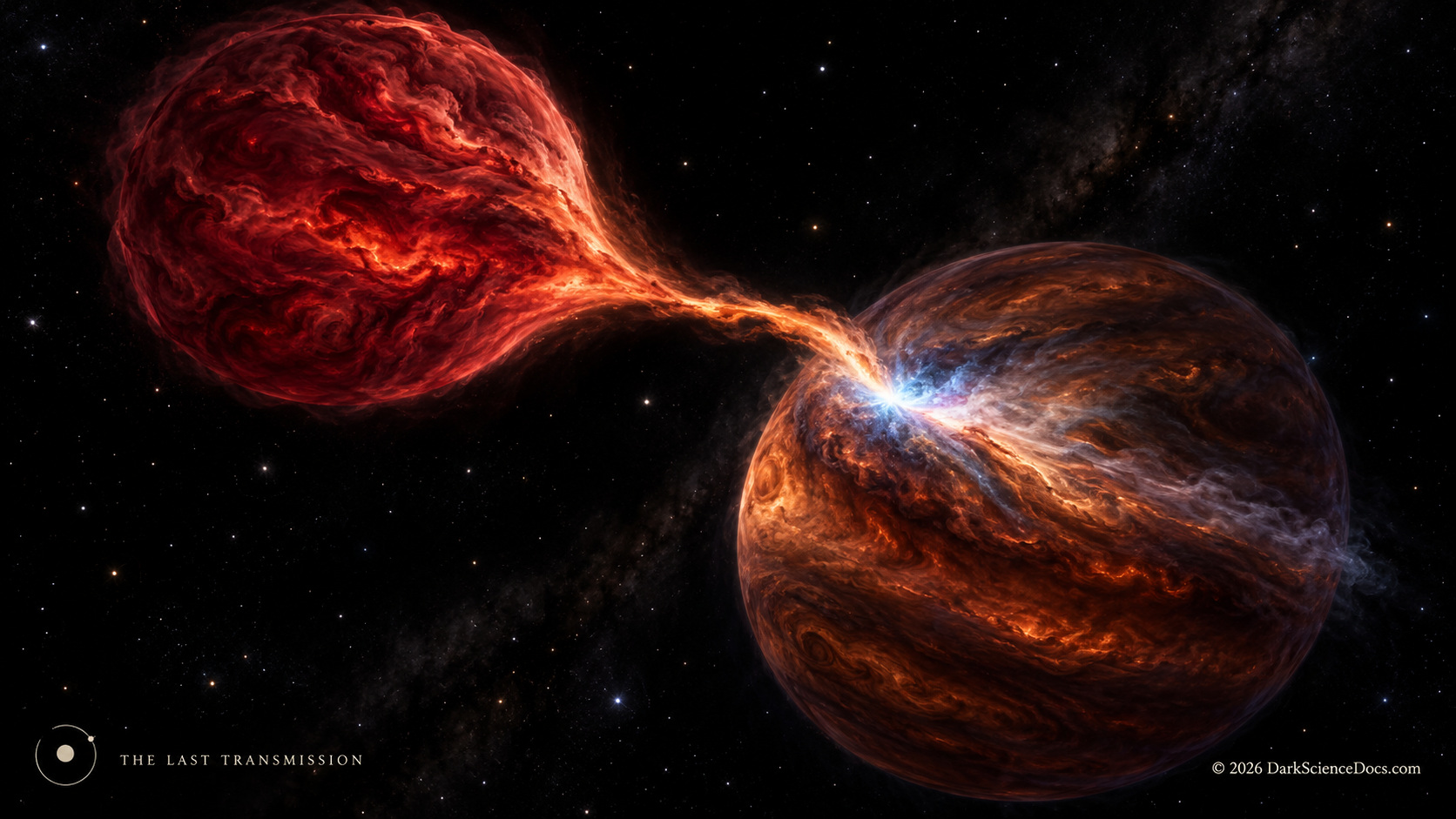
Direct-impact accretion turns incoming material into a concentrated region of heat.

A conceptual close-up of direct-impact accretion: transferred gas strikes the receiving brown dwarf’s atmosphere and heats a luminous region to roughly 8,900 kelvin. The image depicts the mechanism inferred from observations, rather than a resolved view of the system.
THE OBSERVATION
What we can actually see.
Brightness changes and spectral analysis in the reported binary support a hotspot where transferred material reaches the accretor. The system is not spatially resolved into the detailed gas stream and glowing atmospheric structure shown here.
THE ILLUSTRATION
What the artwork imagines.
The composition visualizes this idea: Direct-impact accretion turns incoming material into a concentrated region of heat. A conceptual close-up of direct-impact accretion: transferred gas strikes the receiving brown dwarf’s atmosphere and heats a luminous region to roughly 8,900 kelvin. The image depicts the mechanism inferred from observations, rather than a resolved view of the system.
FROM THE ILLUSTRATED ARTICLE
The story that inspired it.
The article begins with a rapidly orbiting, mass-transferring brown-dwarf pair, then expands to the small young objects and unusual infrared chemistry Webb is investigating. It separates present accretion heating from a possible future change in stellar status. This frame focuses on direct-impact accretion turns incoming material into a concentrated region of heat.
Read A Failed Star Is Eating Its Companion. It May Finally Ignite.CHECK THE RECORD
The image interprets the research below. Follow the original work for the measurements and limits behind the scene.
NASA: What Makes Brown Dwarfs Unique? Caltech: How Two Dim Stars Came Together to Shine Brightly ESA/Webb: Webb Reveals Stunning Panorama of Star Formation Spiegel, Burrows, and Milsom: The Deuterium-Burning Mass Limit for Brown Dwarfs and Giant Planets arxiv.org MIT: Astronomers Catch a Star Slowly Snacking on a Brown Dwarf arxiv.org Luhman and Alves de Oliveira (2025): A Spectral Class of Brown Dwarfs at the Bottom of the IMF in IC 348 NASA: Webb Finds Signs of Possible Aurorae on an Isolated Brown Dwarf arxiv.org Whitebook et al. (2026): A Mass Transferring Brown Dwarf Binary on a 57 Minute Orbit Parker and Alves de Oliveira (2026): Planet or Brown Dwarf? Constraints on the Formation of H-type Objects in IC 348 Suárez et al. (2025): Diversity of Cold Worlds Smith et al. (August 2026 preprint): Understanding the Energy Input Required for Methane Emission on W1935OTHER IMAGE STORIES
Keep looking.
 The Companion Becoming Brighter
 A Warmth That Runs Down
 The Mark Shared by Titan and Pluto
EXPLORE IN 3D / ATLAS S-01
Explore how companions change stellar fates
Compare single-star evolution with selected binary stories, including the ways companions can change a star’s fate. The explorer is a teaching illustration, not a calculation of ZTF J1239+8347.
Explore Stellar Fates in 3D