
VISUAL ARCHIVE / IMAGE STORY
The First Openings in the Dark
An imagined cosmic dawn makes the patchy escape of radiation visible without turning a simulation into a photograph.
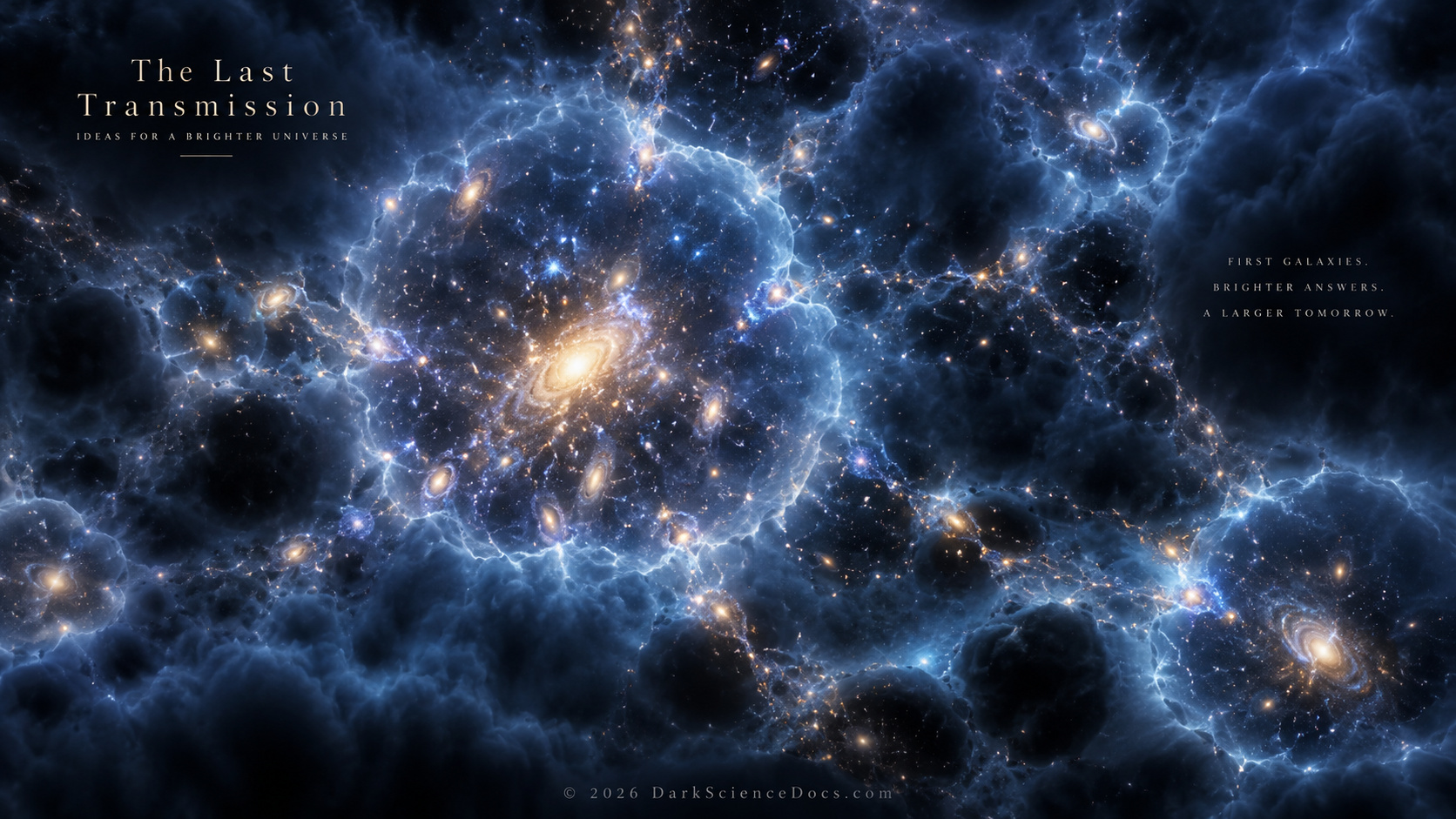
Artist’s interpretation of the cosmic dawn, when the first galaxies began carving enormous ionized regions through a universe still filled with neutral hydrogen. AI-generated artistic interpretation, not a scientific visualization.
THE OBSERVATION
What we can actually see.
Distant galaxy and quasar light, together with microwave-background measurements, constrains the era when intergalactic hydrogen became ionized. Simulations such as THESAN examine how radiation may have propagated unevenly through that changing gas.
THE ILLUSTRATION
What the artwork imagines.
The glowing cavities, colors, and viewpoint are artistic choices. No telescope took this picture of the first galaxies reshaping the entire universe; an ionized bubble is inferred through radiation and models rather than seen as a bright-edged sphere.
FROM THE ILLUSTRATED ARTICLE
The story that inspired it.
The illustrated article follows the escape of early light and asks why a galaxy might become detectable from one direction while neutral material obscures it from another.
Read The Universe Was Dark Until Light Learned How to EscapeCHECK THE RECORD
The image interprets the research below. Follow the original work for the measurements and limits behind the scene.
THESAN Lyman-alpha studyOTHER IMAGE STORIES
 The Web Before the Dawn
 Clearings Around the First Galaxies
 The Mark Shared by Titan and Pluto