
VISUAL ARCHIVE / IMAGE STORY
Two Worlds Around a Red Dwarf
LHS 1140 b and c are real transiting planets; the pictured orbit spacing and surfaces are illustrative.
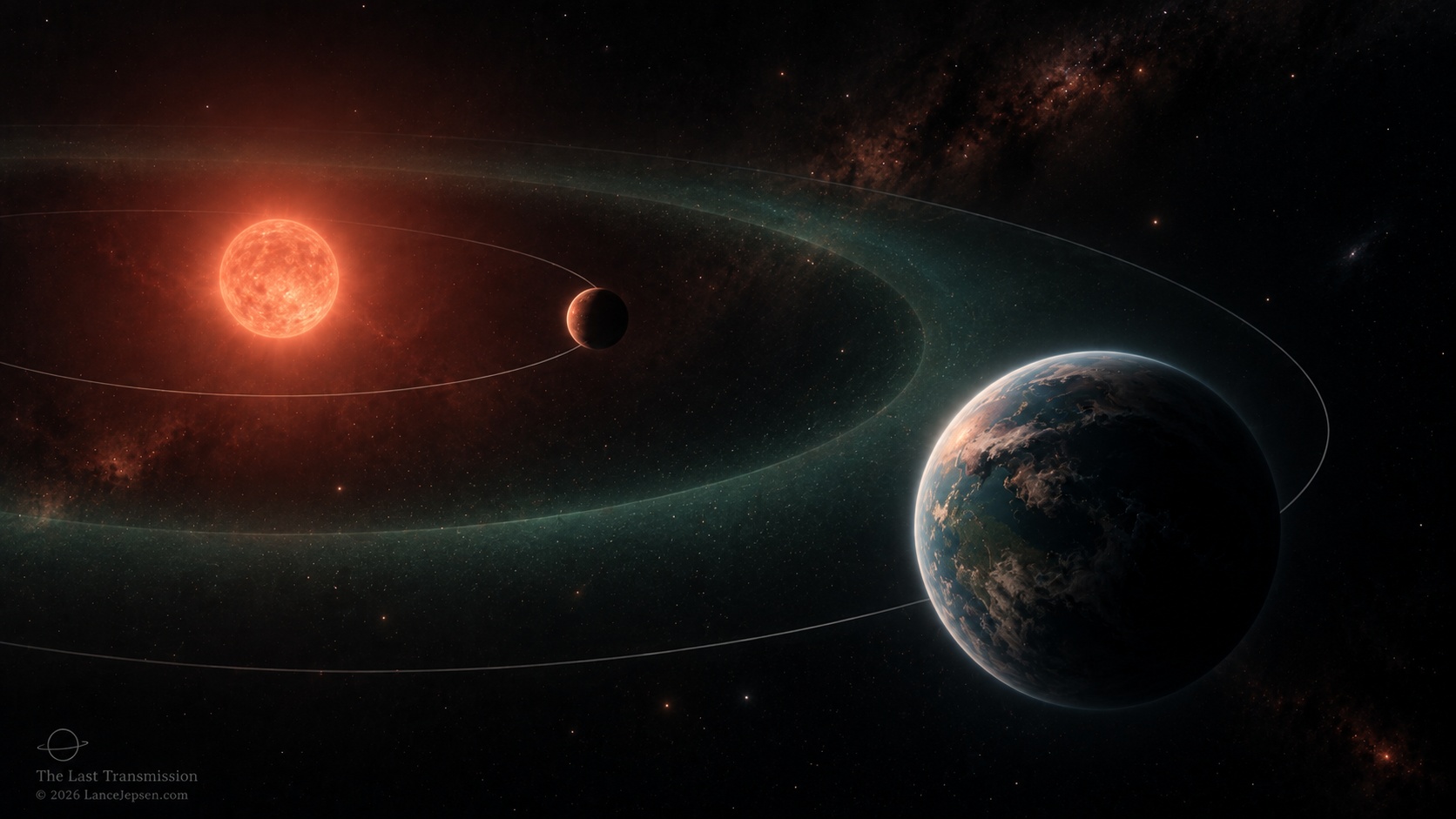
Artist’s concept of the LHS 1140 planetary system. The larger LHS 1140 b travels through the temperate region around a cool red dwarf, while the smaller LHS 1140 c orbits closer to the star. The orbital geometry is illustrative rather than to scale. AI illustration by The Last Transmission. © 2026 DarkScienceDocs.com
THE OBSERVATION
What we can actually see.
Transit and other observations establish two planets in the LHS 1140 system. Planet b takes a longer orbit than the more strongly irradiated c. The reported helium feature for b has not been reproduced in four Webb transits; no comparable helium signature was reported for c in the original ground-based work.
THE ILLUSTRATION
What the artwork imagines.
The planets’ apparent sizes, colors, surfaces, and distance from the star are chosen for visual comparison. The diagram is not to scale and does not show a photographed atmosphere on either world.
FROM THE ILLUSTRATED ARTICLE
The story that inspired it.
The article compares neighboring planets to ask how different exposure to a small star might shape their atmospheric histories.
Read A Planet 48 Light-Years Away May Have an Atmosphere. Then JWST Made It Stranger.CHECK THE RECORD
The image interprets the research below. Follow the original work for the measurements and limits behind the scene.
Reported LHS 1140 b helium absorption Four Webb transits with no helium detectionOTHER IMAGE STORIES
 A Planet’s Atmosphere in Starlight
 Two Possible Atmospheric Fates
 The Mark Shared by Titan and Pluto