
47 / A signal that did not return
The Helium Signal That Did Not Return
A ground-based observation suggested helium escaping from LHS 1140 b. Four Webb transits later, the same signature remained undetected, and the planet's atmosphere became a harder question.
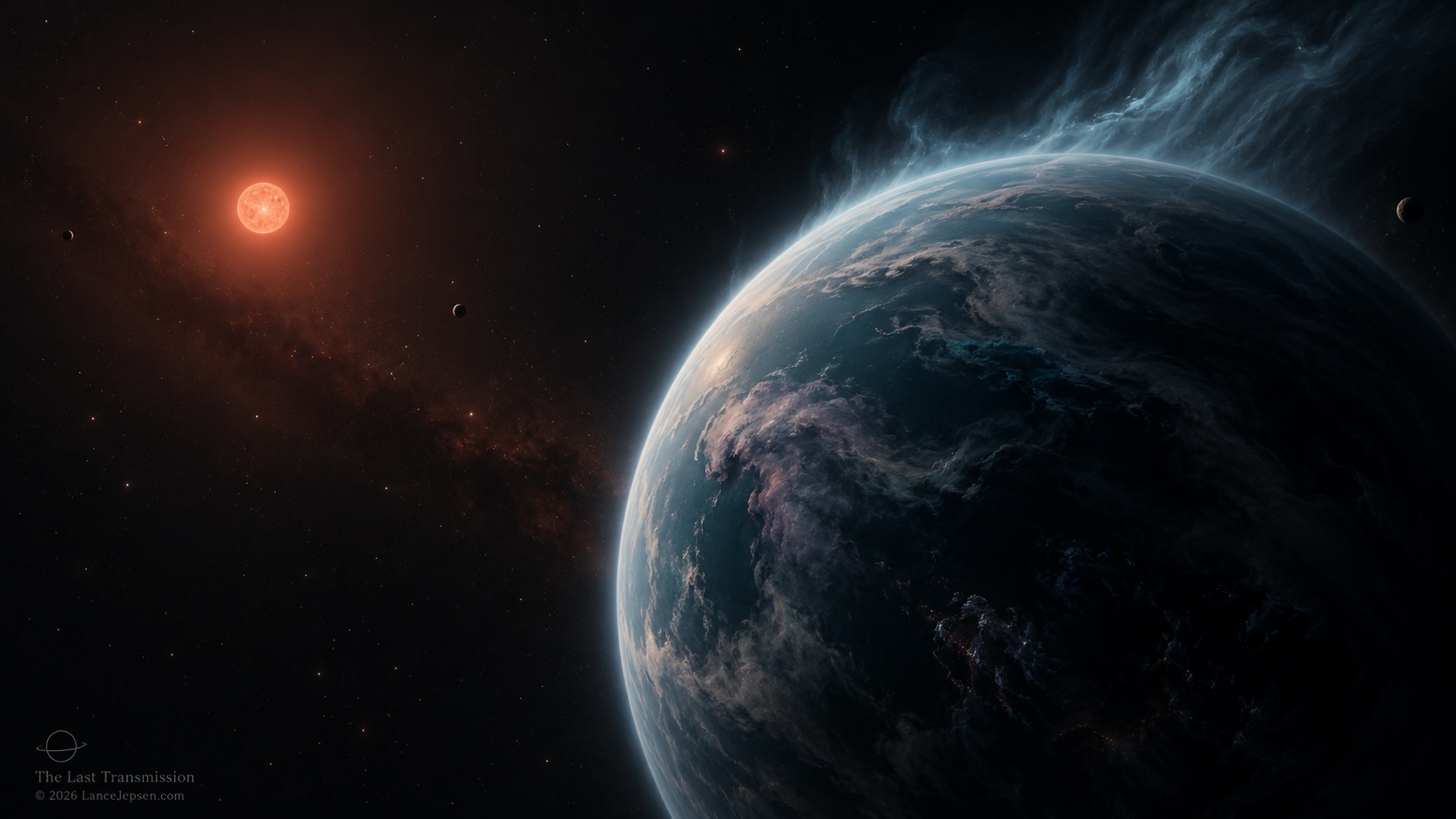
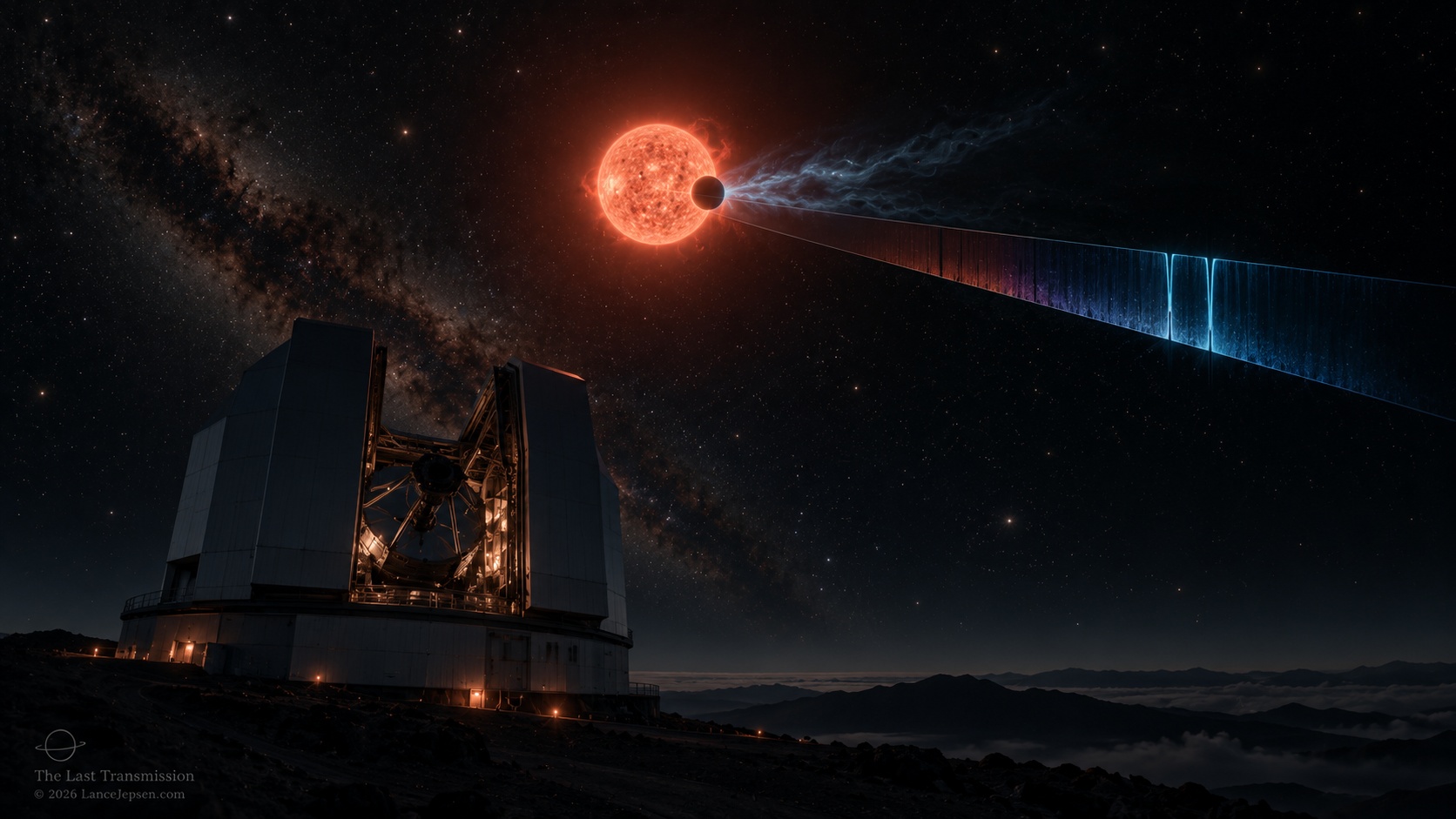
LHS 1140 b travels around a cool red star about forty-eight light-years away. Its size, density, and orbit make it an unusually tempting target in the search for small worlds with atmospheres. A helium feature reported from a 2024 transit appeared to offer a glimpse of gas escaping into space. But an observation is strongest when it returns. Webb examined four transits and did not see a comparable feature. The apparent contradiction is now part of the evidence, rather than an inconvenience to edit out of the story.
The full investigation continues with the evidence, illustrations, and sources at The Last Transmission on Substack.
Continue reading on SubstackTHE EVIDENCE / THE OPEN QUESTION
What we know.
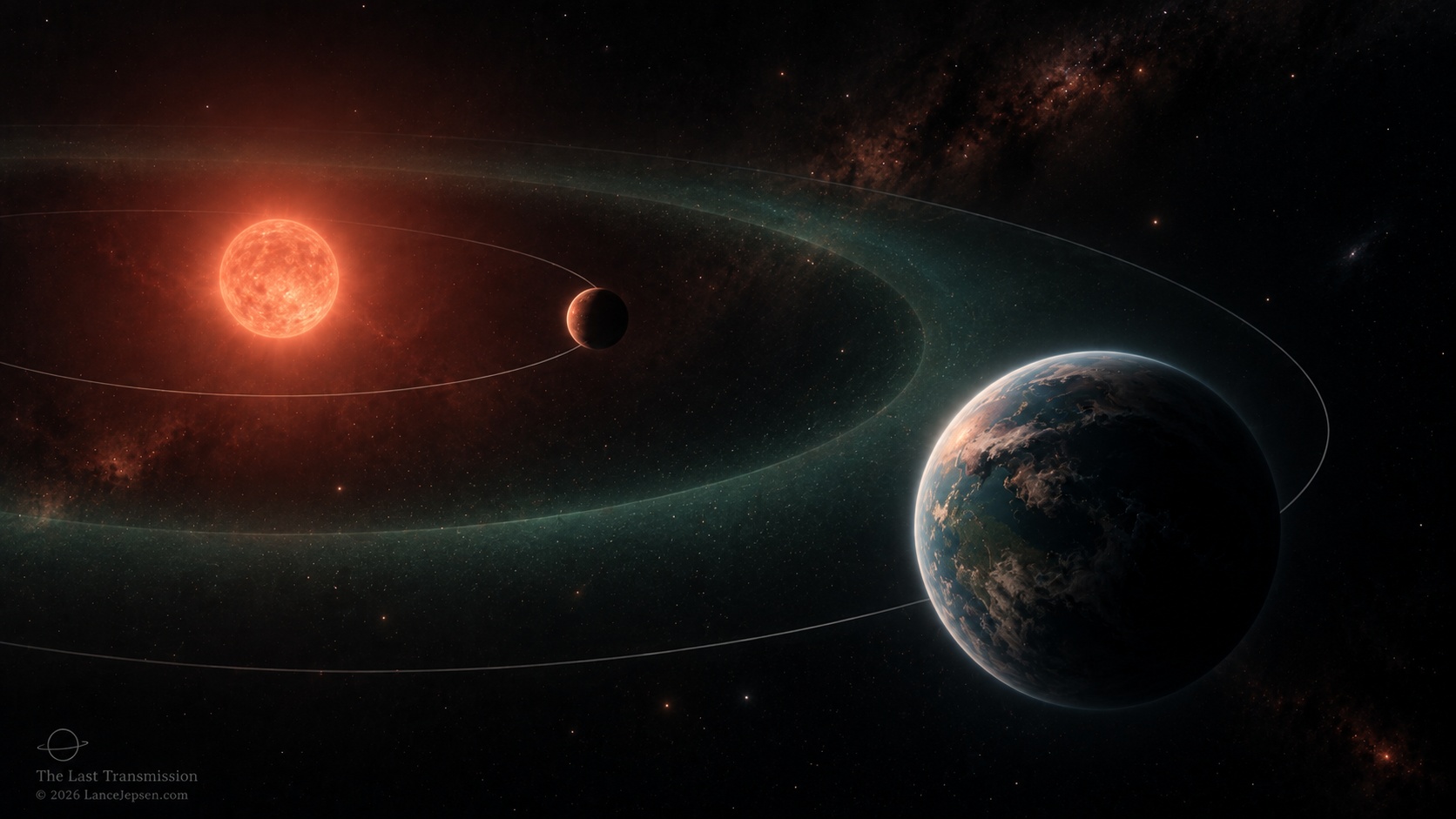
The planet is roughly 1.7 Earth radii across and completes an orbit in about 24.7 days. A ground-based study interpreted an absorption feature as metastable helium in escaping upper-atmosphere gas. Two later analyses of four Webb observations placed stringent limits on that helium signal. Separate Webb work also disfavors a thick hydrogen-rich mini-Neptune envelope and leaves a water-rich planet with a heavier atmosphere as a plausible possibility.
What remains open.
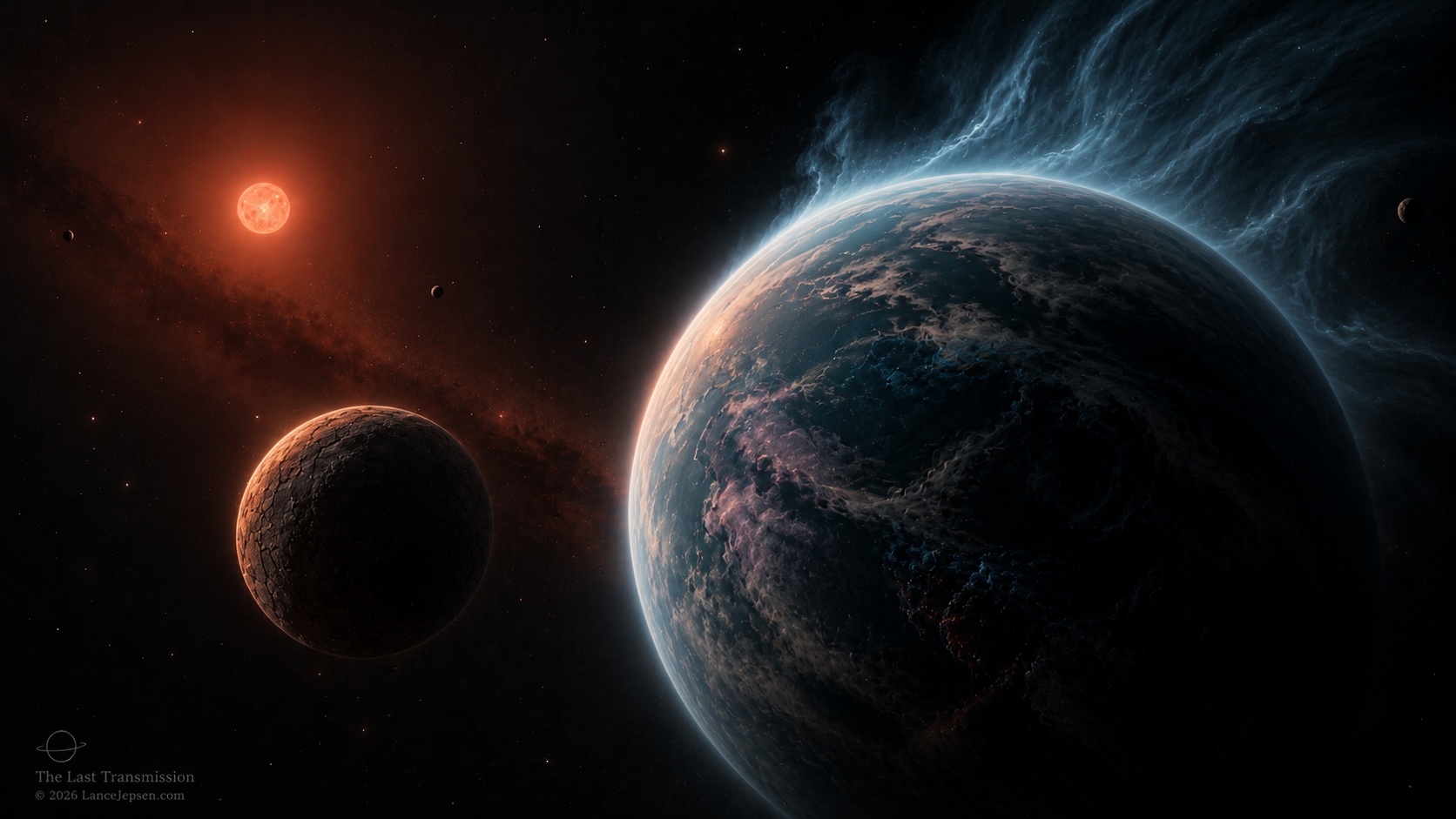
The helium feature might have been spurious, or escaping gas might vary with stellar radiation and viewing conditions. Non-detection of that particular state of helium does not prove that the planet has no atmosphere. Neither a water-rich interior nor liquid water at the surface has been established. Each interpretation depends on the difficult work of separating a small planetary signal from its star and the instruments used to observe it.
Why it matters.
This is how the search for habitable worlds actually advances: a promising hint is tested by another instrument, and the story becomes more precise even when the result is less tidy. LHS 1140 b remains a valuable laboratory for atmospheric loss, possible water-rich planets, and the limits of what transit spectra can tell us from forty-eight light-years away.
FOLLOW THE EVIDENCE
Research behind the field note.
COMING MILESTONE / SCIENCE COUNTDOWN
The next planet hunter opens 26 eyes
Plato will look for small planets around bright stars, where a planet's size is only part of the story. March 2027, planned launch month.
WATCH THE RELATED DOCUMENTARY
The story in motion.
VISUAL EVIDENCE
Inside the investigation.
FOLLOW THE THREAD
Related signals.

The Planets That Go Quiet While Their Stars Still Shine
A world can receive the right amount of sunlight and still lose the machinery that keeps its climate alive.

The Planets That Could Be Better Than Earth Have One Terrifying Problem
Scientists have identified distant worlds that may offer life conditions more favorable than our own. Some could have warmer oceans, longer-lived suns, and billions of extra years for evolution.
A Planet 64 Light-Years Away Is Firing Radio Bursts Into Space
A study traces the signal to a young giant planet and infers a magnetic field of at least 1,250 gauss where the bursts originate. The discovery could open a way to investigate worlds.