
VISUAL ARCHIVE / IMAGE STORY
Two Possible Atmospheric Fates
A reported b signal and c nondetection invite comparison, but neither illustrated fate is established.
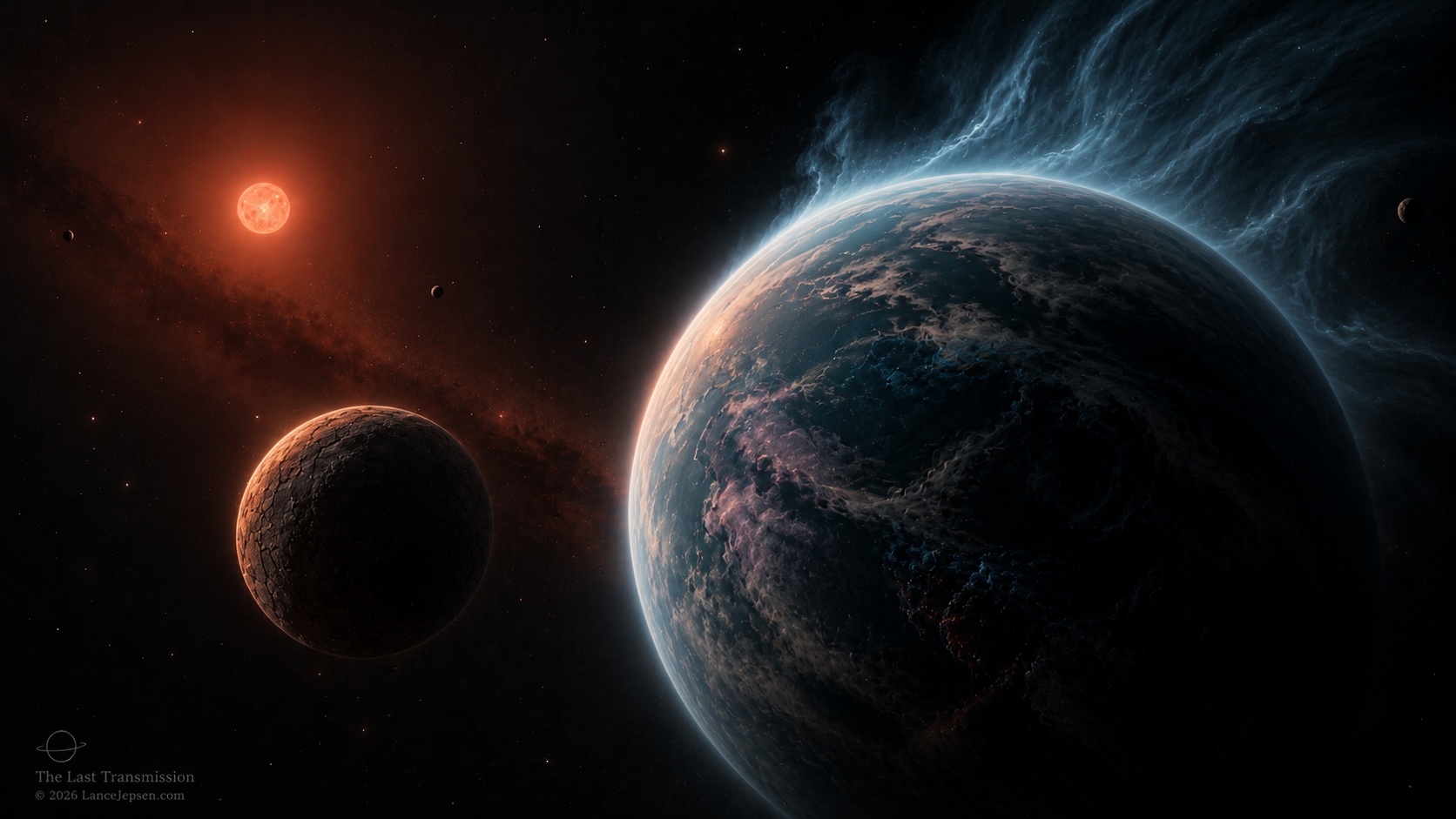
Two worlds, two possible fates. LHS 1140 b may have retained a substantial atmosphere while the hotter inner planet LHS 1140 c shows no comparable helium signature. The image is an artistic interpretation of their possible evolutionary difference, not a direct observation. AI illustration by The Last Transmission. © 2026 DarkScienceDocs.com
THE OBSERVATION
What we can actually see.
One team reported variable helium absorption around LHS 1140 b in ground-based data and no signal for the hotter inner planet c. Four later Webb observations of b did not detect helium at the reported level, so even the first half of the comparison remains disputed. Neither dataset alone maps a long-term evolutionary path for both planets.
THE ILLUSTRATION
What the artwork imagines.
The two contrasting worlds dramatize possible loss and retention of gas. Their atmospheric thicknesses, colors, and surfaces are not observations, and the scene cannot decide whether b has a substantial atmosphere.
FROM THE ILLUSTRATED ARTICLE
The story that inspired it.
The article’s tension comes from how an enticing atmospheric story changes when another instrument examines the same system.
Read A Planet 48 Light-Years Away May Have an Atmosphere. Then JWST Made It Stranger.CHECK THE RECORD
The image interprets the research below. Follow the original work for the measurements and limits behind the scene.
Reported LHS 1140 b helium absorption Four Webb transits with no helium detectionOTHER IMAGE STORIES
 A Planet’s Atmosphere in Starlight
 Two Worlds Around a Red Dwarf
 The Mark Shared by Titan and Pluto