
VISUAL ARCHIVE / IMAGE STORY
A Possible Evolution From Gas to Rock
Planetary models allow atmospheric loss; this step-by-step transformation is a hypothesis.
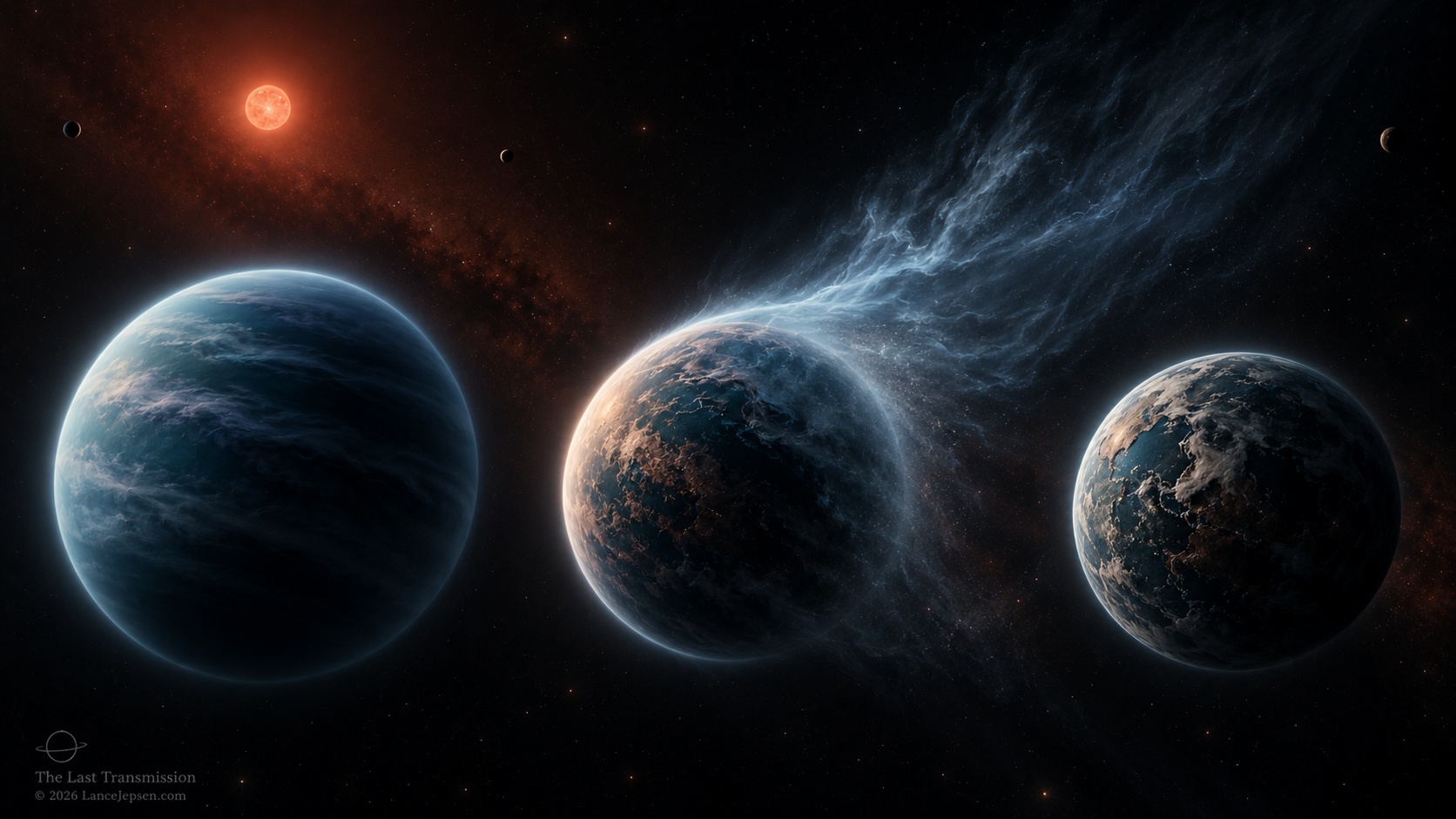
A conceptual sequence showing how a small gas-rich planet could lose much of its primordial envelope and evolve toward a denser super-Earth. If the helium interpretation of LHS 1140 b is confirmed, the planet could help astronomers understand this poorly observed stage of planetary evolution. AI illustration by The Last Transmission. © 2026 DarkScienceDocs.com
THE OBSERVATION
What we can actually see.
The ground-based helium interpretation raised the possibility of atmospheric escape from LHS 1140 b. Webb analyses subsequently found no helium in four transits and placed strong limits on a signal of the published strength. Whether escape varies with time, and what atmosphere remains, need further testing.
THE ILLUSTRATION
What the artwork imagines.
The sequential panels turn a model into a visual biography. No telescope observed LHS 1140 b in these earlier stages, and the image cannot establish that it began with the pictured gas envelope.
FROM THE ILLUSTRATED ARTICLE
The story that inspired it.
The article tests a compelling evolutionary explanation against measurements that currently disagree, keeping the planet’s past conditional.
Read A Planet 48 Light-Years Away May Have an Atmosphere. Then JWST Made It Stranger.CHECK THE RECORD
The image interprets the research below. Follow the original work for the measurements and limits behind the scene.
Reported LHS 1140 b helium absorption Four Webb transits with no helium detectionOTHER IMAGE STORIES
 A Planet’s Atmosphere in Starlight
 Two Worlds Around a Red Dwarf
 The Mark Shared by Titan and Pluto